On this page
Last Updated on October 13, 2026 by Muhammad Toqeer
A sump pit collects groundwater from the drains around your footings and throws it back outside. That is the entire job. It is not connected to the house’s waste plumbing, it must never receive sewage, and the water it moves must never go into the sanitary sewer.
If there are two holes in your basement floor, they are two different systems — and the code says so in both directions.
The two pits, and why the difference is not cosmetic
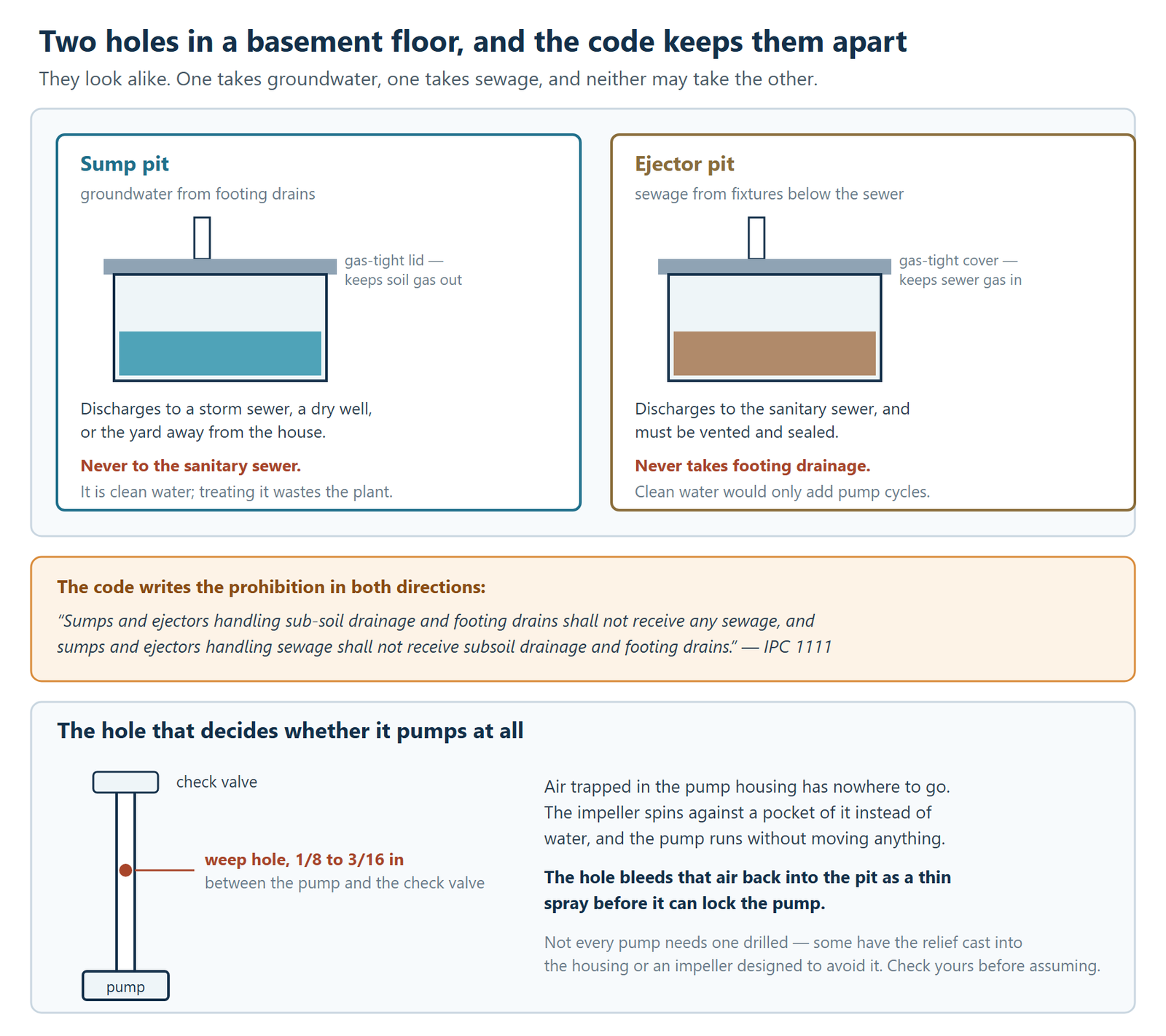
A sump pit takes subsoil water — the drain tile around your foundation, and whatever finds its way in through the slab. Its lid should be gas-tight too, though for a different reason: not to hold sewer gas in, but to keep soil gas and evaporating moisture out of the basement.
An ejector pit takes sewage from fixtures sitting below the level of the sewer line. Its cover is gas-tight and it is vented as part of the drainage system, because what is in it must not get out.
The code keeps them separate, and it is worth reading the sentence twice:
“Sumps and ejectors handling sub-soil drainage and footing drains shall not receive any sewage, and sumps and ejectors handling sewage shall not receive subsoil drainage and footing drains.”
Both directions. Not just “don’t put sewage in the sump” — also “don’t run your footing drains into the sewage pit.”
The second half catches people out, because a sewage pit is sitting right there with a pump already in it. Adding clean groundwater to it means paying a sewage pump to move water that was never dirty, and in a wet spring it means running that pump continuously.
Where the water is allowed to go
A sump pump’s discharge goes outside, to a storm sewer, or to a dry well. Not into the sanitary sewer. The ordinance language is widely adopted and blunt:
“No person shall discharge or cause to be discharged any storm water, surface water, groundwater, roof runoff, subsurface drainage, uncontaminated cooling water or unpolluted industrial process waters to any sanitary sewer.”
The reason is arithmetic at the treatment plant. Groundwater arrives clean. Sending it down the sanitary sewer means treating water that needed nothing done to it, and in a heavy storm it is the volume that pushes a system into overflow. Municipalities inspect for this and they do fine people for it.
The practical version: the pipe leaving your sump should end somewhere you can see it, well away from the foundation — otherwise it is delivering the same water back to the drains it just came from.
The part almost nobody explains
There is usually a small hole drilled in the discharge pipe, just above the pump, below the check valve. It sprays water back into the pit every time the pump runs, and it looks exactly like a leak.
It is not a leak. It is the reason the pump works.
Here is the mechanism. A check valve sits above the pump to stop the column of water in the discharge pipe draining back down each time the pump stops. That valve also traps air. If air collects in the pump housing between the impeller and that valve, the impeller ends up spinning against a pocket of air instead of water — and an impeller cannot move air. The pump runs, sounds normal, and nothing comes out.
The weep hole gives that air somewhere to go. It bleeds out as a thin spray, back into the pit, before it can build into a lock.
Size: 1/8 to 3/16 of an inch, in the discharge pipe between the pump and the check valve.
Not every pump needs one drilled. Some have the relief cast into the housing, and some use an impeller designed not to trap air in the first place. Check what yours calls for before assuming — and if there is no hole and no relief, that is a conversation for whoever installed it rather than a job to do with a drill on a pump already in service.
What is actually in the pit
The pump, either submersible (sitting in the water, quieter, out of the way) or pedestal (motor on a column above the water, easier to service, noisier).
A float, which tells the pump when to run. Tethered floats swing on a cord and need room; vertical floats slide on a rod and suit a narrow pit. Which one you have decides what “stuck” looks like.
A check valve in the discharge, doing the job described above.
A lid. Most existing pits have one resting loose on the rim, but the IRC requires a gas-tight, removable cover on any installed sump pump — and an open pit both evaporates into the basement and lets soil gas in.
The failures worth knowing about
It runs and moves nothing. Air lock is the classic cause, and the weep hole is why. A blocked or frozen discharge line does the same thing.
It runs constantly. Either water is genuinely arriving that fast, or it is coming back — a failed check valve returns the same column of water to the pit every cycle.
It does not run at all. Float, switch, power. The maker lists nine causes and the motor is third — and on a pit with standing water, none of them is a casual check.
The discharge freezes. A sump line running to daylight in a cold climate is exposed pipe with standing water in it, and it freezes at the far end first, where it is coldest and the water stands.
Can you use a utility pump instead?
It is the most common substitution question about this pit, usually asked with a transfer pump already in the garage.
The short answer is that they are built for different duty cycles and different switching, and the full comparison is worth reading before you rely on one. A utility pump is a tool you stand next to; a sump pump is an appliance that has to work while nobody is home.
If it runs constantly and it has not rained, look in the pit before anything else — the most common source is the discharge returning its own water.
If the discharge has frozen, it froze at one of two specific places and the buried run between them is not one of them.
And if you are sizing a replacement, measure the pit rather than the basement — one minute with the pump switched off gives you the real inflow.
If there are two pumps in the pit, each needs its own check valve and the position matters more than the count — above the junction, the running pump feeds the idle one.
And if it keeps cutting out, find out what actually tripped. Three protective devices sit between the panel and the pump — and only one of them resets itself, which is the quickest way to tell which cause list you are in.
And it should not be on an extension cord. The code does not permit a cord to stand in for a circuit, whatever gauge it is.
And if it bangs once as it stops, that noise is the water reversing rather than the valve landing — which is why the valve that cures it closes faster rather than more gently.
And if an alarm is sounding over a dry pit, that is usually the backup system reporting that it already ran — which makes it a report about the primary pump rather than a false alarm.
And the battery under a backup system is sold separately, so every runtime figure you have read assumes a capacity you have not bought yet — match the one the claim was quoted against.
And if a dehumidifier drains into the pit, only a small and capped fraction of that water comes back to the air — but it will cycle the pump in dry weather, which is easy to mistake for a fault.
And if a water softener drains into it, that is a different question entirely — the pump copes, but a sump sends water to the one place brine is not allowed to go.
And if a washing machine drains into it, lint is not described by the pump’s solids rating at all — and laundry waste belongs on the sanitary side, which is the side a sump may not reach.
And on a property with a septic system, the same separation rule runs the other way — a storm through a settling tank leaves it no time to settle, and the drainfield downstream is yours.
And if the house is on a private well, the discharge has a separation distance to respect that no sump ordinance mentions — a sump counts as a building foundation drain on the well tables.
And if there is orange slime in the pit, that is iron ochre, and it forms inside your pipework rather than washing in — which decides both what it fouls and why it is managed rather than cured.
And if the pit smells, the sharp sewer smell is usually the floor drain beside it rather than the pit — a trap seal is two to four inches of water, and the code already requires it to be protected.
And if it runs but the level barely drops, the maker’s first remedy is to reroute the discharge rather than buy a bigger pump — three of its five causes are the pipe.
And if you are asking how deep the pit should be, the bottom seven inches are already spoken for by the pump — what is left is the drawdown, and it is what decides how often the pump starts.
And if you are replacing the check valve, two quite different valves are sold as quiet and only one stops a bang — one uses a spring, the other only an angled seat.
And if you are replacing the float switch, check the horsepower rating first — several floats sold alongside the pump-duty ones are rated 5 amps and are meant to signal a panel, not to switch a pump.
And if you want telling before the water is on the floor, a float hung in the pit and a probe on the floor warn at completely different moments — both are sold as high water alarms, and only one of them gives you any time.
And if the question is simply how much longer the one you have has got, no manufacturer publishes a lifespan at all — what they publish is a warranty, and one maker’s own sump range runs from one year to five.
And if the plan for the next outage is a generator, one manufacturer states in its current manual that its pumps are not designed to be used with a portable generator — which is worth checking against your own manual before buying one.
And the lid the code requires is a product in its own right. On the maker’s own pages only the radon domes carry a sealing claim — the flat covers carry it on retailers’ listings instead, and covers are ordered by basin model rather than by measuring the pit.
And when the switch itself is what needs changing, the maker’s sheet names a screw size and two different two-inch rules — longer screws crack the cover, and the off level must not sit below two inches above the pump base.
And the container all of it sits in is a choice too. A -DR suffix means drilled, and a drilled basin takes groundwater in through its walls — every other published figure is identical, and the bolt circle is not constant across the range, so one basin in the family takes none of the usual covers.
And when the check valve is what needs changing, the manual asks for a gate valve above it, to allow cleaning the check valve or removing the pump — whether yours has one decides whether the standing column stays up there or arrives in the basement.
And if the complaint is noise rather than a single bang, the maker lists three causes and two of them say replace pump — only the pipework has a remedy that is a part, and it can be too loose as easily as too rigid.
And the thing it is plugged into is specified too. One maker prohibits surge protectors by name, in the same sentence as extension cords — and the reasons given are sizing, damage, and the connection falling into the sump, none of them about surges.
And if it starts and stops repeatedly rather than running on, two makers publish the same two causes and neither is the pump — the check valve and the switch, with one of them naming the mechanism as back-flow of water from the discharge pipe.
And before you send anything hot down there, one maker publishes a 77 °F maximum where this site has been quoting 130 — and the published consequence of exceeding it is the pump tripping its own overload and shutting off independently of the switch.
And none of this gets found unless somebody looks. The maker publishes a monthly test and six further checks — the bucket most people know about is one of the seven.
And when it is time to replace one, compare the published flow at the lift your pit actually has rather than the horsepower on the box — two pumps with the same nameplate can differ by more than double at fifteen feet.
And the pump is useless in a power cut, which is what a backup is for — but the gallons-per-hour figure those are sold on is the wrong one to shop by, because a backup pump is limited by its battery rather than its impeller.
When this needs a pro
Anything involving the discharge line’s route or termination. It is drainage work, it is inspected in many places, and where it ends determines whether your basement stays dry.
Any connection to the sanitary sewer, which is the thing to have undone rather than done.
Electrical work in or near the pit. Standing water and line voltage.
A pit that has been taking footing drains into a sewage system, or sewage into a sump. That is a code violation with a health dimension and it needs correcting properly.
What you can reasonably do yourself: look in the pit, note whether the pump sits in the water or on a column, find where the discharge pipe leaves the house and follow it, and check whether there is a small hole spraying water above the pump when it runs. That is a genuinely useful picture to hand somebody, and none of it needs a tool.
And if the question is whether one pit is enough, capacity and geometry are two different arguments — drain tile is gravity pipe, so a wing the existing run cannot fall to needs its own pit however big the pump is.
And if the liner itself has cracked at the base, the pump stops drawing from the pit and starts drawing through the crack — soil migrates in, and the void that opens can reach the footing.
And if the pump on the column is a pedestal rather than a submersible, the pit it needs is smaller but the way it has to stand is stricter — 12 inches by 12 is the published minimum, and a column that is not vertical can overheat the switch inside the motor.
And if a condensate pump shares the sump’s GFCI circuit, one GFCI watches the whole circuit rather than one pump at a time — both motors’ normal leakage sums at the breaker, and UL 943 Class A must trip at 6 mA.
And if an ejector pump is put on the sump’s battery backup, that is one battery serving two very different draws — a DC sump motor draws near-continuously, while an AC ejector needs an inverter sized for its start spike.
And if the idea is to reuse the sump discharge for irrigation, a booster needs a tank to draw from rather than a sump line — a pit that is dry most days gives a dry-run fault, not steady pressure.
And a pit in an unheated garage fails differently from one in a basement, because a thin ice skin can pin the float while the water keeps rising underneath — the switch never closes and the pump stays silent.
And the discharge pipe has a size of its own. Flow follows the narrowest point in the chain — and on many pumps the factory fitting at the outlet is already the tightest point, before any pipe is run.
FAQ
What does a sump pump actually do?
It collects groundwater arriving from the drain tile around your foundation and from under the slab, and pumps it back outside, to a storm sewer or a dry well. It is not part of the house’s waste plumbing and it must never receive sewage.
What is the difference between a sump pit and an ejector pit?
A sump pit takes groundwater; an ejector pit takes sewage from fixtures below the sewer line and has a gas-tight, vented cover. The code prohibits mixing them in both directions — no sewage into a sump, and no footing drains into a sewage pit.
Can a sump pump discharge into the sanitary sewer?
No. Widely adopted ordinance language prohibits discharging groundwater, storm water or subsurface drainage into a sanitary sewer, because it is clean water that loads the treatment plant for no reason and contributes to overflows in storms.
Why is my sump pump spraying water back into the pit?
That is almost certainly the weep hole, a deliberate 1/8 to 3/16 inch hole in the discharge pipe between the pump and the check valve. It bleeds trapped air out of the pump housing so the impeller never ends up spinning against an air pocket.
Do all sump pumps need a weep hole?
No. Some have the relief cast into the housing and some use an impeller designed not to trap air. Check what your pump specifies rather than assuming either way.
Why does my sump pump run but not move any water?
Air lock is the classic reason, which is what the weep hole prevents. A blocked, frozen or disconnected discharge line produces the same symptom, as does a check valve installed the wrong way round.


