On this page
Last Updated on September 30, 2026 by Muhammad Toqeer
Somewhere between 4% and 19% comes back, depending on your pit and your machine — and a sealed lid takes it to roughly zero. The “you’re just recycling the water” warning is right in direction and badly wrong in size.
The reason is simple once you see it. What the machine takes out of the air scales with the machine. What the pit gives back does not — it depends on the surface area of the water and the temperature of the room, and it is the same whether you pour in five pints or fifty.
The input scales. The return is capped.
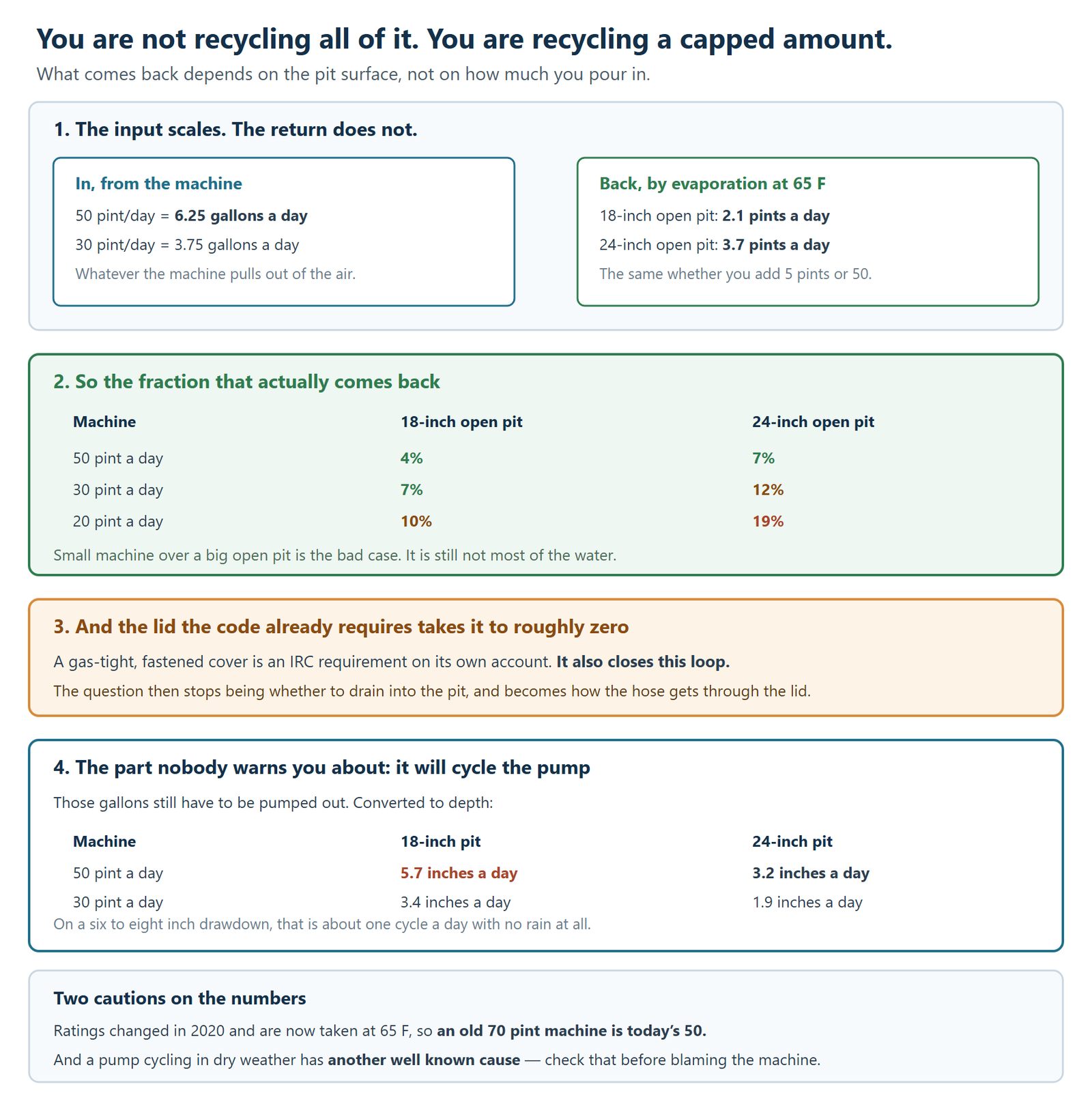
A dehumidifier’s output scales with the machine. A 50-pint unit removes up to 6.25 gallons a day; a 30-pint unit, 3.75.
Evaporation from the pit does not work that way. It is driven by the area of exposed water and the temperature of the air above it, and adding more water to the pit does not increase either. The pit is a wet surface either way.
So the input grows and the return stays put. That is the whole mechanism, and it is why the recycling worry is so much smaller than it sounds.
Using the evaporation arithmetic this site already published for open pits, at 65 °F:
- 18-inch pit: about 2.1 pints a day
- 24-inch pit: about 3.7 pints a day
That is the ceiling on what returns to your air, no matter how hard the machine works.
So what fraction actually comes back
| Machine | 18-inch open pit | 24-inch open pit |
|---|---|---|
| 50 pint/day | 4% | 7% |
| 30 pint/day | 7% | 12% |
| 20 pint/day | 10% | 19% |
Read the shape of that table rather than any one number. The worst case is a small machine over a large open pit — because the return is fixed and you are dividing it into a smaller total.
Nineteen per cent is not nothing. But it is not “you are recycling your own water,” which is what the forums say.
And 65 °F is not an arbitrary choice. It happens to be the temperature the industry now tests dehumidifiers at, which makes these two figures directly comparable in a way they usually are not.
The lid closes the loop entirely
This is the part that turns the whole question around.
A gas-tight, fastened cover is already required — not as advice for damp basements, but as a code requirement in its own right, and for reasons that have nothing to do with dehumidifiers.
Fit the cover the code already asks for and the evaporation path is closed. The return drops to roughly zero and the table above stops mattering.
At which point the question is no longer “should I drain into the pit?” It becomes “how does the hose get through the lid?” — because a penetration that is not sealed gives back the gas-tightness you just paid for.
That is a real question with a real answer, and it belongs to whoever fits the cover. A grommeted penetration is a standard part of a proper lid; a hole cut with a spade bit is not.
The thing nobody warns you about: the pump
That water does not vanish into the pit. It has to be pumped out.
Converting with the gallons-per-inch figures for common pit sizes — 1.1 gallons per inch in an 18-inch pit, about 2.0 in a 24-inch one:
| Machine | 18-inch pit | 24-inch pit |
|---|---|---|
| 50 pint/day | 5.7 in/day | 3.2 in/day |
| 30 pint/day | 3.4 in/day | 1.9 in/day |
| 20 pint/day | 2.3 in/day | 1.3 in/day |
On a typical drawdown of six to eight inches, a 50-pint machine in an 18-inch pit runs the pump about once a day — in a dry week, with no rain at all.
And that is exactly what a fault looks like. Someone hears the pump cycling on a dry August night and starts hunting for the returning-water loop that makes a pump run with no rain. Here the cause is the appliance they plugged in themselves.
Worth knowing before you go looking. And worth knowing the other way round too: if the cycling started before the dehumidifier did, the dehumidifier is not the answer.
A caution on your machine’s rating
The number on the box changed meaning in 2020, and a lot of advice online still uses the old one.
Dehumidifiers used to be tested at 80 °F. They are now tested at 65 °F, which is much closer to an actual basement — and cooler air holds less moisture, so the same physical machine scores lower.
The manufacturer’s own conversion:
| Old rating | Today’s equivalent |
|---|---|
| 30 pint | 20 pint |
| 50 pint | 30 pint |
| 70 pint | 50 pint |
So a machine you bought in 2016 labelled 70 pint is a 50-pint machine by current labelling. Use today’s scale when reading the tables above, or you will overestimate what is going into your pit by a third.
Current capacities sold are 20, 30 and 50 pint.
What about whether you are allowed to
A separate question, and this site answers it elsewhere rather than twice.
The list of receptors the code actually names, and where a sump pit sits on it, is covered properly in the condensate silo — including the point that a sump pit has no positive authorisation to point at, even where it is tolerated.
Two things do not carry over from that page to this one, and it is worth being explicit:
- Dehumidifier water is not acidic. The neutraliser discussion there is about furnace condensate and does not apply here.
- The volumes are not comparable. A condensing furnace produces roughly a gallon per therm — on the order of a hundred gallons a year. A 50-pint dehumidifier does 6.25 gallons a day.
Different water, different quantity, same hole in the floor.
When this needs a pro
The lid penetration. Getting a hose through a cover while keeping it gas-tight is the entire technical content of this job, and it is the part that is easy to do badly.
Any change to the pit or its cover. It sits over pipework, a pump cord and usually a float cable, and the cover is doing more jobs than one.
A pump that was already cycling before the dehumidifier arrived. That is a different problem and adding water to the pit will only obscure it.
What you can do yourself: note your machine’s pint rating and the year you bought it, measure your pit’s diameter, and look at whether the lid is sealed or simply resting there. Three facts, and they tell you which row of which table above you are on.
FAQ
Can you drain a dehumidifier into a sump pit?
Physically yes, and it is very common. Whether it is a permitted receptor is a separate question with no positive authorisation in the code either way, covered in this site’s guide to condensate routing. The practical answers are about evaporation and pump cycling.
Does draining a dehumidifier into the sump pit just recycle the water?
Only a fraction of it. Evaporation from the pit is capped by surface area and temperature, not by how much you add — about 2.1 pints a day from an 18-inch pit at 65 °F. That is 4% of a 50-pint machine’s output and around 19% of a 20-pint machine’s.
Will a sealed sump lid stop the water evaporating back?
Essentially yes. A gas-tight, fastened cover closes the evaporation path, and it is a code requirement in its own right. The remaining question is whether the hose penetration is sealed too.
Will draining a dehumidifier into the pit make the pump run more?
Yes, noticeably. A 50-pint machine raises an 18-inch pit about 5.7 inches a day, which on a typical drawdown is roughly one extra pump cycle every day even in dry weather.
Why does my sump pump run when it has not rained?
It can be the dehumidifier if one drains into the pit. It can also be water returning down the discharge line through a failed check valve, which is the more common cause and worth ruling out first.
Is my 70-pint dehumidifier really 70 pints?
Not by current labelling. Testing moved from 80 °F to 65 °F in 2020, and the manufacturer’s own conversion makes an old 70-pint machine equivalent to a 50-pint one today.


