On this page
Last Updated on October 2, 2026 by Muhammad Toqeer
Smell it properly before you do anything. A sharp, rotten-egg sewer smell and an earthy, swampy one come from completely different places, and only one of them is the pit.
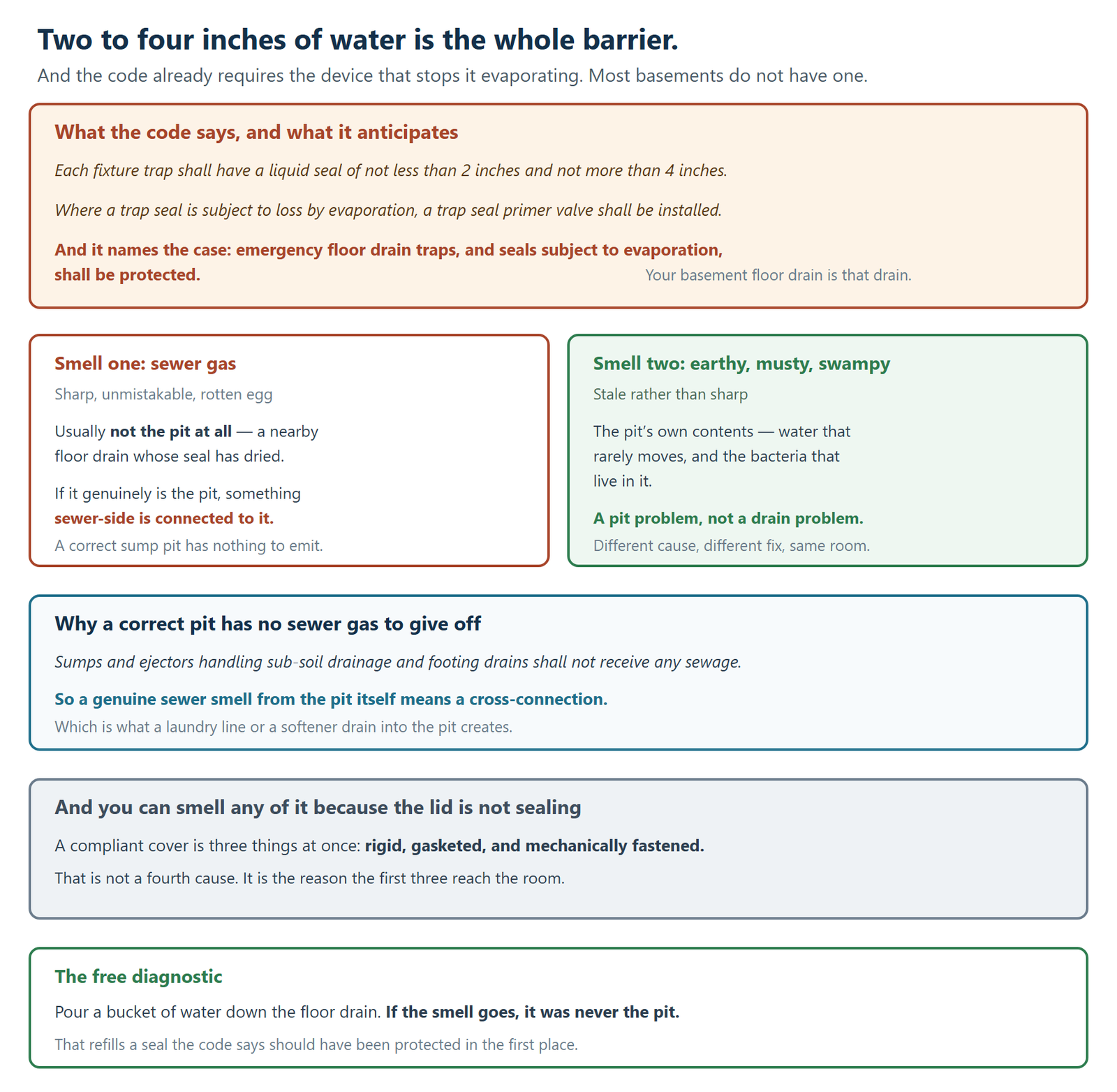
If it is sewer gas, it is usually the floor drain beside the pit rather than the pit itself — and the water seal that stopped it is two to four inches deep. That is the entire barrier between a basement and the sewer.
The code anticipates it drying out and requires a device to stop that. Most basements do not have one.
What the code says, and what it already expects to go wrong
From the plumbing code:
“Each fixture trap shall have a liquid seal of not less than 2 inches (51 mm) and not more than 4 inches (102 mm)”
Two to four inches of standing water. That is what separates your basement from the sewer, and it is held in a bend of pipe under a drain nobody has used for months.
And the code does not pretend this is robust:
“Where a trap seal is subject to loss by evaporation, a trap seal primer valve shall be installed.”
It then names the exact fixture. Trap seals of emergency floor drain traps, and trap seals subject to evaporation, shall be protected — by one of the methods the code goes on to list.
A basement floor drain is the emergency floor drain the code is describing. It exists for a flood that may never happen, so it is used rarely by design, so its seal evaporates by design.
Which makes this a required device that was never fitted, rather than an unlucky failure.
The free diagnostic, and it takes a bucket
Pour a bucket of water down the floor drain.
If the smell goes, it was never the pit. You have just refilled a seal that the code says should have been protected in the first place, and it will dry out again.
If the smell stays, keep reading — because now it may genuinely be the pit, and that is a different problem.
Two smells, two causes
Sewer gas — sharp, unmistakable, rotten egg
If this is coming from the pit itself rather than a nearby drain, something sewer-side is connected to it.
The code keeps the two systems apart in both directions:
“Sumps and ejectors handling sub-soil drainage and footing drains shall not receive any sewage, and sumps and ejectors handling sewage shall not receive subsoil drainage and footing drains.”
A correctly built sump pit has nothing sewer-side connected to it, so it has no sewer gas to emit. If it smells of sewage, the question is what has been plumbed into it — and a laundry line is the most common answer, with a softener drain close behind.
One-minute test: look into the pit and count what enters it. Anything beyond the drain tile and the discharge is worth explaining.
Earthy, musty, swampy — stale rather than sharp
This one is the pit, and it is biological.
Water that rarely moves goes anaerobic, and a pit that cycles once a week in dry weather holds the same water in between.
And there may be an organism in there already. Iron bacteria produce the orange slime this site covers separately, and a pit with ochre in it is a pit with a thriving population.
One-minute test: look at the water and at the float’s cord. Orange-brown slime tells you what you are smelling, and it is a different article’s problem.
Why you can smell any of it
Because the lid is not doing its job.
A compliant cover is three things at once — rigid, gasketed, and mechanically fastened — and the code requires it to be gas-tight for reasons that have nothing to do with smell.
That is not a fourth cause. It is the reason the first three reach the room at all. A pit with a proper cover can have all of the above going on and you will not know.
Which cuts both ways, and the article that covers the cover says so: sealing a pit changes what gets into the air, not what is in the pit.
What not to do
Do not pour bleach or drain cleaner into the pit. This site refuses that advice on condensate pumps for the same reason it refuses it here: the pit discharges to open ground or a storm sewer, so whatever goes in comes out somewhere.
Do not seal the floor drain. It is there for a flood. The answer is a protected trap seal, not a blocked one.
Do not assume it is the pump. Nothing described on this page is a pump fault.
When this needs a pro
A persistent sewer smell after the trap has been refilled. At that point it is a drainage question — a failed seal, a broken line, or a connection that should not exist — and it is a plumber’s.
Fitting trap seal protection, which is the code-named answer and is plumbing work.
Any cross-connection you find. Disconnecting a laundry or appliance line from a pit means making a proper sanitary connection instead.
Opening or resealing the cover, which carries pipework, a cord and usually a float cable through it.
What you can do yourself: smell it carefully, pour a bucket down the floor drain, and count what enters the pit. Three things, no tools — and between them they tell you which of the two problems you have.
FAQ
Why does my sump pit smell like sewage?
Most often the smell is not the pit but a nearby floor drain whose trap seal has evaporated. A trap seal is only two to four inches of water, and a basement floor drain goes months without use. Pour a bucket of water down it and see whether the smell goes.
Can a sump pit give off sewer gas?
A correctly built one cannot, because the code does not permit a sump handling sub-soil drainage to receive sewage — so there is nothing in it to produce sewer gas. If the pit itself genuinely smells of sewage, something sewer-side has been connected to it.
Why does my sump pit smell musty or swampy rather than like sewage?
That is the pit’s own contents. Water that rarely moves goes stale, and iron bacteria thrive in it. It is a different problem from sewer gas, with a different fix, and the orange slime that often accompanies it has its own article.
How deep is a trap seal supposed to be?
Between two and four inches of water, according to the plumbing code. That is the entire barrier between a basement and the sewer, which is why the code also requires protection where a seal is subject to evaporation.
Should I pour bleach into my sump pit to stop the smell?
No. A sump pit discharges to open ground or a storm sewer, so anything poured in ends up outside. The same objection applies here as to dosing a condensate pump.
Will sealing the sump lid stop the smell?
It will stop you noticing it, which is not the same thing. A gas-tight cover is required anyway and it is the reason a correct pit is odourless — but the cause underneath it is still worth finding.


