On this page
- Why Two Working Pumps Can Trip One GFCI
- Rule Out an Overloaded Circuit First
- Breaker Trip or GFCI Trip?
- The Isolation Test for Finding Which Pump Is Leaking
- Little Giant's Own Manual Already Bans This Setup
- Code Allows One Shared Circuit — Just Not This One
- The Fix Is a Dedicated Circuit, Not a Bigger Breaker
- Pulling a New Circuit Is an Electrician's Job
- FAQ
Last Updated on October 11, 2026 by umar bwn
If your condensate pump and sump pump are sharing a GFCI and it keeps tripping — same outlet, or just the same GFCI-protected branch circuit — the instinct is to blame one of the pumps. That’s usually wrong. Each pump can leak a small, normal amount of current and sit comfortably under the level that trips a GFCI by itself. Run them on the same circuit and the two leaks add together, and sometimes that’s enough to cross the line. Neither pump has to be failing for this to happen.
Why Two Working Pumps Can Trip One GFCI
Every GFCI, condensate pump’s or sump pump’s, is watching one thing: whether the current going out on the hot wire matches the current coming back on the neutral. Every motor loses a trace of current to its frame and ground path — that’s normal, not a fault. A Class A GFCI (the kind in every US home since the 2008 NEC) is built around two numbers from UL 943: it must trip at 6 mA or more, and it must not trip below 4 mA. IAEI Magazine, quoting UL 943’s own note on that 4 mA floor, says it exists specifically “to prevent unwanted tripping due to the natural leakage in appliances, tools and other connected loads, and in the wiring itself.” Read that again — the standard itself assumes more than one leaky device might share a circuit. That’s not a defect in your pumps. It’s the thing the floor was built to tolerate, right up until two of them push the total past the ceiling.
It also doesn’t matter whether both pumps plug into the same physical outlet. A thread on the Mike Holt electricians’ forum lays out a case where a sump pump kicking on tripped a GFCI protecting a different receptacle on the same branch — because leakage current can travel the shared equipment grounding conductor from one device’s case to another’s and return on a neutral the GFCI is watching the whole time. Same GFCI-protected circuit is enough. They don’t need to share a plug.
If you want the fuller code history of why a condensate pump ends up GFCI-protected at all — the 2008 and 2020 NEC changes, and why some local amendments differ — our piece on a condensate pump tripping its own GFCI covers that in depth. This article picks up from there: what happens when two separate pumps’ leakage currents meet on one circuit.
Rule Out an Overloaded Circuit First
Before you chase leakage current, make sure this isn’t just too much load on one circuit — a different, simpler problem with a different fix (a bigger breaker, not an electrician rewiring for leakage).
One-minute test: add up the running amps on both pump nameplates. A Little Giant VCMA-20 condensate pump draws about 1.5 A at 115 V. A common 1/3 hp submersible sump pump — a Liberty 237, for instance — draws roughly 5.2 A running. Together that’s under 7 A, nowhere near a 15 A or 20 A branch breaker’s capacity. If your two pumps add up anywhere near that, this section is moot and you should check for other loads on the same circuit. For almost everyone, though, this rules out “too much on one circuit” as the cause in under a minute, and that matters, because it’s most people’s first guess.
Breaker Trip or GFCI Trip?
A tripped breaker and a tripped GFCI feel the same from the basement — the pump is dead — but they’re different devices failing for different reasons, and the fix for one does nothing for the other.
One-minute test: look at the device itself. A breaker that tripped on overcurrent shows its handle sitting in the middle, between ON and OFF — you have to push it fully off before it resets. A tripped GFCI receptacle shows its red reset button popped out, with the little indicator (if it has one) usually dark; pressing TEST should make it pop again, and pressing RESET should hold if the fault has cleared. If you keep pressing RESET and it won’t hold even a few seconds after both pumps are unplugged, something is still leaking current into that circuit that isn’t either pump — worth ruling out before you spend more time on the pumps themselves.
The Isolation Test for Finding Which Pump Is Leaking
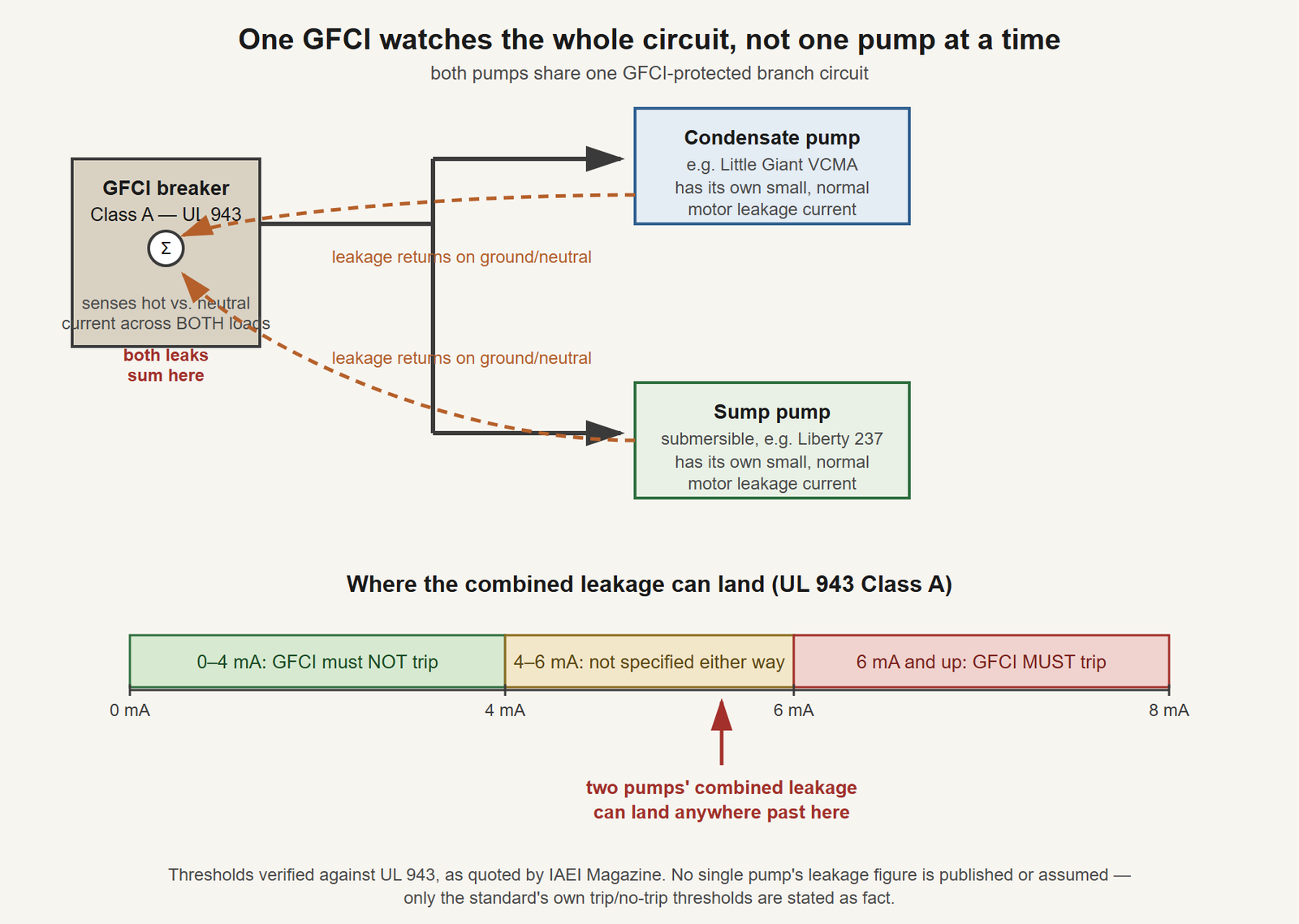
This is the step none of the trade-forum threads lay out for a homeowner — they stop at “measure it with a clamp meter,” which isn’t something most people have sitting in a drawer. You don’t need one to narrow this down.
One-minute test, done in stages:
- Unplug both pumps. Press RESET on the GFCI. It should hold.
- Plug in only the condensate pump and let it run a cycle (or just sit powered if it’s idle). Does the GFCI hold?
- Unplug the condensate pump, plug in only the sump pump, and let it cycle. Does the GFCI hold?
- Plug both back in together.
If both pumps hold the GFCI alone in steps 2 and 3, and it only trips with both plugged in together (step 4), that confirms combined leakage, exactly as this article describes — neither pump is at fault on its own, and the fix is wiring, not a new pump.
If one pump trips the GFCI by itself, with nothing else on the circuit, that’s a different finding: that pump’s own leakage current is already near or past the UL 943 threshold alone, which usually points to aging motor insulation rather than a wiring problem. That’s the point where replacing the pump — not rewiring the circuit — is genuinely the next step. If it’s the sump pump, our sump pump buying guide has verified specs on current models. If it’s the condensate pump, our condensate pump buying guide does the same for that silo.
Little Giant’s Own Manual Already Bans This Setup
Nobody in the trade forums connects this part, and it’s the single most direct fact in this article: Little Giant’s own Owner’s Manual for the VCMA-10/15/20 condensate pumps (Franklin Electric, Form 998086), under Electrical Connections, says the power cord “must be connected to a constant source of power (not a fan or other device that runs intermittently).”
A sump pump is, almost by definition, a device that runs intermittently — it’s off for hours, then on in a burst when water arrives. The maker isn’t warning about GFCI leakage specifically here; the instruction predates and doesn’t name that mechanism. But it bans the exact pairing in this article’s title anyway, for its own stated reason.
Liberty’s installation manuals for its submersible sump pumps add the matching instruction from the sump side: “electrical outlets shall be simplex.” A simplex receptacle serves exactly one device. That alone rules out the shared-duplex-outlet version of this setup — two plugs, one box — regardless of what the GFCI does.
Code Allows One Shared Circuit — Just Not This One
It’s worth knowing code doesn’t ban sharing a circuit outright, because that’s an easy, wrong conclusion to walk away with. NEC 422.12, Exception No. 1, permits a receptacle for a furnace’s own condensate pump to sit on the furnace’s dedicated branch circuit — one appliance and the pump that serves it, sharing a circuit built for that appliance. That’s the one circuit-sharing arrangement the code actually sanctions.
A furnace sharing a circuit with its own condensate pump is sanctioned. A condensate pump sharing a circuit with an unrelated sump pump is not — and now you have both the manufacturer’s reason and the code’s own contrast to explain why.
The Fix Is a Dedicated Circuit, Not a Bigger Breaker
Swapping in a “better” GFCI, a higher-rated one, or a different brand doesn’t fix this — Class A is Class A, and the 6 mA ceiling is the standard, not a model-specific setting. The actual fix is separation: each pump gets its own circuit and its own simplex receptacle, which is both what Little Giant’s manual already instructs and what Liberty’s simplex requirement independently demands. Our piece on running a sump pump off an extension cord covers the related NEC rule against lengthening that circuit informally instead of running a real one — the same logic applies here: a dedicated circuit means a dedicated run, not a splitter or a multi-outlet strip stuffed behind the furnace. Our piece on sump pumps and surge protectors goes further into why Liberty’s simplex instruction rules out gang-plugging anything onto a sump pump’s receptacle at all, surge protector or otherwise — the same rule that rules out a condensate pump sharing that plug.
Pulling a New Circuit Is an Electrician’s Job
Everything up to this point — the amp math, watching the breaker handle, the isolation test — is safe to do with the pumps unplugged or running normally. Running a new dedicated branch circuit back to the panel is not a DIY step. It means opening the panel, sizing and pulling new conductors, and landing them on an open breaker space (or adding one), all on a live electrical service in a basement that’s often damp exactly because the sump pump has work to do there. Have a licensed electrician run the new circuit and install it GFCI-protected at the device or the breaker, per whatever your local code requires. Mention both appliances when you call — the point of the visit is giving each one its own circuit, not just finding one more outlet.
FAQ
Can a condensate pump and sump pump share a GFCI or circuit?
Code doesn’t flatly forbid it everywhere, but both manufacturers’ own manuals do. Little Giant’s VCMA manual bans connecting the pump to “a fan or other device that runs intermittently,” which describes a sump pump exactly, and Liberty’s sump pump manuals separately require a simplex (single-device) receptacle. Treat it as a “don’t,” not a “maybe.”
Why does my sump pump trip the GFCI when the AC is running?
If the condensate pump and the sump pump are on the same GFCI-protected circuit, this is the classic trigger: the AC running means the condensate pump is also running, adding its own leakage current on top of whatever the sump pump is already contributing. Run the isolation test above to confirm it’s the combination and not one pump leaking on its own.
My sump pump keeps tripping the GFCI for no reason. What’s going on?
“For no reason” usually means you haven’t found the other load on the circuit yet. Check what else is plugged into the same GFCI-protected outlet or circuit — a condensate pump, a dehumidifier, anything else with a motor — before assuming the sump pump itself is failing. If it trips completely alone, with nothing else powered on that circuit, that’s a different finding and points at the pump’s own motor.
Does it matter if the pumps plug into the same outlet, or just the same circuit?
Just the same GFCI-protected branch circuit is enough. Leakage current from one device’s case can return through the shared grounding path and get picked up by a GFCI protecting a different receptacle entirely on that branch — electricians have documented this exact scenario. You don’t need both cords in one box for this to happen.


