On this page
Last Updated on September 30, 2026 by Muhammad Toqeer
It is iron ochre, and the important thing about it is where it forms. The bacteria responsible do not manufacture iron. They dissolve it out in the soil, where there is no oxygen, and put it back down wherever there is air — which is the inside of your drain tile and your sump pit.
Your drainage system is not being attacked from outside. It is the vessel the reaction finishes in.
That one fact explains the rest: why the deposit is inside the pipe rather than out in the ground, why the pit is where you first see it, and why every remedy that ignores oxygen only works for a while.
Two places, two different reactions
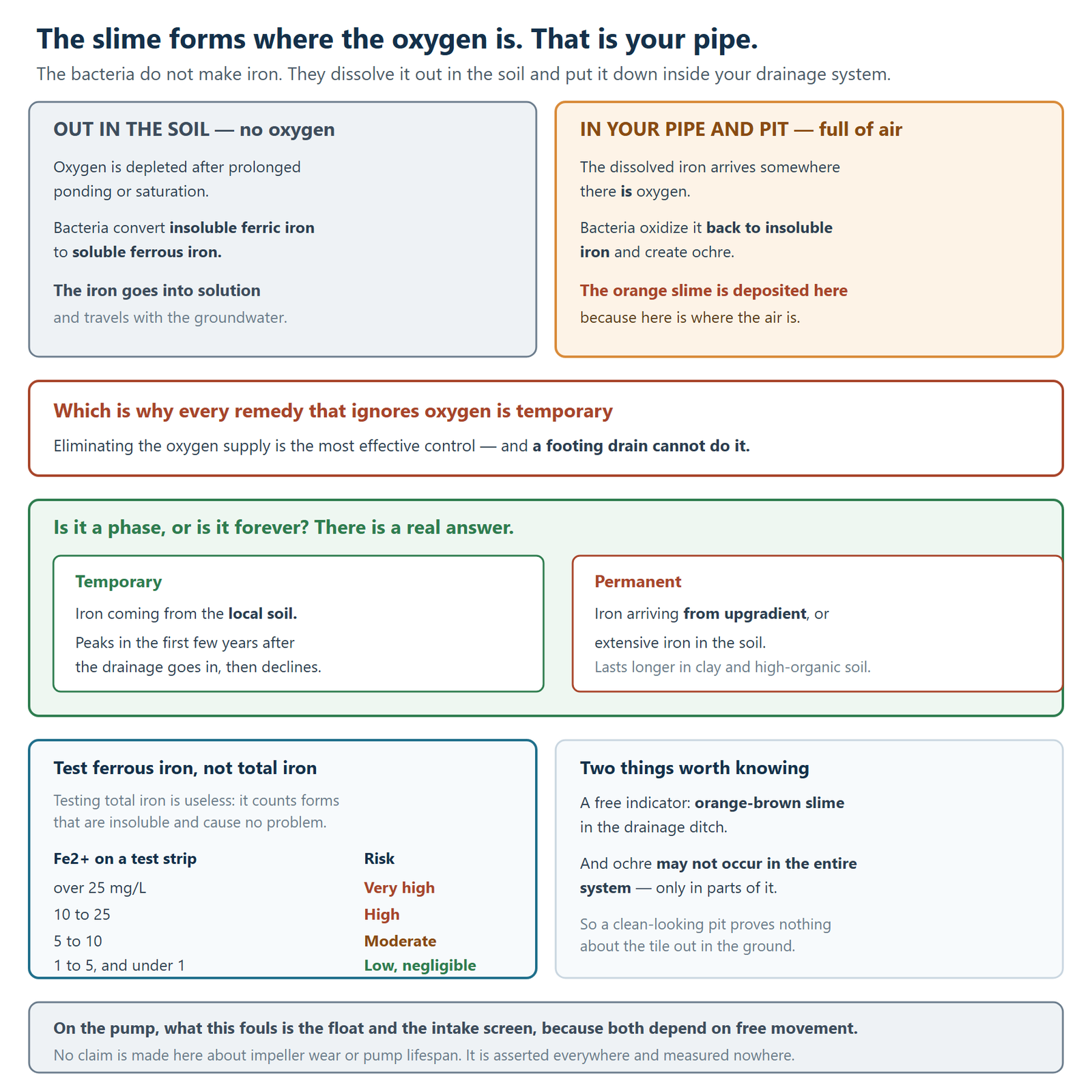
Out in the soil, there is no oxygen. Michigan State University’s extension bulletin on iron ochre puts the mechanism plainly:
“When oxygen in groundwater is depleted after prolonged ponding or saturation, bacteria convert the insoluble ferric iron to soluble ferrous iron in the presence of organic matter.”
The iron goes into solution and travels with the water. At this stage it is invisible and it is not a problem.
Then it reaches your drain tile, which is full of air.
“When the soluble iron enters the pipe where there is oxygen, bacteria oxidize the soluble iron back to insoluble iron and create ochre.”
And that is the slime. Described in the same bulletin as “an orange-brown slimy filamentous deposit in and around the drain.”
So the deposit is not something that washed in. It was assembled on site, out of dissolved iron that arrived clear, using the oxygen your drainage system supplies by existing.
Why this makes the problem hard to cure
The bulletin is direct about what works, and it is the one thing a basement cannot do:
“Eliminating the oxygen supply is the most effective method that should be used along with other methods to keep ochre under control.”
A footing drain moves groundwater through perforated pipe into an open pit. Air is not an accident of the design; it is the design.
Which is why the same bulletin is honest about remedies:
“mitigation and removal methods have limitations and may not fully address the ochre issue”
Read that as permission to stop shopping for a cure. On a house this is a maintenance item, not a condition you eliminate — and anyone promising otherwise is selling something.
Is it a phase or is it forever? There is a real answer
This is the question everyone actually has, and it has a published answer that depends on where your iron is coming from.
Temporary, in the bulletin’s own words:
“When the source of iron is from the local soil, iron ochre is a temporary issue. In this case, the leaching of the iron usually peaks over the first few years after subsurface drainage installation, followed by a gradual decline over several years, after which it stops being an issue.”
Permanent:
“If the iron moves with groundwater from another source upstream or there are extensive quantities of iron in the soil, ochre can become a permanent issue.”
And a soil modifier worth knowing: it “lasts longer in clay soil and in soil with high organic matter than in sandy soil.”
So if your drainage went in recently and the iron is local, what you are looking at is likely to fade. If it arrives from uphill, it will not.
The test almost everybody would get wrong
If you decide to measure rather than guess, measure the right thing.
“Analyzing a soil sample for total iron is useless because it includes iron forms that are insoluble and may not cause iron ochre problems. Iron alone does not cause iron ochre; the presence of bacteria generates ochre.”
What you want is ferrous iron — Fe²⁺ — on an iron indicator test strip. The published method:
“With an excavator or auger, dig a hole about 3 to 5 ft deep and take a sample of the groundwater. It is better if the water table is less than 3-ft deep.”
And the risk bands:
| Ferrous iron (mg/L) | Risk of iron ochre |
|---|---|
| Over 25 | Very high |
| 10–25 | High |
| 5–10 | Moderate |
| 1–5 | Low |
| Under 1 | Negligible |
There is also a free indicator, which costs a walk:
“Another simple indicator of iron ochre potential is observing orange-brown slime in the drainage ditch.”
What it actually does to your pump
Narrower than the internet suggests, and worth being precise about.
It fouls things that depend on free movement. A float has to rise and fall cleanly; an intake screen has to stay open. A filamentous slime is very good at interfering with both, and that is the failure you should expect.
A fouled float is also how this turns into a different symptom entirely. A pump that will not switch, or switches late, or runs on — and on a system with a backup controller, that is the kind of thing the alarm exists to report.
What this page will not tell you is that it destroys impellers or halves pump life. That claim is everywhere and is measured nowhere — no manufacturer states it and the bulletin does not either.
And one more caution against false comfort:
“Iron ochre may not occur in the entire drainage system. It can occur in only parts of the drainage [system]”
A pit that looks clean proves nothing about the tile out in the ground, which is the part you cannot see and the part that matters more.
What to do about it, honestly
Keep the float and the intake clear. That is the maintenance item, and it is the one that prevents an actual flood.
Look at it on a schedule rather than when something goes wrong, because this builds gradually and there is no moment at which it announces itself.
Establish which kind you have. Recent drainage plus local iron is likely to decline. Iron from upgradient is a long-term arrangement, and knowing which one you are in changes how much you should invest in it.
And when the pump is next replaced, choose it on flow at your actual lift as usual — but bear in mind that the part which will give you trouble here is the switch, not the curve.
Deliberately not recommended here: any named chemical treatment. Chlorine and oxalic acid are both common advice, both go into a pit that discharges to open ground or a storm sewer, and neither is something this site will send a homeowner to pour down a hole.
When this needs a pro
Anything involving the drain tile itself — jetting, flushing or replacement. That is excavation or specialist equipment, and it is where the real deposit is.
Any chemical introduced into the pit, for the discharge reason above. Where that water ends up is a regulated question.
A pit you cannot inspect properly. The cover should be gas-tight and fastened down, so a real look is a job rather than a glance.
A system that is losing performance rather than looking unpleasant. Slow drainage with ochre present is a drainage question, not a pump question.
What you can do yourself: look at the float and the intake screen, and look at where your drainage discharges to see whether the slime is out there too. Two observations, no tools, and between them they tell you whether this is cosmetic or spreading.
FAQ
What is the orange slime in my sump pit?
It is iron ochre, produced by iron bacteria. They dissolve iron out of oxygen-starved soil as soluble ferrous iron, and it precipitates back to insoluble iron wherever there is oxygen — which is inside your drain tile and your pit.
Is iron ochre in a sump pit dangerous?
Iron bacteria are treated as a nuisance organism rather than a health hazard, and this page does not go further than that. The practical problem is mechanical: the slime fouls floats and intake screens.
Will iron ochre go away on its own?
It can. Where the iron comes from the local soil, the published guidance is that leaching peaks in the first few years after drainage is installed and then declines until it stops being an issue. Where iron arrives from upgradient, it is permanent.
How do I test for iron ochre?
Test groundwater for ferrous iron with an iron indicator test strip, taken from a hole dug three to five feet deep. Testing a soil sample for total iron is useless, because it counts insoluble forms that cause no problem.
Can you get rid of iron ochre permanently?
Not on a house. Eliminating the oxygen supply is the most effective control, and a footing drain draining into an open pit cannot be run without oxygen. Published guidance says removal methods have limitations and may not fully address it.
Does iron ochre damage a sump pump?
It fouls the parts that need to move freely — the float switch and the intake screen — and that is the failure to plan for. Claims that it destroys impellers or shortens pump life are common but are not supported by any manufacturer figure.


