On this page
Last Updated on October 1, 2026 by Muhammad Toqeer
The manufacturer lists nine causes, and the motor is third. Everything above and most of what follows is power, voltage, water level or a float that cannot move — and all of those are checkable without touching the pump.
Work down the list in the maker’s order rather than in order of fear. Most people start by assuming the pump is dead, which is the one cause they cannot check themselves and the worst one to assume.
The list, in the manufacturer’s own order
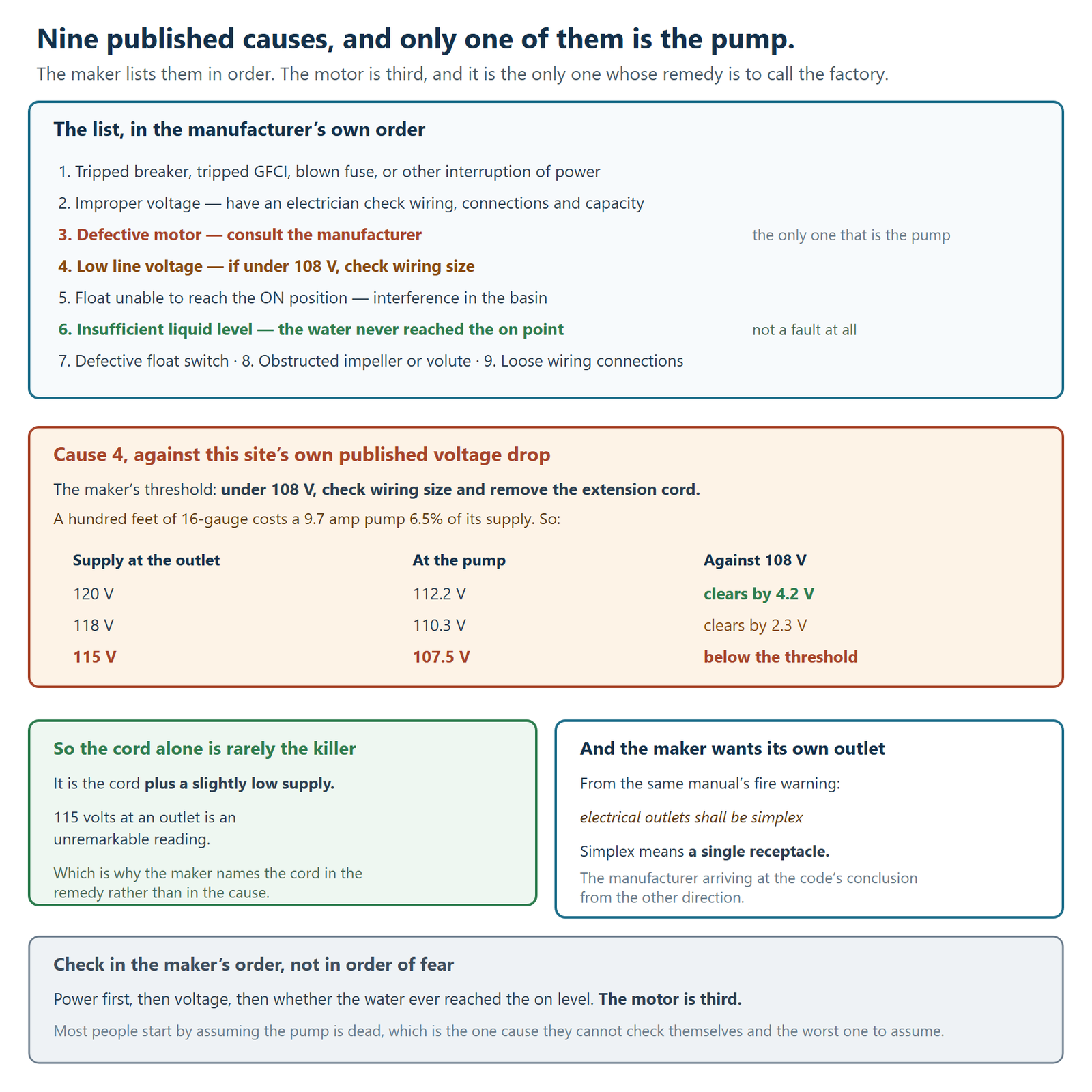
Liberty publishes this list under “Pump does not start”:
- Tripped circuit breaker, tripped GFCI, blown fuse, or other interruption of power
- Improper voltage
- Defective motor — “Consult Liberty Pumps”
- Low line voltage
- Float switch unable to move to pump ON position due to interference in basin or other obstruction
- Insufficient liquid level
- Defective float switch
- Obstructed impeller or volute
- Loose wiring connections
Notice the shape. Eight of the nine are things you can look at, and the ninth has a remedy of call the manufacturer rather than replace the pump.
Start with power, because the remedy list is specific
The manual’s own instruction for cause one:
“Reset tripped circuit breaker, reset GFCI, replace blown fuse with properly sized fuse, check that the unit is securely plugged in, investigate power interruption.”
“Check that the unit is securely plugged in” is in a manufacturer’s troubleshooting table for a reason. A piggyback plug half out of the socket is the most common finding in a basement, and it looks like a dead pump from the stairs.
One-minute test: unplug and replug firmly, and look at the GFCI as well as the breaker. They are two separate things and either can have tripped without the other showing anything.
The voltage threshold, and why it matters more than it sounds
This is the figure nobody publishes, and the maker does:
“Low line voltage. Check voltage. If under 108V, check wiring size. Remove extension cord, or use with heavier gauge.“
108 volts. Exactly ninety per cent of 120.
And this site already computed how you get there. A hundred feet of 16-gauge costs a 9.7-amp pump 6.5% of its supply — so the figure at the pump depends entirely on what the outlet was giving you:
| Supply at the outlet | At the pump | Against 108 V |
|---|---|---|
| 120 V | 112.2 V | clears by 4.2 V |
| 118 V | 110.3 V | clears by 2.3 V |
| 115 V | 107.5 V | below the threshold |
The cord alone does not stop the pump. The cord plus a slightly low supply does.
And 115 volts at an outlet is an unremarkable reading — long branch circuits, a loaded panel and a hot afternoon all push it there. Which is precisely why the manufacturer names the cord in the remedy rather than in the cause.
The same manual says the outlet should be its own, in a fire warning rather than a convenience note:
“electrical outlets shall be simplex”
Simplex means a single receptacle. The maker arriving at the code’s conclusion from the other direction.
Then check whether it should have started at all
Cause six is the one that sends people shopping unnecessarily:
“Insufficient liquid level. Verify the liquid level is allowed to rise enough to activate float switch.”
A pump that has not started because the water never reached the on level is working correctly. That is not a fault, and the remedy is not a part.
One-minute test: pour water in — a bucket, steadily — and watch the level rise past where the float sits. If it starts, nothing is wrong, and what you have is a pit that fills slowly or a drawdown set wider than you remembered.
That band between on and off is a design decision, and the bottom seven inches of the pit are spoken for before you get to choose it.
Then the float, which has two separate failures
The manual splits them, and so should you.
Cause five is mechanical: “Float switch unable to move to pump ON position due to interference in basin or other obstruction.” The remedy is “Position the pump or float switch so that it has adequate clearance for free movement.”
Cause seven is electrical: “Defective float switch. Replace float switch.”
One-minute test for the difference: with the power off, reach in and move the float by hand through its full travel. If it binds on the pipe, the cord or the basin wall, you have cause five and nothing needs buying. If it swings freely and the pump still will not start with the level up, you are looking at cause seven.
A float that is sticking rather than obstructed is a different symptom again — a pump that runs when it should not is the opposite problem with its own causes.
What is left
Cause eight, an obstructed impeller or volute, is the one that explains a pump that hums and does nothing rather than one that is silent.
Cause nine, loose wiring connections, belongs to an electrician — the pit is wet and the manual’s remedy for improper voltage is “have an electrician check all wiring.”
And cause three, the defective motor, is third on the list and last in the order you should reach for it.
When this needs a pro
Anything electrical beyond resetting a breaker or a GFCI. Liberty’s own remedy for improper voltage is to have an electrician check wiring, connections and capacity.
Measuring voltage at the pump. It is the single most useful number here and it is taken at a live outlet in a damp basement.
Opening the pump. “Defective motor. Consult Liberty Pumps.” There is no step between that and a replacement that belongs to a homeowner.
Anything in a pit with standing water in it, which is where this symptom usually finds you.
What you can do yourself: check the plug and the GFCI, move the float by hand with the power off, and pour water in to see whether the level ever reaches the on point. Three checks, no tools, and they clear five of the nine causes.
And if it does turn out to be the pump, choose the replacement on flow at your actual lift rather than on horsepower — and check the cord length while you are at it, because the factory cord is not an extension cord and reaching the outlet matters.
FAQ
Why is my sump pump not turning on?
The manufacturer’s list has nine causes and the motor is third. Above it are power interruption and improper voltage; below it are low line voltage, a float that cannot move, and water that never reached the on level. Most are checkable without touching the pump.
What voltage does a sump pump need to start?
Liberty specifies that below 108 volts you should check the wiring size and remove any extension cord. That is 90% of a nominal 120-volt supply, and it is the only published threshold of its kind on this site.
Can an extension cord stop a sump pump from starting?
It can, but usually only with help. A hundred feet of 16-gauge costs a 9.7-amp pump about 6.5% of its supply, which leaves 112 volts from a healthy 120-volt outlet — above the threshold. From a 115-volt outlet the same cord lands at 107.5 volts, which is below it.
How do I know if the float switch is bad or just stuck?
Turn the power off and move the float through its full travel by hand. If it catches on the pipe, the cord or the basin wall, it is obstructed and the fix is clearance. If it moves freely and the pump still will not run with the water up, the switch itself is suspect.
My sump pump has not run in weeks — is it broken?
Not necessarily. “Insufficient liquid level” is on the manufacturer’s own cause list, and a pump that has not started because the water never reached the on point is behaving correctly. Pour water in and watch the level rise past the float.
Should I replace a sump pump that will not start?
Not before working down the list. Eight of the nine published causes are not the pump, and the one that is has a remedy of consulting the manufacturer rather than buying a replacement outright.


