On this page
- Pump switch or control switch
- The starting figure is the one that matters
- The eight worth knowing
- Side by side
- The pit has to be wide enough, and there are two numbers
- The tether length is the setting, not a detail
- Testing it, with the limit the maker puts on it
- How to choose, in order
- When this needs a pro
- FAQ
Last Updated on October 2, 2026 by Muhammad Toqeer
Check the horsepower rating before anything else. If a float switch does not have one, it is not meant to switch a pump — it is meant to signal a control panel or an alarm, and it will go on the end of a pump cord perfectly happily until the day it fails.
The same manufacturer sells both. Same shape, same PVC housing, same choice of 10, 15, 20 or 30 foot cable. One is rated 13 amps running and 85 amps starting. The other is rated 5 amps and carries no horsepower figure at all.
That distinction is not in a single round-up on the first page of results, and it decides whether the switch you buy is the right part.
Pump switch or control switch
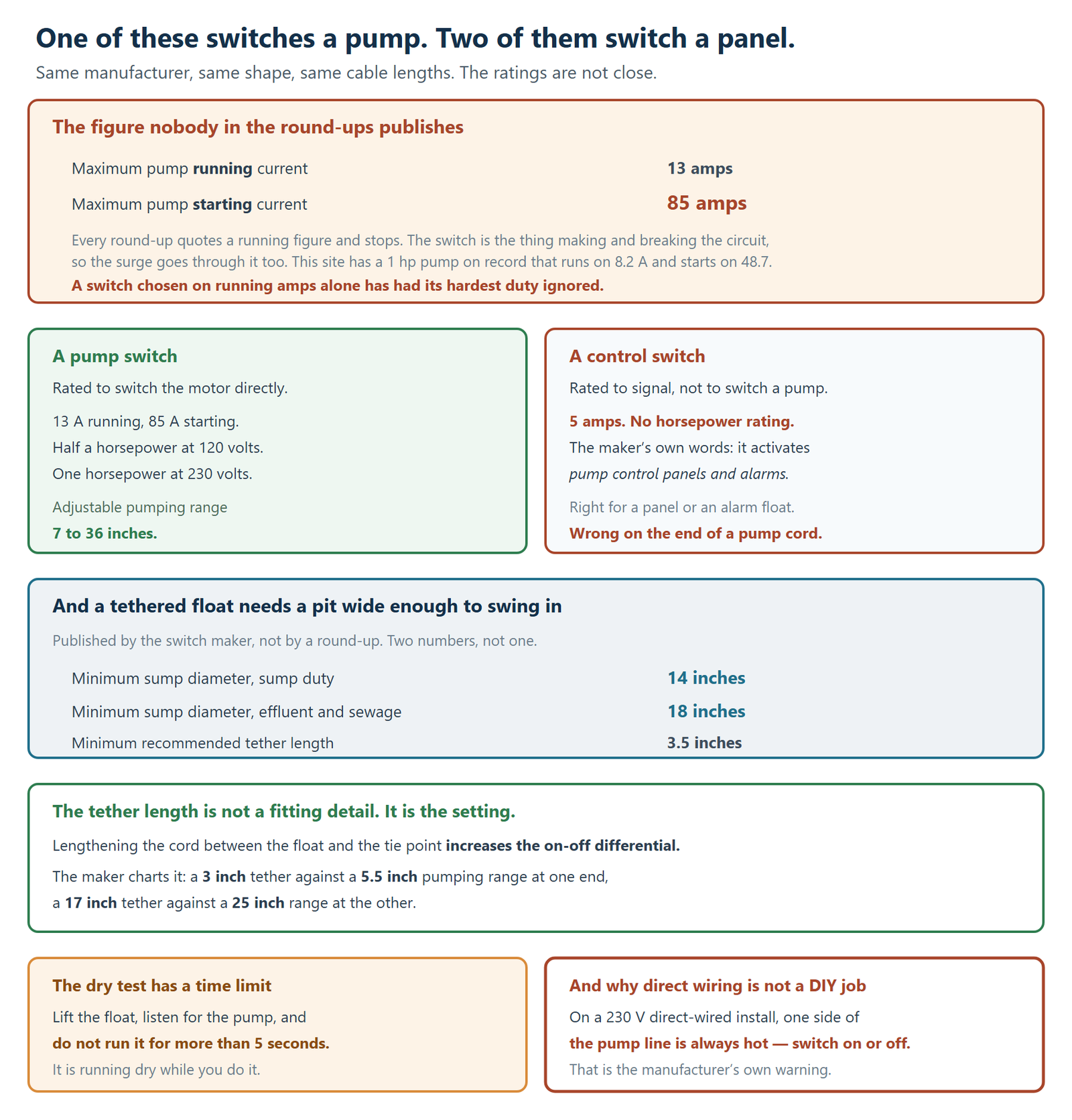
The two ratings, as the manufacturer publishes them.
A pump-duty float switch carries a horsepower figure and a current pair:
“Maximum Pump Running Current: 13 amps” “Maximum Pump Starting Current: 85 amps” “Recommended Pump HP: 1/2 HP or less” at 120 VAC, “1 HP or less” at 230 VAC
A control float carries neither:
“5 amps, 125/250 VAC, 50/60 Hz” — “used to accurately monitor high (normally open) or low (normally closed) liquid levels to activate pump control panels and alarms”
Read the second one again. It activates a panel. It does not run a pump, and the maker never says it does.
One-minute check on anything you are about to buy: look for a horsepower rating. No horsepower rating means no pump duty. It is the fastest filter in the category and it costs nothing.
The starting figure is the one that matters
This is the number that separates a manufacturer’s spec sheet from a round-up.
Every list on this subject quotes a running current — 10 amps, 13, 16 — and stops there. A float switch is the thing physically making and breaking the circuit, so the surge at startup goes through its contacts, not past them.
And this site has that surge on record. A 1 hp submersible runs on 8.2 amps and starts on 48.7 — nearly six times its running current, on the motor maker’s own published figures.
Against 48.7, a 13-amp running rating is not the binding constraint. The 85-amp starting rating is — and it is the only published starting figure found anywhere in this category.
Pro note: a switch that has been “working fine for years” and then fails on a start is not a coincidence. The contacts do their hardest work in the first fraction of a second of every cycle, and a switch under-rated for that wears out through the duty it was never specified for.
The eight worth knowing
SJE PumpMaster — the one with a published starting rating
SJE-Rhombus PumpMaster — wide-angle tethered pump switch. 13 amps maximum running current, 85 amps maximum starting current. Recommended ½ HP or less at 120 VAC, 1 HP or less at 230 VAC. Adjustable pumping range of 7 to 36 inches. Float is 3.05 inches diameter × 3.56 inches long, high-impact corrosion-resistant PVC, rated to 140 °F. 16 gauge SJOW cable in 10, 15, 20 or 30 foot lengths. The maker says it is “not sensitive to rotation or turbulence.”
Who it is for: anyone replacing a switch on a pump they cannot find a starting-current figure for, which is most people. It is the one product here that lets you check the hardest duty rather than guess at it.
The honest drawback: it is a tether, so it needs pit width. In a narrow pit it is the wrong shape regardless of its ratings.
Little Giant RFSN-6 (599118) — the short-cord standard
Little Giant RFSN-6 — piggyback mechanical float switch, ½ HP maximum, 115 V, 10 foot cord.
Who it is for: a standard residential sump within ten feet of its outlet. The piggyback plug means the pump plugs into the back of the switch and the switch into the wall, so the pump can still be run manually by unplugging the pair.
The honest drawback: ten feet is short. If the outlet is across the basement, this is the wrong item number and the fix is a longer-cord variant, not an extension lead.
Little Giant RFSN-16 (599211) — when the pump is bigger than a half
Little Giant RFSN-16 — piggyback mechanical float switch, ¾ HP maximum, 115 V, 20 foot cord.
Who it is for: a ¾ horsepower sump or effluent pump, where the ½ HP switches are simply out of their rating.
The honest drawback: nothing about the switch tells you your pump is ¾ HP. That comes off the pump’s nameplate, and if you are guessing, you are guessing on the part that carries the current.
Little Giant RFSN-9 230 V (599128) — the 230 volt version
Little Giant RFSN-9, 230 V — piggyback mechanical float switch, 1 HP maximum, 208/230 V, 15 foot cord.
Who it is for: a 230 volt pump. The 115 V and 230 V versions share a model family and are not interchangeable, which is the same trap the booster silo documents on supply variants.
The honest drawback: the model name alone does not distinguish it from the 115 V RFSN-9. The item number does — 599128 against 599117 — and that is what to order by.
Little Giant RFSN-20 (599321) — the one with real headroom
Little Giant RFSN-20 — piggyback mechanical float switch, 1½ HP at 115 V and 3 HP at 230 V, 125/250 V, 30 foot cord.
Who it is for: the largest residential sump and sewage pumps, and any run where thirty feet of cord is genuinely needed.
The honest drawback: more rating than most sumps will ever use. Buying headroom you do not need is not a safety margin here — it is a larger float and a longer cord to find room for.
Little Giant RVMS-20 (599263) — the vertical, for a narrow pit
Little Giant RVMS-20 — piggyback mechanical vertical float switch. 13 amps, ½ HP at 115 V and 1 HP at 230 V, 20 foot cord.
Who it is for: a pit too narrow for a tethered float to swing in. A vertical float rides a rod instead of swinging on a cord, so the width requirement largely goes away.
The honest drawback: a vertical switch has a short, fixed differential. The pump will cycle more often than it would on a tether, which is the trade you are making for the space.
SJE SignalMaster — a control float, and only that
SJE-Rhombus SignalMaster — 5 amps, 125/250 VAC, 50/60 Hz. Float 2.74 inches diameter × 4.83 inches long. Maximum water depth 30 feet (13 PSI). For “sewage and water up to 140 °F (60 °C).” Standard cables of 10, 15, 20 or 30 feet.
Who it is for: someone running a control panel or an alarm, where the float is a signal and a relay does the switching.
The honest drawback — and it is the point of this guide: it is not a pump switch. It has no horsepower rating, and its 5-amp contacts are not specified for a motor’s starting current. The maker also notes it is “not recommended for controlling electrical loads less than 100 milliamps, 12 VAC and non-arcing electrical loads” — it has a floor as well as a ceiling.
SJE Sensor Float — the other control float
SJE-Rhombus Sensor Float — 5 amps, 120/230 VAC, 50/60 Hz. Float 3.38 inches diameter × 4.55 inches long, high-impact corrosion-resistant PVC. Maximum water depth 30 feet (13 PSI), 140 °F. 18 gauge, 2 conductor SJOW cable with a water-resistant CPE jacket, in 10, 15, 20 or 30 foot lengths. Three mountings: discharge-pipe clamp, internally weighted, externally weighted.
Who it is for: the same job as the SignalMaster, in a slightly larger float with a choice of mounting.
The honest drawback: same 5-amp ceiling, same absence of a horsepower rating, and an 18 gauge cable against the pump switch’s 16. Everything about it says signal rather than load, if you know to read it that way.
Side by side
| Switch | Type | Rating | Cord |
|---|---|---|---|
| SJE PumpMaster | tether, pump duty | 13 A run / 85 A start, ½ HP @120 V, 1 HP @230 V | 10/15/20/30 ft |
| Little Giant RFSN-6 | tether, pump duty | ½ HP, 115 V | 10 ft |
| Little Giant RFSN-16 | tether, pump duty | ¾ HP, 115 V | 20 ft |
| Little Giant RFSN-9 (599128) | tether, pump duty | 1 HP, 208/230 V | 15 ft |
| Little Giant RFSN-20 (599321) | tether, pump duty | 1½ HP @115 V, 3 HP @230 V | 30 ft |
| Little Giant RVMS-20 | vertical, pump duty | 13 A, ½ HP @115 V, 1 HP @230 V | 20 ft |
| SJE SignalMaster | control only | 5 A, no HP rating | 10/15/20/30 ft |
| SJE Sensor Float | control only | 5 A, no HP rating | 10/15/20/30 ft |
All eight are current catalogue items on the manufacturers’ own sites, checked 2 October 2026.
The pit has to be wide enough, and there are two numbers
This is published by the switch maker and it is not in the round-ups.
“A sump with a minimum diameter of 14″ is required for the #6 series sump pumps.”
“A sump with a minimum diameter of 18″ is required for the Little Giant Effluent and Sewage pumps or other pumps rated 13 amps or less.”
Fourteen inches for sump duty. Eighteen for effluent and sewage. The second figure appears nowhere in the search results for this topic, and it is the one that catches people fitting a tethered float in an ejector basin.
There is a tether minimum as well:
“A minimum tether length of 3½” is recommended…”
And an instruction that reads like an afterthought and is not:
“The clamp and pump handle must be positioned to allow free operation of float.”
One-minute check before ordering: measure the inside diameter of the pit, and look at whether the discharge pipe, the cord and the handle leave the float a clear arc. If the answer is no, the decision is already made — a vertical switch, not a tether.
The tether length is the setting, not a detail
This is the part that turns a replacement part into a tuning decision.
“Increasing cord length between float and tie point increases on-off differential, while decreasing cord length between float and tie-off decreases on-off differential.”
The maker charts it. At one end, a 3-inch tether against a 5.5-inch pumping range; at the other, a 17-inch tether against a 25-inch range.
A longer tether means a deeper draw and fewer, longer cycles. A shorter one means shallower, more frequent ones. That is the same variable the pit depth and drawdown question works with from the other direction, and the two have to agree — the float can only use the depth the pit actually has.
And it is the first thing to look at on a pump that will not stop. A float whose differential has been set too short, or that has drifted, is one of the causes behind a pump running with no rain in the forecast.
Testing it, with the limit the maker puts on it
The published procedure is short, and it has a number in it most people do not expect:
“Without water in sump, plug pump cord into the back of the switch plug. Plug switch into outlet. Lift float and listen for pump to operate. Do not run pump for more than 5 seconds.“
Five seconds, because the pump is running dry while you do it. The full test, with water, is a separate procedure — this one is only confirming that the switch makes and breaks.
How to choose, in order
First, is it a pump switch at all? A horsepower rating means yes. No horsepower rating means it is a control float, whatever the shop listing calls it.
Second, does the rating cover your pump? Off the pump’s nameplate, not off a guess at its size. And prefer a switch that publishes a starting figure, because that is the duty that wears the contacts.
Third, will a tether physically swing? Fourteen inches for a sump, eighteen for effluent or sewage, with a clear arc past the pipe and the handle. If not, vertical.
Fourth, is the cord long enough to reach the outlet without an extension lead.
Only then does the tether length come in, and that is an adjustment rather than a purchase.
When this needs a pro
Any direct-wired installation. The manufacturer’s own warning is the reason:
“WARNING: In a 230V direct wire installation, one side of the line going to the pump is always HOT. This condition exists whether the float switch is ON or OFF.”
A switch that is not isolating the pump is a switch that cannot be relied on to make anything safe to touch. That is an electrician’s job and a double-pole disconnect, not a weekend one.
Anything on a control panel. If the float is feeding a panel, the panel is what is being worked on.
A pump that trips its breaker rather than failing to start. That is a current problem, not a switch problem, and the two present identically from the top of the stairs.
And a pump old enough that the switch is the third thing to have gone. At that point you are maintaining a pump that is telling you something, and a new switch on a worn pump buys months rather than years.
What you can do yourself: read the horsepower off the pump’s nameplate, measure the pit’s inside diameter, and check the float has a clear arc. Three measurements, one tape — and they settle the whole decision before any model number comes into it.
FAQ
How do I know if a float switch will run my sump pump?
Look for a horsepower rating. A pump-duty switch publishes one — typically ½ HP at 115 V or 1 HP at 230 V — along with a maximum running current. A float with a 5-amp rating and no horsepower figure is a control switch for a panel or an alarm, not for a pump.
What amp rating do I need for a sump pump float switch?
Match the running rating to the pump’s nameplate, but the figure that does the damage is the starting current. One manufacturer publishes a maximum pump starting current of 85 amps against a 13-amp running rating, and a 1 hp submersible can draw nearly six times its running current at the instant it starts.
Tethered or vertical float switch — which is better?
It is mostly a pit-width question. A tethered float needs a published minimum of 14 inches diameter for sump duty and 18 inches for effluent and sewage, plus a clear arc past the pipe and handle. Below that, a vertical switch is the only one that works, at the cost of more frequent cycling.
What does the tether length on a float switch do?
It sets the on-off differential. Lengthening the cord between the float and the tie point increases the differential, so the pump runs longer and less often; shortening it does the reverse. The maker charts it from a 3-inch tether giving a 5.5-inch pumping range up to a 17-inch tether giving 25 inches.
Can I test a float switch without water in the pit?
Yes, briefly. Plug the pump into the back of the switch, plug the switch into the outlet, lift the float and listen for the pump — but the manufacturer’s instruction is not to run it for more than five seconds, because it is running dry the whole time.
Why does my float switch keep failing?
Often because it was never rated for the starting current it sees, or because it is a control float being used as a pump switch. Fouling is the other common cause: a float that cannot swing freely, or that has been coated by what is in the pit, stops reporting the level correctly long before it stops moving.


