On this page
Last Updated on October 6, 2026 by Muhammad Toqeer
A manufacturer prohibits it by name, in the same sentence as an extension cord:
“DO NOT USE AN EXTENSION CORD OR SURGE PROTECTOR.“
And the three reasons given have nothing to do with surges. “If not sized properly, become damaged or the connection falls into the sump.”
That is the thing worth understanding. The objection is not that the protector works badly — it is that electrically, in this position, it is an extension cord, and it puts one more connection on the floor of the wettest room in the house.
What the manual actually says
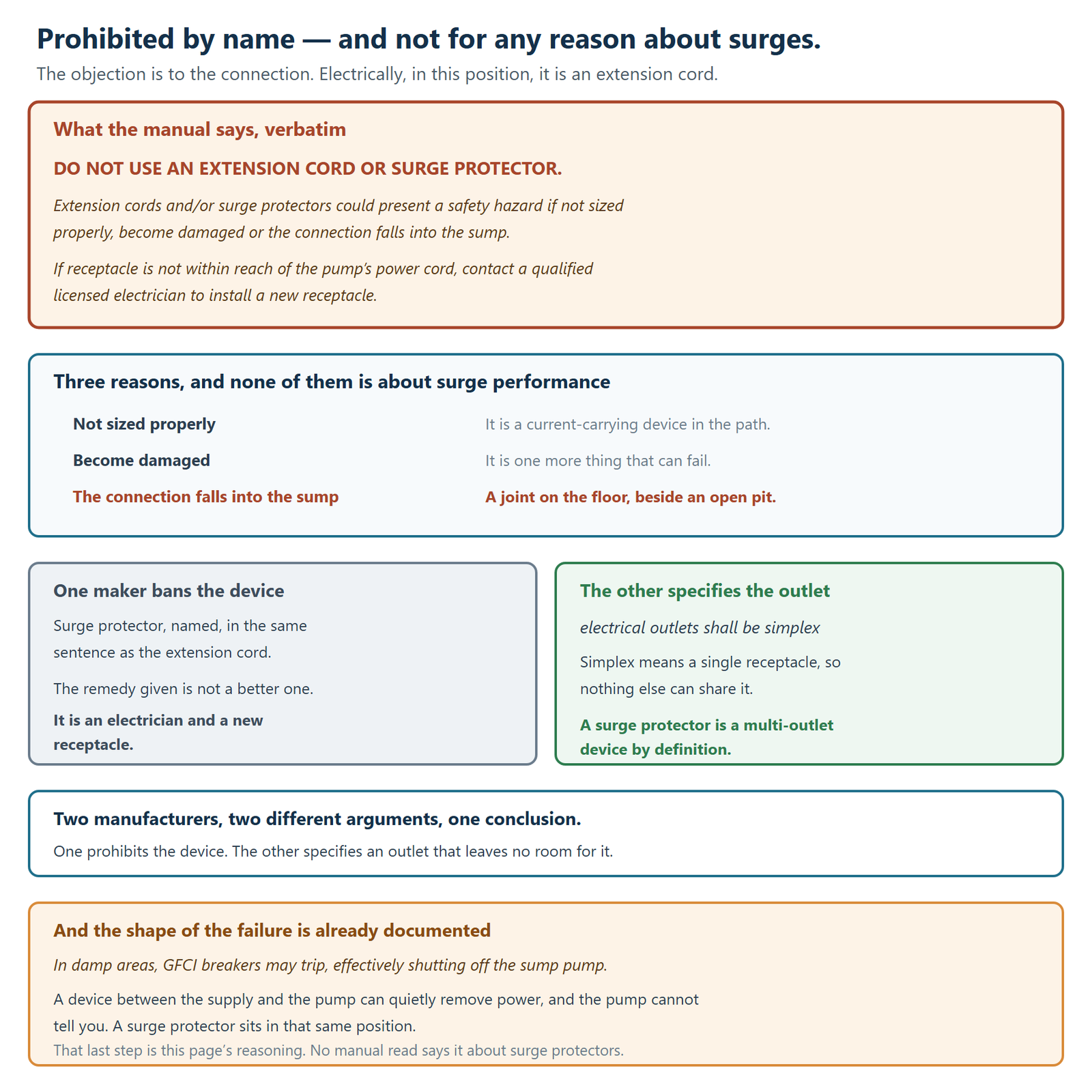
Verbatim, from the manual:
“DO NOT USE AN EXTENSION CORD OR SURGE PROTECTOR. Extension cords and/or surge protectors could present a safety hazard if not sized properly, become damaged or the connection falls into the sump. If receptacle is not within reach of the pump’s power cord, contact a qualified licensed electrician to install a new receptacle.“
Three reasons, and it is worth taking them one at a time:
“If not sized properly.” A surge protector is a current-carrying device sitting in the supply path. It has an ampacity like any other, and a pump is a motor load.
“Become damaged.” It is one more component between the outlet and the pump, and components fail.
“The connection falls into the sump.” This is the vivid one. A strip sits on the floor by definition — that is where the cord reaches — and the floor it sits on is next to an open pit in a room that floods.
And note what the remedy is not. It is not a heavier-duty protector or a better-rated strip. It is an electrician and a new receptacle.
The second manufacturer gets there from the other direction
This site already quotes a different maker’s requirement in the article on a pump that will not start:
“electrical outlets shall be simplex“
Simplex means a single receptacle — one socket, so nothing else can share it.
A surge protector is a multi-outlet device by definition. That is the entire product.
So one manufacturer prohibits the device and the other specifies an outlet that leaves no room for it. Two different arguments, neither about surge performance, arriving at the same place.
One-minute check: look at what the pump is plugged into. If it is anything with more than one socket on it, or anything with a cord between it and the wall, that is the arrangement both manuals are describing.
Why people fit one, and why that reasoning does not survive
The intent is good and worth saying out loud. A sump pump is the appliance you most need to survive a storm, storms bring surges, and a strip looks like easy insurance. Fitting one is a considered decision, not a careless one.
The manufacturer’s objection is simply about where it has to live.
A surge protector protects against an event that may never happen, by adding a component that is certainly there, in a place where water certainly is. The pump is already the appliance you are least likely to be standing next to when it matters.
And this site has the same trade-off documented on the cord side. The code answer on extension cords is no regardless of gauge, and the voltage-drop arithmetic there explains what a long cord costs a motor — the surge protector is the same argument wearing a different box.
The failure mode nobody plans for
A sump pump cannot tell you it has lost power. It simply does not run, and you find out when the basement does.
That is not speculation — the shape of it is already documented. The same manufacturer warns that:
“In damp areas, GFCI breakers may trip, effectively shutting off the sump pump. Check in on your sump pump and reset the GFCI if necessary.”
A protective device between the supply and the pump can quietly remove power, and nothing announces it.
A surge protector sits in that same position. Many carry an internal breaker or thermal cutout, and a protector that has absorbed a surge may have done its job and stopped passing current.
To be precise: no manual read here says that surge protectors trip and stop sump pumps. That extension is this page’s reasoning from a documented failure mode — but it is the reason the “one more component” objection is not merely tidiness.
So what should it be plugged into?
The manufacturer answers this directly: a receptacle within reach of the pump’s own cord, and if there isn’t one, a qualified licensed electrician installing a new one.
And the other maker tells you what kind: a single — simplex — receptacle, so nothing else shares the circuit.
If you want protection, that is a conversation about the supply rather than about a strip in the basement. Panel-level and circuit-level options exist and they are an electrician’s subject — nothing read for this page addresses them, so nothing here recommends one.
And if the worry behind the surge protector is really “will the pump run when I need it”, that is a different and better question. An alarm tells you when it has not, and a generator is its own question with a manufacturer restriction attached.
When this needs a pro
Installing the receptacle, which is the manufacturer’s own remedy and is explicitly routed to a licensed electrician.
Anything about the circuit — whether it is dedicated, how it is protected, and what else is on it.
Removing a surge protector that is currently in use, if that leaves the pump unable to reach an outlet. Do not solve a reach problem by adding a cord — that is the same prohibition in the same sentence.
And any installation where the outlet is low enough to be reached by water. That is a position problem rather than a device problem, and it is more urgent than either.
And if the supply has never been looked at as part of the system, the pit, the pump and the circuit are one installation rather than three purchases.
What you can do yourself: look at what the pump is plugged into, count the sockets on it, and see whether the outlet is within reach of the pump’s own cord. Three things, no tools — and they tell an electrician exactly what to quote for.
FAQ
Can I plug a sump pump into a surge protector?
A manufacturer prohibits it by name, in the same sentence as an extension cord. The published reasons are that it may not be sized properly, may become damaged, or that the connection may fall into the sump — none of them about surge performance.
Why would a surge protector be bad for a sump pump?
Because of where it has to sit rather than what it does. It is a current-carrying component in the supply path, it is one more thing that can fail, and it puts a connection on the floor beside an open pit. The remedy the manual gives is an electrician and a new receptacle.
What should a sump pump be plugged into?
A receptacle within reach of the pump’s own power cord, and one manufacturer specifies that electrical outlets shall be simplex — a single receptacle, so nothing else can share it. A multi-outlet strip is the opposite of that by definition.
Can a surge protector stop my sump pump without me knowing?
No manual read states that specifically, so treat it as reasoning rather than a published fact. What is published is that GFCI breakers in damp areas may trip and effectively shut off the sump pump — a device between the supply and the pump can remove power quietly, and a surge protector occupies that same position.
My outlet is too far from the pump. What then?
Not a cord and not a strip — the manual addresses this directly and says to contact a qualified licensed electrician to install a new receptacle. Solving a reach problem with an extension cord runs into the same prohibition in the same sentence.
Is whole-house surge protection a better idea?
It is a different product in a different place, and nothing read for this page addresses it, so this page does not recommend it either way. It is a question for an electrician looking at the panel rather than at the pump.


