On this page
- Why this isn't the frozen-discharge-line fault
- Why an unheated garage pit freezes when a basement pit doesn't
- Is the pit actually frozen solid?
- Break the ice without creating a bigger problem
- Where this stops being a DIY fix
- Stopping it from happening again
- The float froze. The pump never got the chance to fail.
Last Updated on October 11, 2026 by umar bwn
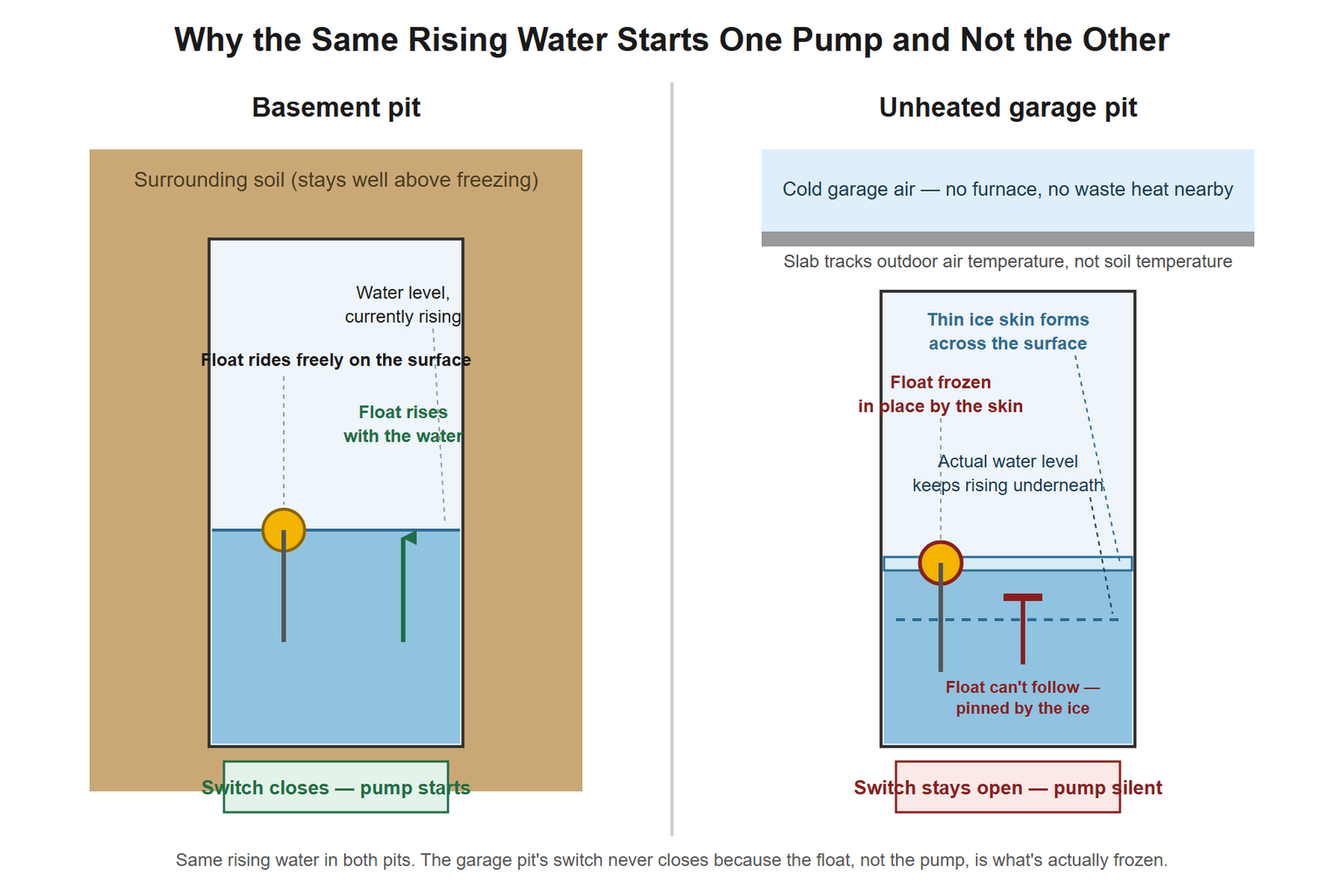
A sump pit freezing in an unheated garage doesn’t look like the frozen sump pump problem most guides describe. Search “sump pump frozen” and nearly every result is about the discharge pipe — the line carrying water away after the pump fires. Out here, the fault usually sits upstream of that: water sitting inside the pit skins over with a thin layer of ice before the pump ever turns on, pinning the float at one level so the switch never closes. The pump isn’t failing to pump. It’s failing to be told to start.
Why this isn’t the frozen-discharge-line fault
If the pump cycles on, hums or buzzes, and nothing moves, that’s a different article. Sump pump discharge line frozen already covers that one in detail: the exposed vertical riser above the pit freezes while the buried run stays safe, because soil holds heat the air above it doesn’t. The garage version of this fault looks nothing like that. There’s no hum, no vibration, no motor noise at all — because the switch never closed the circuit that would have started the motor in the first place.
One-minute test: open the lid and pour a cup of warm — not boiling — water around the float. If the motor doesn’t even try to start, you’re reading the right article. If it starts and runs but the water level doesn’t drop, go read the discharge-line piece instead.
Why an unheated garage pit freezes when a basement pit doesn’t
A basement sump pit sits below grade, wrapped on most sides by soil that stays well above freezing most of a winter even in a cold climate — the same buffering the discharge-line article leans on to explain why a buried pipe survives while an exposed one doesn’t. An unheated garage removes that buffering twice over. The slab, and whatever shallow pit sits under it, tracks outdoor air temperature far more closely than a basement’s surrounding earth does. And the room above has none of a basement’s usual free heat: no furnace nearby, no water heater standing by, no warmth leaking down through an occupied floor overhead. A run of nights below freezing with nothing warming that space is enough to put a skin on standing water, while the ground under the house next door, a few feet away, never gets close.
This isn’t a rare setup, either. Detached and attached garages in snow country commonly have a floor drain for melting snow and ice off a parked vehicle, piped to a small pit with its own pump because there’s nowhere nearby to gravity-drain it. If that’s the layout, the pit is exposed to the same air as the garage floor — no basement to hide in.
Is the pit actually frozen solid?
“Frozen solid” is how it looks from the lid, not what’s actually happened underneath. A float switch only needs a small amount of vertical travel to go from off to on — sizing a sump pit’s depth already breaks down how little room a float actually works with inside a typical pit. A thin skin of ice across the surface is enough to anchor the float wherever it happened to be floating when that skin formed. Water underneath can keep rising — it usually does, since nothing is pumping it out — while the float stays locked exactly where the ice grabbed it. The switch isn’t broken. It’s reporting the only thing it can sense, and that hasn’t moved.
That’s also why thawing it out is less work than it sounds. You’re not melting a pit’s worth of ice. You’re breaking one thin layer, right at the surface.
Break the ice without creating a bigger problem
Pour warm tap water directly around the float, not boiling — a sudden temperature swing is harder on a plastic float and any PVC fittings nearby than the ice itself. If that doesn’t do it, work something blunt and handle-length — a broom handle, a length of dowel — through the skin near the float, pushing straight down rather than prying sideways. A float arm or tether takes a twist badly; it’s designed to bend one way.
Once the skin is broken, reach in and lift the float by hand through its full range. If the pump kicks on the moment it reaches the “on” position, that confirms the fault was the ice, not the switch, the motor, or the power feeding it. If you break the ice, lift the float, and the pump still stays silent, you’ve got a second, unrelated fault — sump pump not turning on runs through the float, switch and power causes that have nothing to do with ice.
Where this stops being a DIY fix
Reaching into a pit with an energized pump sitting in standing water is routine when the cord, plug and outlet all look fine. It stops being routine the moment any of them don’t — a cracked or pinched cord, an outlet that feels warm, a plug that’s been sitting in water rather than above it, or any sign someone’s run a space heater or heat tape into that garage on an extension cord to fight exactly this problem. Water plus a damaged conductor isn’t something to work around with a broom handle. Call an electrician before adding any heat source to this setup, not after one’s already been jury-rigged in.
Stopping it from happening again
Insulating the pit lid — a gasketed cover with foam board underneath rather than a bare plastic or plywood cap — cuts the heat loss straight up through the one opening the pit has. It won’t help a garage that sits below freezing for a week straight, but it buys real margin on the borderline nights that cause most of these calls. Beyond that, most unheated garages don’t have a realistic way to add ambient heat without defeating the point of being unheated, so the other lever is the switch itself rather than the room. A float riding on the surface is exactly the part that ice can grab; a vertical float switch or a non-mechanical level sensor doesn’t depend on something floating freely on open water, and that’s a pump-level decision rather than a five-minute fix for a pit that’s already frozen today. If this garage pit ices over every hard freeze rather than once in a bad year, our best sump pumps guide is where to look at switch types before the next one goes in, rather than replacing the one that’s there with the same design.
For the rest of how this pit, its discharge and its weep hole are supposed to work together, the sump pump pillar covers the mechanics this article assumes.
The float froze. The pump never got the chance to fail.
Nothing about the motor, the switch wiring, or the pump itself has to be wrong for this to happen. A thin skin of ice sitting exactly where the float sits is enough on its own, and it only takes a cold-enough stretch with no heat source anywhere near that pit. Worth remembering before the next hard freeze: the fix that worked today — breaking the skin and freeing the float — is the same fix that’ll work again next time, right up until the switch gets changed for one ice can’t reach.


