On this page
Last Updated on September 30, 2026 by Muhammad Toqeer
Roughly the bottom seven inches of the pit are not yours. A stand holds the pump about 2½ inches clear of the floor, and the manufacturer wants at least 4½ inches of water still in there when the pump shuts off.
What is left above that is the drawdown — the band between pump-off and pump-on — and it is the only layer you actually choose.
It is also the one that decides how often your pump starts. At the storm inflow this site already worked out, a six-inch band in an eighteen-inch pit means one pump start a minute.
The four layers, from the bottom up
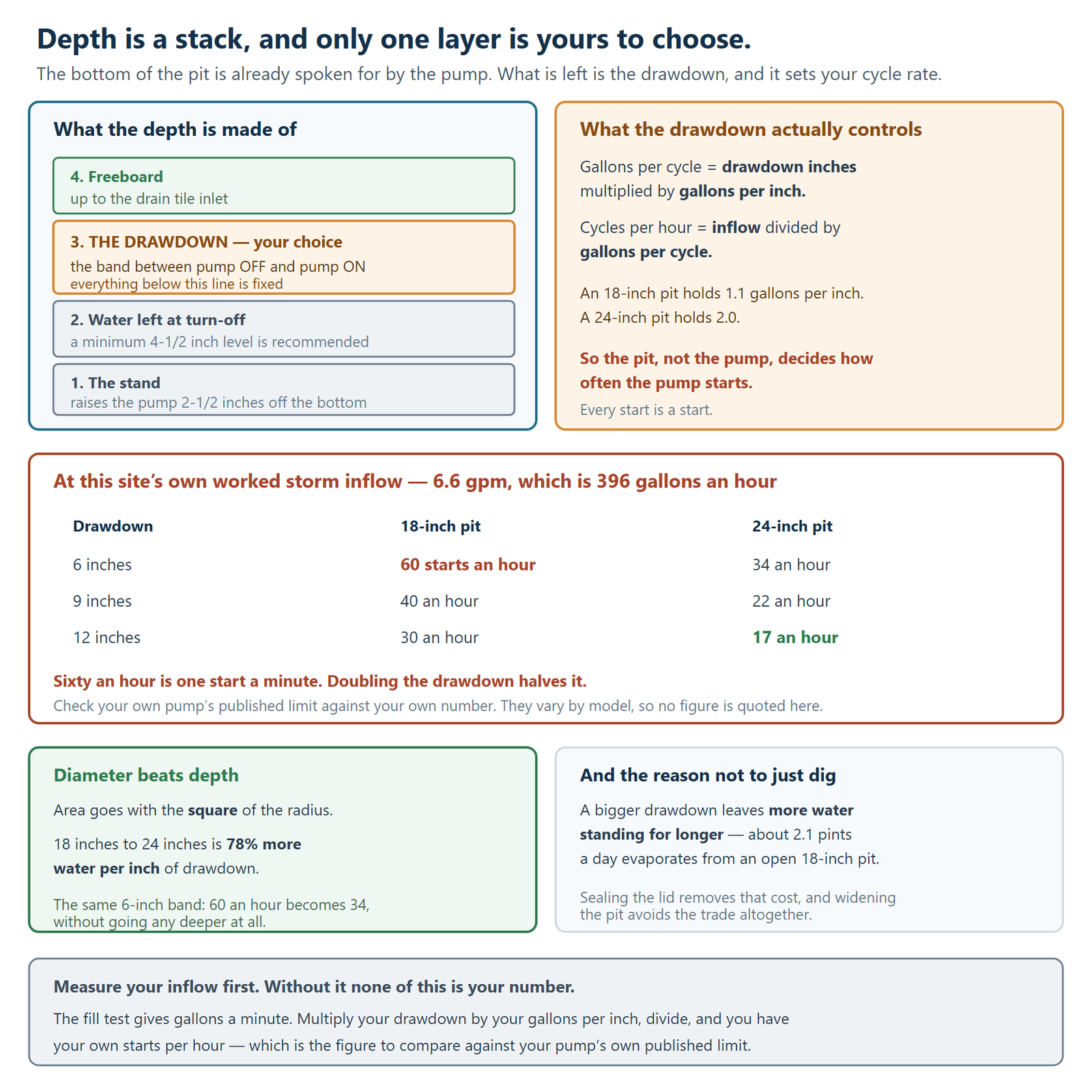
1. The stand. Liberty’s own accessory description is that it “raises the pump 2-1/2[″] off the bottom of the basin, reducing the potential for jamming from rocks and debris.” The intake is not supposed to sit on the floor, where the silt and grit are.
2. The water that stays behind. From the same manual: the pump “should not be run dry for extended periods of time. A minimum 4-1/2[″] water level is recommended,” and “Set the turn OFF level at 4-1/2[″] or greater.”
That water is not waste. A submersible sump pump is cooled by the liquid around it, and the off level is what guarantees it is still there when the motor stops.
3. The drawdown. The band between the off level and the on level. Everything below it is fixed by the equipment. This part is a decision.
4. Freeboard. Above the on level, up to where the drain tile enters the pit. If water reaches the inlet, it is backing up into the tile rather than draining out of it.
So “how deep should it be” has no answer until you have chosen the drawdown, and the rest is addition.
What the drawdown is actually for
It converts your inflow into a number of pump starts, and that is its whole job.
The arithmetic is short:
- Gallons per cycle = drawdown in inches × gallons per inch
- Starts per hour = inflow in gallons per hour ÷ gallons per cycle
And the gallons per inch depend on diameter, from this site’s sizing figures: an 18-inch pit holds about 1.1 gallons per inch, a 24-inch pit about 2.0.
Worked at a real storm inflow
Using the same 6.6 gallons a minute this site used when sizing a pump — which is 396 gallons an hour:
| Drawdown | 18-inch pit | 24-inch pit |
|---|---|---|
| 6 inches | 60 starts an hour | 34 an hour |
| 9 inches | 40 an hour | 22 an hour |
| 12 inches | 30 an hour | 17 an hour |
Sixty starts an hour is one a minute, sustained for as long as the storm delivers that much water. Doubling the drawdown halves it.
A caution about what this page will not tell you. Pump makers do publish maximum start rates, and they vary by model. The figures circulating online are either unattributed or belong to different machines — some of the most-quoted ones are submersible well motor ratings, which is a different pump doing a different job.
So no limit is quoted here. What this gives you is your own starts-per-hour figure, which is the number to compare against whatever your own pump’s documentation says.
Diameter beats depth, and by a calculable margin
This is the part that inverts the usual advice.
Area goes with the square of the radius, so a wider pit gains volume much faster than a deeper one gains it.
Going from an 18-inch pit to a 24-inch pit is 78% more water per inch of drawdown.
Which means the same six-inch band drops from 60 starts an hour to 34 — without going any deeper at all.
If the pit is being installed or replaced, width is the lever with more in it, and it is the one nobody recommends.
Why not just dig deeper, then
Because a bigger drawdown means more water standing in the pit, for longer.
An open pit evaporates about 2.1 pints a day at 65 °F from an 18-inch basin, continuously, into the space you are paying to condition. Deepening the drawdown keeps more surface wet for more of the time.
Two things make that a non-issue rather than a trade-off:
- Sealing the lid, which the code requires anyway and which closes the evaporation path outright
- Widening rather than deepening, which buys the same reduction in starts without extending how long water sits
Which is a second reason the diameter is the better lever.
How to work out yours
Measure the inflow first. Without it, none of the numbers above are yours — they are one worked example from one storm.
Then find your gallons per inch. 1.1 for an 18-inch pit, 2.0 for a 24-inch one, or π × radius² × inches ÷ 231 for anything else.
Then measure your actual drawdown, which is the vertical distance between where the pump switches off and where it switches on. On a tethered float this is set by the tether length, and it is adjustable within limits.
Multiply, divide, and you have your starts per hour at peak. Compare it against what your pump’s manual says.
And if the answer is uncomfortable, your options in order of cost are: lengthen the drawdown within what the pit allows, widen the pit, or choose a pump that clears the inflow at your lift with margin so each cycle is short and decisive.
When this needs a pro
Anything that changes the pit — deepening, widening, or replacing the liner. That is excavation in a basement floor next to a foundation.
The drain tile connection, because the inlet height is what sets your freeboard and it is not something to guess at.
Float adjustment on a pump you did not install, if the off level would end up below what the manufacturer specifies. Below that, the pump is running without its cooling.
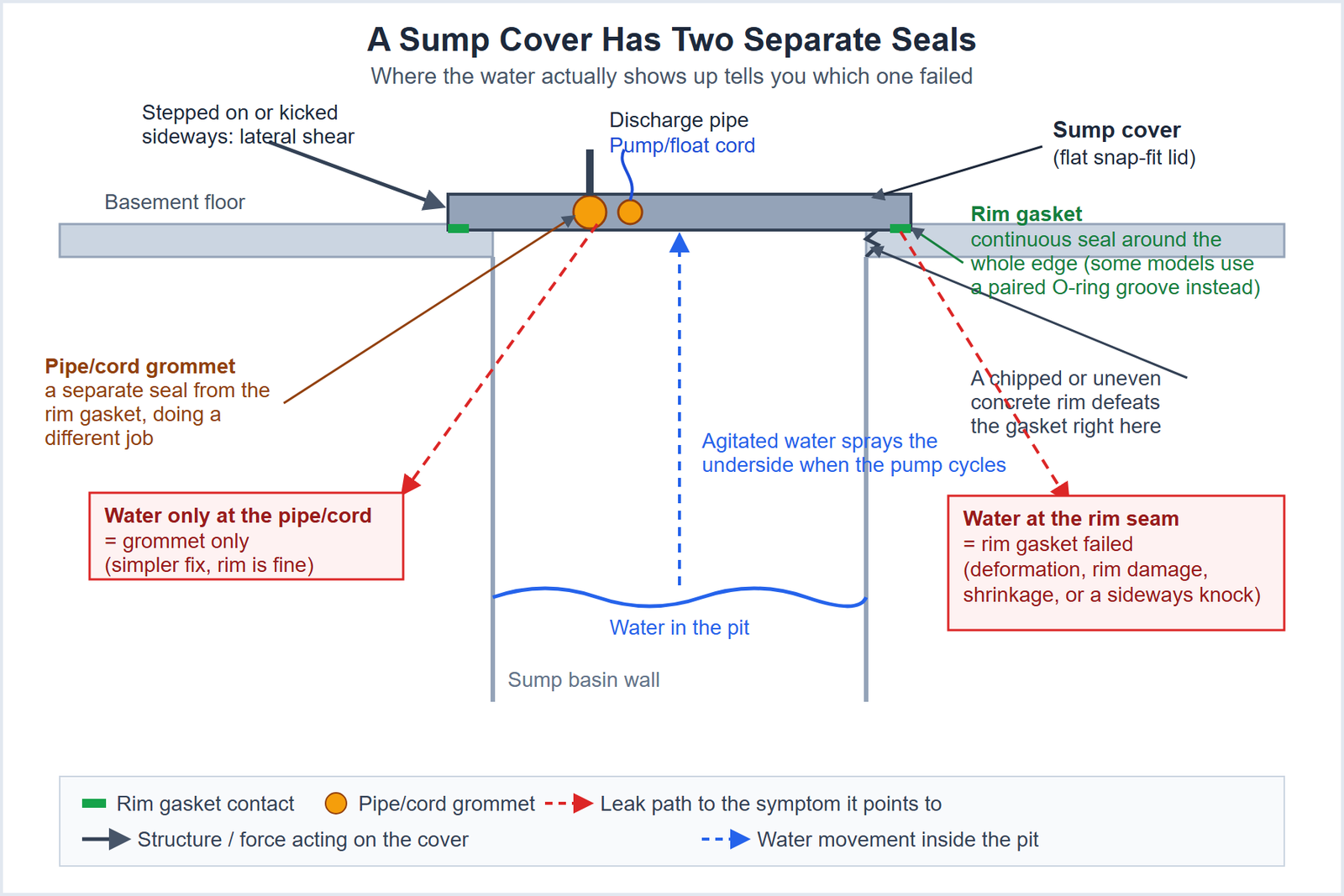
Anything with the lid off, since the cover should be gas-tight and fastened down and it is doing more than one job.
What you can do yourself: measure the pit’s diameter, and watch one cycle to see how far the water drops between the pump stopping and starting. Two measurements, and they are the two the arithmetic needs.
FAQ
How deep should a sump pit be?
There is no single figure, because depth is a stack. Roughly the bottom seven inches are fixed — about 2½ inches of pump stand and at least 4½ inches of water that must remain at turn-off — and above that you choose the drawdown, then add freeboard up to the drain tile inlet.
What is drawdown on a sump pump?
The vertical distance between the level at which the pump switches off and the level at which it switches on. It sets how many gallons each cycle moves, and therefore how often the pump starts at any given inflow.
How much water should be left in a sump pit when the pump stops?
Manufacturers specify a minimum. Liberty’s sump manual recommends a minimum 4½-inch water level and says to set the turn-off level at 4½ inches or greater, because the pump should not run dry and the liquid is what cools the motor.
Is a wider sump pit better than a deeper one?
For reducing pump starts, yes, and by a calculable margin. Area rises with the square of the radius, so an 18-inch pit widened to 24 inches holds 78% more water per inch of drawdown — the same six-inch band goes from 60 starts an hour to 34.
How many times an hour should a sump pump start?
Published limits vary by model and this page does not quote one, because many figures circulating online belong to different classes of pump. Work out your own starts per hour from your inflow, pit diameter and drawdown, then compare it with your pump’s own documentation.
Does a bigger drawdown have a downside?
It leaves more water standing in the pit for longer, and an open pit evaporates continuously into the basement — about 2.1 pints a day from an 18-inch basin at 65 °F. A sealed lid removes that, and widening the pit instead of deepening it avoids the question.