On this page
Last Updated on September 30, 2026 by Muhammad Toqeer
Switch the pump off at the breaker first. It is running against a closed pipe, it cannot move water, and the flow that normally cools the motor has stopped. A pump cannot win against ice and it will destroy itself trying.
Then stop looking at the buried part. A discharge line freezes at two specific places — where it crosses the frost line, and at the open end — and the buried run between them is the one section that is safe.
Where it actually freezes
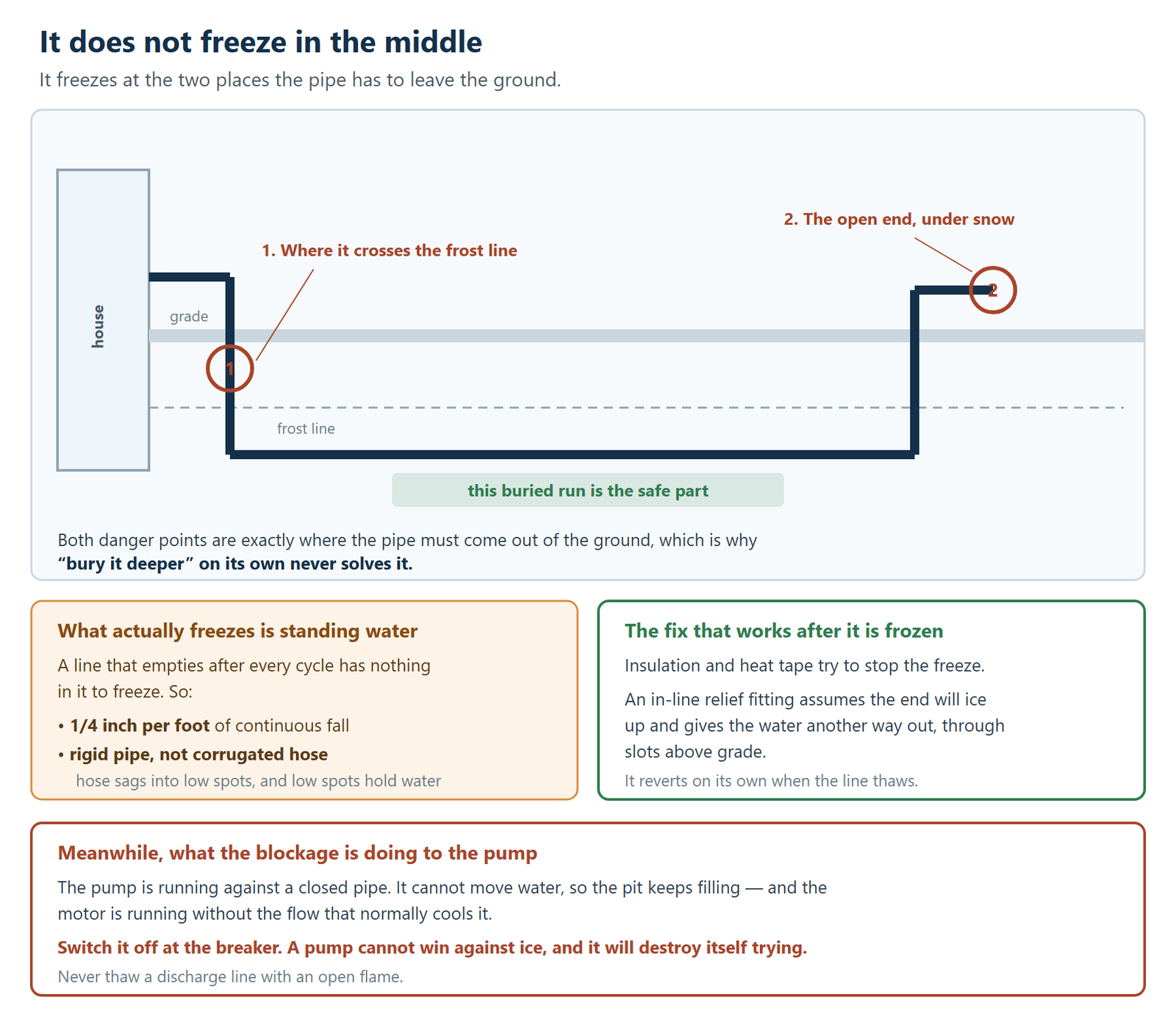
The two vulnerable points are where the pipe meets the ground at the frost line, and the end of the line where the water disperses.
Everything between them is below the frost line and is not the problem.
A sump line runs to daylight rather than into a drain, which is why it is exposed to weather in a way no other pump’s discharge in the house is.
That single fact changes what you do about it, because both danger points are exactly where the pipe has to leave the ground. You cannot bury your way out of them — the pipe has to surface at the house and it has to surface where the water comes out. “Bury it deeper” on its own never solves this.
What is actually freezing is standing water
A pipe with nothing in it cannot freeze shut. A line that empties completely after every cycle has nothing to turn to ice overnight.
So the two preventions that matter are the two that stop water standing:
Continuous fall, at least 1/4 inch per foot, running away from the house. It does not need to be steep. It needs to be uninterrupted — one low spot is enough.
Rigid pipe rather than corrugated hose. This is the one most people get wrong. Flexible and corrugated hose sags over time and creates exactly the low spots that hold water, and it is the most common thing bolted onto a discharge. A 2-inch rigid PVC line drains faster after each cycle and holds its shape.
Where the run is buried, at least 5 inches below the frost line keeps that section out of trouble — but see above about the two ends.
And keep it well away from the house. Twenty feet is the usual target for other reasons entirely, and it helps here too.
The fix that works when it is already frozen
Insulation and heat tape are attempts to stop the freeze. They can work, and heat tape is an electrical device on an outdoor water pipe, which makes it a professional decision rather than a weekend one.
There is a different approach that assumes the freeze will happen anyway.
An in-line relief fitting sits above grade with engineered perforations in it. When the end of the line is blocked — by ice, by snow, by anything — water escapes through the slots instead of backing up.
The manufacturers describe it plainly: it “automatically allows water to escape through its perforations when pipe terminations are blocked, usually by ice or snow”, and “even if the pipe outlet is buried under a foot of ice and snow, the water can escape.”
When the line thaws, it reverts on its own. There is nothing to switch and nothing to remember.
It does not keep your pipe from freezing. It keeps your basement from flooding while it is frozen — and those are different promises. For a discharge that ices up every winter, the second one is the useful one.
What the blockage is doing while you decide
The pump is running against a closed pipe.
It is not moving water, so the pit keeps filling. And a submersible pump is cooled by the water it moves — with nothing flowing, the motor is heating up with no way to shed it.
A pump that has run continuously has been stressed whether or not it still works, which is worth knowing before you clear the ice and assume you are finished.
Two things not to do. Never thaw a discharge line with an open flame — it is usually PVC, and the result is a hole. And do not leave the pump running while you work on it.
When this needs a pro
Re-sloping, re-routing, or re-burying the line. It is drainage work, where it terminates is often regulated, and a line that now drains toward a neighbour is a different problem.
Fitting a relief device or heat tape. One is plumbing into a pressurised discharge, the other is electrical on an outdoor pipe.
A pit that has overflowed while the line was blocked. That is a water-damage question as well as a pump one.
And a pump that ran against ice for any length of time. It may be fine. It may be a week from failing in the middle of a thaw, which is the worst possible timing.
What you can do yourself: switch it off at the breaker, go outside and find the end of the pipe, and clear snow away from the outlet. If the outlet is buried in a drift, that alone may be the whole fault — and it is two minutes with a shovel.
FAQ
Where does a sump pump discharge line freeze first?
At two places: where the pipe crosses the frost line near the house, and at the open end where the water comes out. The buried section between them sits below the frost line and is the part that is safe.
Will burying the discharge line deeper stop it freezing?
Not on its own. The two points that freeze are exactly where the pipe has to come out of the ground — at the house and at the outlet — so depth in the middle does not remove either of them.
What slope does a sump discharge line need?
At least a quarter of an inch per foot, continuous, running away from the house. The point is that the line empties completely after every cycle, because standing water is what freezes.
Is corrugated hose bad for a sump discharge?
It is the worst common choice in a cold climate. Flexible and corrugated hose sags over time into low spots, and those low spots hold the standing water that freezes. Rigid pipe holds its shape and drains faster.
What is a sump pump freeze relief fitting?
An in-line fitting above grade with slots in it. If the outlet is blocked by ice or snow, water escapes through the slots rather than backing up, and it returns to normal by itself when the line thaws. It does not prevent freezing; it prevents flooding while frozen.
Can I pour hot water down a frozen sump discharge?
It is not the approach to start with, and never use an open flame on a PVC line. Switch the pump off at the breaker first, clear any snow from the outlet, and if the blockage is further in, that is a job to hand over rather than force.


