On this page
- What the manual actually says, and where it sits
- What that manual does publish
- The one that stops a pump while it is still plugged in
- This is one manufacturer's position, not the industry's
- Why the wattage advice is the wrong shape anyway
- The route that does not depend on anyone being home
- When this needs a pro
- FAQ
Last Updated on October 3, 2026 by Muhammad Toqeer
Before you buy a generator for this, read your pump’s own manual. One manufacturer answers the question outright, in the product description of its current manual, across fourteen models:
“These pumps are not designed to be used with a portable generator.”
Every result on the first page of a search says the opposite, confidently, with wattages — about nine amps, 1000W to run and 2000 to 4000W to start, a 2500-watt generator is enough — and not one of those figures is attributed to a pump manufacturer.
That does not make the restriction universal. Three other sump and sewage manuals checked mention generators zero times. It makes it one manufacturer’s stated position, and a very good reason to spend one minute on your own paperwork.
What the manual actually says, and where it sits
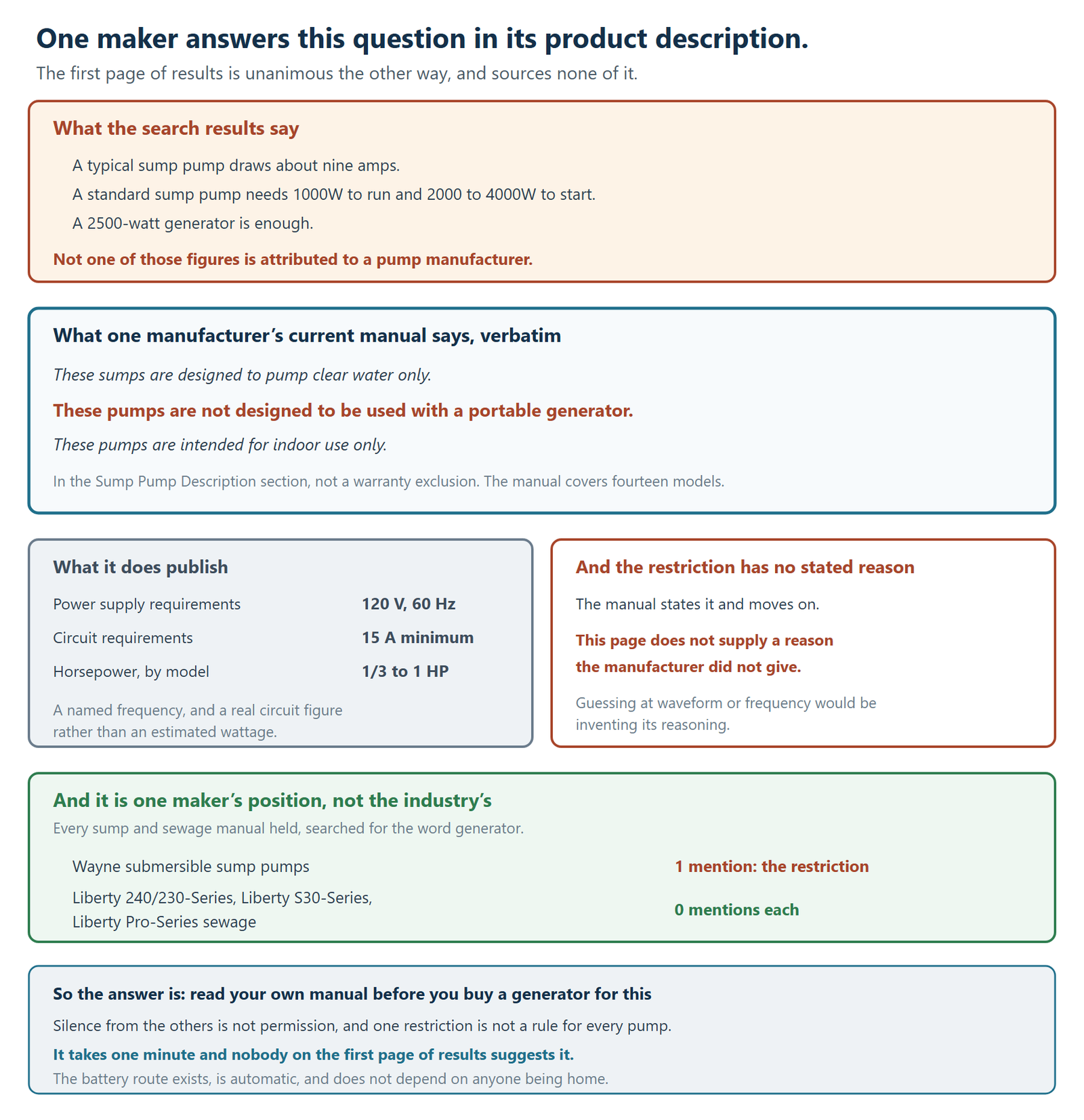
From Wayne Water Systems’ submersible sump pump manual, document `600002W-001-J`, dated 06/25. The passage is in the section headed Sump Pump Description:
“Sump pumps are automatic pumps used to remove ground water from sump pits. The most common application is for basement drainage to prevent flooding in residential buildings. These sumps are designed to pump clear water only. These pumps are not designed to be used with a portable generator. These pumps are intended for indoor use only.”
Three things about that placement matter.
It is not in a warranty exclusion. It is in the paragraph that describes what the product is for, alongside “clear water only” and “indoor use only” — two statements nobody would argue with.
It covers the whole range in that manual — SPF33, SPF50, CDT50, WST33, CDU790, CDU800, CDU790SS, CICDU790, CDU800SS, CICDU800, CDU980E, CDU980ET, CDU1000 and CDU1000ET.
And it gives no reason. The manual states it and moves on. This page is not going to supply one — guessing at waveform quality or frequency stability would be inventing a manufacturer’s reasoning, and the honest report is that the restriction is stated without explanation.
What that manual does publish
These are the figures worth having, because they are specifications rather than estimates:
POWER SUPPLY REQUIREMENTS: 120 V, 60 Hz MOTOR: Single Phase, Dielectric Oil Filled CIRCUIT REQUIREMENTS: 15 A (minimum) HORSEPOWER: 1 HP (CDU1000, CDU1000ET) · ¾ HP (CDU980E, CDU980ET) · ½ HP (CDU800SS, CICDU800, CDU800, SPF50, CDT50) · ⅓ HP (CDU790SS, CICDU790, CDU790, SPF33, WST33)
Note that the supply requirement names a frequency, not just a voltage. And note that 15 amps minimum is a circuit requirement, which is a different and more useful thing than a guessed running wattage.
One-minute check: find your pump’s manual — the model number is on the pump body or the cord tag — and look for two things. A statement about generators, and the published supply and circuit requirements. Both are usually on the same page.
The one that stops a pump while it is still plugged in
The same manual carries a warning that applies whatever the power source is, and it is the failure mode people do not plan for:
“Make sure the pump is plugged in to a working ground fault circuit interrupter (GFCI) outlet and the cord is in good shape. In damp areas, GFCI breakers may trip, effectively shutting off the sump pump. Check in on your sump pump and reset the GFCI if necessary.”
A manufacturer saying that the protective device it requires can quietly stop the pump. A tripped GFCI looks like nothing at all — the pump is plugged in, the power is on, and the water rises.
That is worth knowing on mains power and it does not get simpler on a generator, where portable units commonly have GFCI protection on their own outlets too.
And it is a reason the cord matters. What you plug a sump pump into, and what you plug it in with, is its own question — and it is the same question whether the supply is the wall or a generator.
This is one manufacturer’s position, not the industry’s
Being precise here matters, because it would be easy to turn one sentence into a rule.
Every sump and sewage manual held was searched for the word “generator”:
| Manual | Mentions of “generator” |
|---|---|
| Wayne submersible sump pumps, `600002W-001-J` | 1 — the restriction above |
| Liberty 240/230-Series sump pumps, `7108000` | 0 |
| Liberty S30-Series sump pumps, `7175000` | 0 |
| Liberty Pro-Series sewage systems | 0 |
So the others do not contradict it. They do not address it at all.
Silence is not permission, and one manufacturer’s restriction is not a rule covering every pump on the market. The only thing that settles it for your pump is your pump’s manual — which is exactly the step nobody on the first page of results suggests.
Why the wattage advice is the wrong shape anyway
This site has already worked through generator sizing properly, on the other side of the house.
Sizing a generator for a well pump turns on locked rotor amps — the figure the motor demands at the instant it starts — and the point of that article is that no horsepower chart shows it. A 1 hp submersible runs on 8.2 amps and starts on 48.7.
The sump advice in the search results makes the same mistake in the same direction: it quotes a running figure (“about nine amps”, “1000W to run”) and then an unsourced surge estimate on top.
The method transfers. The numbers do not. A sump pump is a different motor, cord-connected on a 120 V circuit rather than hard-wired at 230 V, and this site has no verified locked-rotor figure for one — so it is not going to print an estimate dressed up as a specification.
What you can verify instead is on your own nameplate and in your own manual, and that is the honest version of the advice.
The route that does not depend on anyone being home
Worth stating plainly, because it is the practical alternative rather than a rival product.
A generator only helps if someone is there to start it, refuel it and connect it — during the storm, usually at night, often when the house is empty. That is the structural limitation, and it is true even where the pump’s manual permits it.
A battery backup starts on its own, which is the whole reason the category exists, and the figure those are sold on is not the one that decides how long you actually get.
None of that makes a generator useless — a generator keeps a whole house going, and a battery keeps one pump going for a while. They answer different questions, and the pump manual decides whether the first one is even available to you.
When this needs a pro
Any permanent connection to a generator. Transfer switches and backfeeding are electrician territory, and backfeeding a house through an outlet is genuinely dangerous to line workers as well as to you.
Deciding what your generator can actually start. That is a calculation from the pump’s nameplate and the generator’s surge rating, not from a chart.
Anything about the circuit itself. The manual quoted specifies a 15 A minimum circuit, and whether yours meets that is a question about the wiring, not the pump.
And the carbon monoxide hazard is real and is not this site’s subject. Generators are run outdoors, well away from doors and windows, and the guidance belongs to the generator’s own manual and to safety agencies rather than to a pump page.
What you can do yourself: find your pump’s model number, download its manual, and read the description and specification sections. Two minutes, no tools — and it tells you whether the generator plan was ever on the table for your pump, which is a different question from whether the pump and pit are right in the first place.
FAQ
Can you run a sump pump on a generator?
Check your pump’s manual first. One manufacturer states in the product description of its current manual, across fourteen models, that its pumps are not designed to be used with a portable generator. Three other manuals checked do not mention generators at all, so the position is not industry-wide — but it is not something to assume either.
What size generator do I need for a sump pump?
The figures circulating — about nine amps, 1000W running, 2000 to 4000W starting — are not attributed to any pump manufacturer. What one maker does publish is a 120 V, 60 Hz supply requirement and a 15 A minimum circuit. Size from your own nameplate and manual rather than from a general chart.
Why would a sump pump not be designed for a portable generator?
The manual that states the restriction gives no reason, and this page will not invent one. What the same manual publishes separately is that the pump requires 120 V at 60 Hz and a GFCI outlet, and that GFCI breakers can trip in damp areas and shut the pump off.
Is a battery backup better than a generator for a sump pump?
They solve different problems. A generator needs someone present to start, fuel and connect it, usually during a storm at night. A battery backup starts by itself, which is why the category exists — but it powers one pump for a limited time rather than the house.
Can a GFCI stop my sump pump without me knowing?
Yes, and the manufacturer says so: in damp areas GFCI breakers may trip, effectively shutting off the sump pump. Nothing looks wrong — the pump is plugged in and the power is on — so the manual advises checking in on the pump and resetting the GFCI if necessary.
Where do I find out whether my own pump allows it?
The model number is on the pump body or the cord tag, and the manual is on the manufacturer’s site. Look at the product description and the specifications: the statement about generators, if there is one, and the published supply voltage, frequency and minimum circuit rating.


