On this page
Last Updated on October 12, 2026 by Muhammad Toqeer
The number is twelve inches across and twelve deep:
“This unit can be installed in sump pit with minimum diameter of 12″ (30cm) and depth of 12″ (30cm).”
That is a small hole. For comparison, the code minimum for a sewage ejector pit is eighteen across and twenty-four deep — a pedestal is permitted in roughly a quarter of the volume, because the motor never goes into it.
And the fitting-it-in part is where every other page on this subject stops.
The manufacturer does not stop there. It spends far more text on how the pump has to sit than on how big the hole is — and the sentence that matters most is this one:
“Pump must be level (column must be vertical) when operating. If motor is tilted, internal start/run switch may overheat and damage motor.”
What the manual asks for, in order
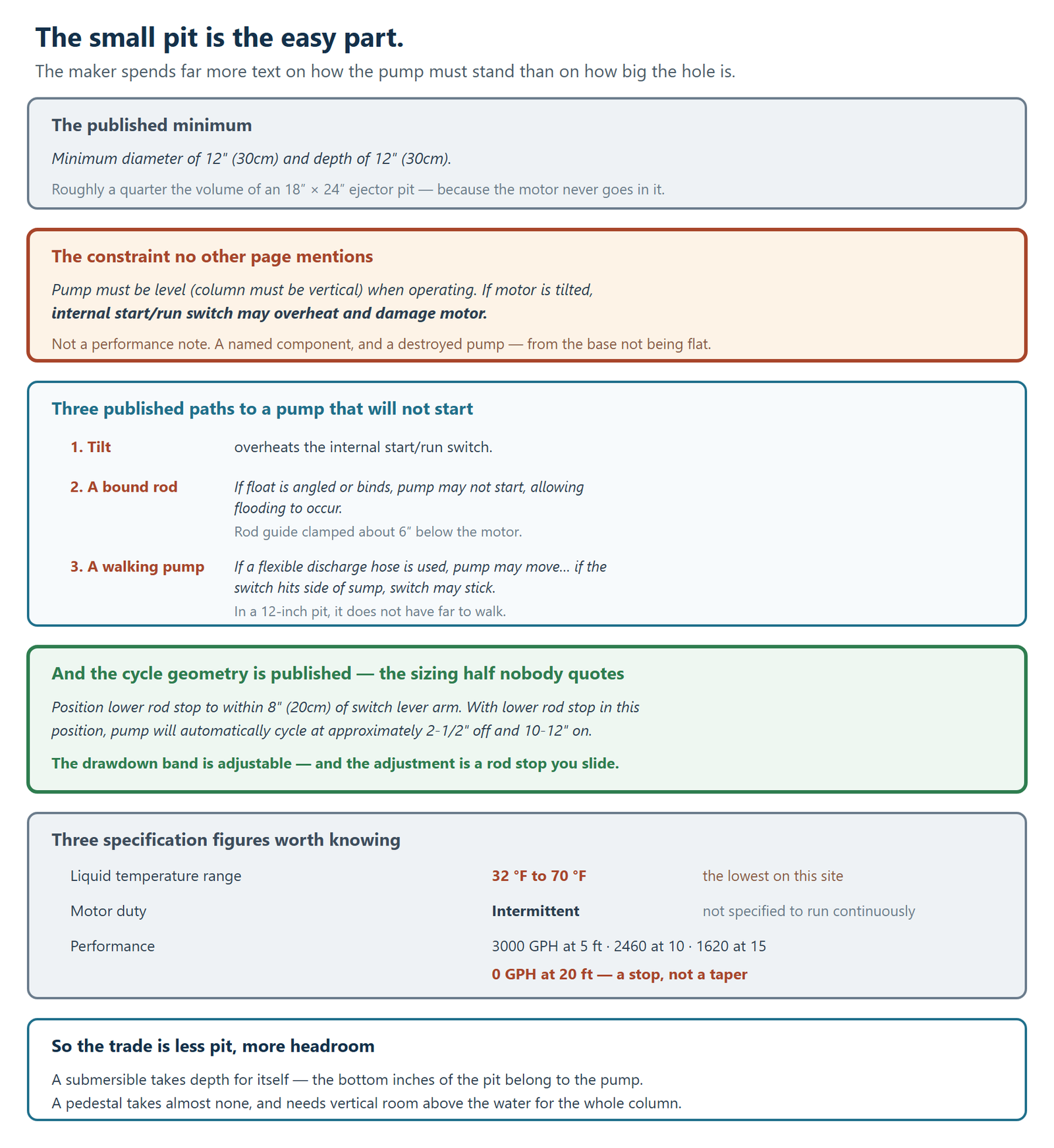
From the Myers MCSP3 pedestal pump owner’s manual, downloaded from the manufacturer’s own site. The installation section gives the pit first and then four constraints on how the pump stands in it.
One — it sits on the floor of the pit, not on the pipe:
“Install pump on solid, level foundation, as near as possible to center of sump pit. Do not hang pump from discharge pipe or power cord.“
Two — the column must be plumb:
“Pump must be level (column must be vertical) when operating. If motor is tilted, internal start/run switch may overheat and damage motor.“
Three — the float rod needs free travel:
“Locate Float Rod Guide about 6″ (16cm) below motor. Clamp guide to column with screw provided.”
“Risk of flooding. Be sure that guide is securely clamped so that float rod is vertical and can move up and down freely. If float is angled or binds, pump may not start, allowing flooding to occur.“
Four — and this one is in the safety section rather than the installation steps:
“Risk of flooding. If a flexible discharge hose is used, pump may move when motor starts. If it moves far enough so that switch hits side of sump, switch may stick and prevent pump from starting.”
Why “vertical” is the constraint that actually bites
Read constraint two again, because it is doing something unusual.
Most tilt warnings are about performance — the pump works a bit worse, the float sits a bit wrong. This one names a component and an outcome: the internal start/run switch may overheat and damage the motor.
That is a destroyed pump, from the pit not being flat.
And it is specific to this machine. A submersible lies in the water and is largely indifferent to a degree or two. A pedestal is a tall column with a heavy motor on top of it — tilt the base and you are levering the top of that column sideways, with a mechanical switch inside it.
Which makes the floor of the pit matter more than its diameter. The manual asks for a “solid, level foundation”, and separately rules out clay, earth and sand surfaces.
One-minute check, and it needs nothing but eyes: stand back and look at the column against the wall behind it. If it is visibly off plumb, that is the problem to fix before anything else — and it is usually the base, not the pump.
The three failure paths all end the same way
Worth noticing that constraints two, three and four are different mechanisms with one shared outcome: the pump does not start.
Tilt overheats the switch. A bound float rod means the switch never gets actuated. A pump that walks on a flexible hose puts the switch against the pit wall, where it sticks.
Three ways to arrive at a basement full of water with a pump that looks perfectly fine. The manufacturer labels two of them “Risk of flooding” in those words.
And the flexible hose one deserves a thought in a twelve-inch pit. The whole appeal of a pedestal is that it fits a narrow hole — but a narrow hole is also one where the pump does not have to travel far to meet the wall. The small pit and the walking hazard are the same fact seen twice.
A short length of rubber hose is the manual’s own remedy for noise and vibration, which is a genuine tension in the same document — so if you use one, securing the pump matters more, not less.
The cycle geometry, which is the sizing half
This is the part the rest of the internet omits entirely, and it is published:
“Position lower rod stop to within 8″ (20cm) of switch lever arm. With lower rod stop in this position, pump will automatically cycle at approximately 2-1/2″ (6cm) off and 10-12″ (25-30cm) on. For faster cycling, move lower rod stop closer to switch lever arm.”
So the drawdown band is adjustable, and the adjustment is a rod stop you slide.
That is a real difference from a submersible, where the on and off levels are set by a float’s tether length or a vertical switch’s travel. Pit depth for a submersible is a stack of layers, and the bottom seven inches belong to the pump. A pedestal takes almost none of that depth for itself — but it needs enough vertical room above the water for the column, the rod guide and the motor.
The trade is clear once you see both numbers: a pedestal needs less pit and more headroom.
Three specification figures worth knowing
From the same manual’s specifications table:
| Liquid temperature range | 32 °F to 70 °F |
| Motor duty | Intermittent |
| Performance | 3000 GPH at 5 ft · 2460 at 10 ft · 1620 at 15 ft · 0 at 20 ft |
Seventy degrees is the lowest maximum liquid temperature on this site, and by some distance. One sump manufacturer publishes 77 °F against the 130 °F quoted elsewhere — this one goes lower still. If anything warm drains into your pit, the figure to check is your own pump’s, and it may be lower than you assume.
“Intermittent” duty is a word worth noticing too. It is not a pump specified to run continuously, which bears on whether it suits a pit with constant inflow.
And zero gallons per hour at twenty feet is a stop, not a taper. Above that lift this model does not move water at all.
When this needs a pro
Forming or levelling the base of a pit. The manual rules out clay, earth and sand and asks for a solid level foundation, and that is concrete work in a hole.
Deciding whether a pedestal suits your pit at all. It needs less diameter and more height, and that trade is part of choosing the pump rather than installing it.
Anything electrical. The manual requires an individual branch circuit with a Class A GFCI.
And a pit you cannot get level. The pit, the pump, the discharge and the switch are one system, and a column that will not stand plumb is a pit problem with a pump consequence.
What you can do yourself: look at the column against a vertical reference, lift the float rod by hand through its full travel and feel for binding, and check the pump cannot rock or slide on its base. Three checks, no tools — and they cover all three of the manufacturer’s flooding paths.
FAQ
What size pit does a pedestal sump pump need?
This model’s manual publishes a minimum of 12 inches in diameter and 12 inches deep. That is one manufacturer’s figure for one model, so check your own — but it is substantially smaller than a submersible or ejector pit, because the motor stays out of the hole.
Does a pedestal sump pump have to be perfectly level?
The manufacturer says the pump must be level with the column vertical when operating, and that if the motor is tilted the internal start/run switch may overheat and damage the motor. It names a component and an outcome rather than just a performance effect.
Why won’t my pedestal pump start even though it looks fine?
Three published paths lead there: a tilted column overheating the switch, a float rod that is angled or binding so the switch is never actuated, or a pump that has walked on a flexible hose until the switch meets the side of the pit and sticks.
How do I change when a pedestal pump turns on and off?
By moving the lower rod stop. The manual says positioning it within 8 inches of the switch lever arm gives roughly 2-1/2 inches off and 10 to 12 inches on, and moving it closer to the lever arm cycles the pump faster.
What water temperature can a pedestal pump handle?
This model publishes a liquid temperature range of 32 °F to 70 °F — the lowest maximum recorded anywhere on this site. Other pumps publish 77 °F and 130 °F, so the figure is very much per-model.
Can a pedestal pump hang from the discharge pipe?
No. The manual says plainly not to hang the pump from the discharge pipe or the power cord, and to install it on a solid, level foundation as near as possible to the centre of the pit.