On this page
Last Updated on October 1, 2026 by Muhammad Toqeer
If you are buying one to stop a bang, buy a spring. Two quite different valves are sold under the word “quiet”, and only the spring-loaded kind prevents the thing that makes the noise.
The other kind uses an angled seat. It shortens the distance the flapper travels, which reduces the slam without preventing it. Quieter rather than quiet — and nothing on the box tells you which one you have picked up.
The two mechanisms, in the manufacturers’ own words
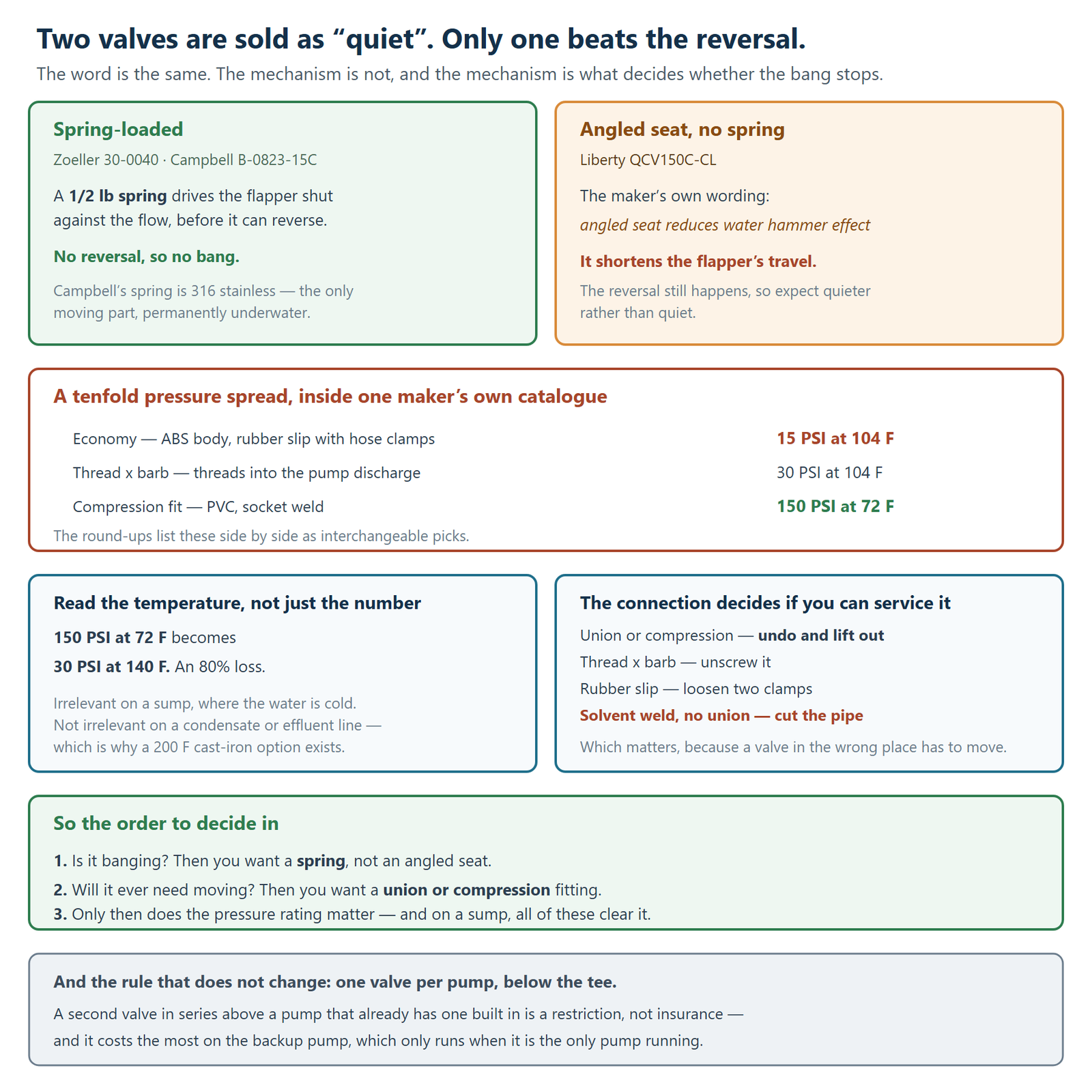
The spring kind. Zoeller and Campbell both publish a ½ lb spring, and it does not cushion anything. It drives the flapper shut against the flow, while water is still moving forward, so the reversal that causes the noise never starts.
The mechanism is covered properly in its own article — the short version is that the bang is a moving column of water being stopped, and a spring valve is already closed before there is anything moving backwards to stop.
The angled seat kind. Liberty’s quiet check valve has no spring at all. Its own product page gives the mechanism in five words:
“Angled seat reduces ‘water hammer’ effect”
Reduces, not prevents. A shorter flapper travel means less time for the reversal to build, so there is less energy in the slam — but the reversal still happens.
Both are honest products. Only one of them is the answer to “my sump pump bangs.”
The eight worth knowing
Zoeller 30-0040 Quiet Check — the one to buy for a banging pump
Zoeller 30-0040 — 1½ inch PVC, ½ lb spring, 50 PSI (115 feet of head), solvent-weld ends with unions, full-flow non-clog design, fits horizontally or vertically. Zoeller says to consult the factory for use above 130°F.
Who it is for: anyone whose pump bangs once as it shuts off. This is the default answer on this page.
The honest drawback: solvent-weld ends mean committing to the position. The unions are what save you — without them this would be a valve you could never move, which matters more than it sounds.
Campbell B-0823-15C — the same mechanism, in a clear body
Campbell B-0823-15C — 1½ inch, ½ lb spring in 316 stainless, clear see-through body, full flow, 100 GPM, 150 PSI at 72°F, horizontal or vertical.
Who it is for: the same banging pump, plus anyone who wants to see the flapper working without taking anything apart.
The 316 stainless spring is the detail worth noticing. The spring is the only moving part in the valve and it sits permanently underwater; the grade of steel it is made from is not a marketing line.
The honest drawback: a clear body shows you the flapper and it also shows you everything else. On a pit with iron ochre in it, that window will not stay clear — which is cosmetic, but it is the feature you paid for.
Liberty QCV150C-CL Clear Quiet — quieter, by a different route
Liberty QCV150C-CL — 1½ inch (2 inch as QCV200C-CL), heavy-duty clear PVC, compression-style connection, 150 PSI at 72°F, full port design which Liberty describes as giving “less friction and easier pumping”, vertical or horizontal.
Who it is for: a new installation where noise is a consideration rather than a complaint, and where the compression connection is worth having.
The honest drawback, and it is the point of this page: there is no spring. If you are buying this specifically to stop an existing bang, you have bought the other mechanism.
Zoeller 30-0181 — the plain union check valve
Zoeller 30-0181 — PVC, slip × slip, full-flow union design, 1¼ or 1½ inch, horizontal or vertical.
Who it is for: a straightforward replacement where the existing valve is fine in principle and simply worn out, and noise is not the complaint.
The honest drawback: no spring and no angled-seat claim, so expect a standard valve’s behaviour on shutdown. One reseller lists this at “4.3 PSI” — that figure appears nowhere in Zoeller’s own material and is not used on this page.
Liberty CV2N1C — the compression workhorse
Liberty CV2N1C — heavy-duty PVC, socket weld with compression fit, a 1¼ and 1½ inch combo body, 150 PSI at 72°F / 30 PSI at 140°F, vertical or horizontal.
Who it is for: installations where the pipe size is not settled, since the combo body covers both.
The honest drawback: nothing here addresses noise. It is a well-made ordinary check valve.
Liberty BCV150 — ball valve and check valve in one body
Liberty BCV150 — ball/check combination, heavy-duty PVC, 150 PSI at 72°F, union for disassembly, which Liberty describes as a “compact design”.
Who it is for: anyone who wants to be able to isolate the pump without draining the discharge line. On a pit with two pumps that is a genuinely useful thing to have.
The honest drawback: two functions in one body means replacing both when either fails, and it is more to go wrong in the one part of the system you cannot see.
Liberty HCV150 — cast iron, for water that is not cold
Liberty HCV150 — heavy-duty cast iron body, high-temperature rubber flapper rated 200°F, 125 PSI, female NPT connections, full flow. Also 2 inch (HCV200) and 3 inch (HCV300).
Who it is for: not a sump. It is here because it explains the temperature column on every other row — this exists because PVC valves lose most of their rating when the liquid is hot.
The honest drawback: cast iron in a permanently wet pit is a corrosion question, and for cold groundwater you are paying for a capability you will never use.
Liberty CV150 and CV2N1 Economy — what the bottom of the range actually is
Liberty CV150 — ABS valve body, rubber slip connections with hose clamps, vertical or horizontal, 15 PSI rated at 104°F.
Who it is for: a temporary arrangement, or a utility pump discharge that gets set up and taken down.
The honest drawback: fifteen PSI. That is one tenth of the compression valve above it in the same catalogue. It still clears what a normal sump discharge asks, but the margin is gone and the body is ABS held on with hose clamps.
Side by side
| Valve | Quiet mechanism | Rating | Connection |
|---|---|---|---|
| Zoeller 30-0040 | ½ lb spring | 50 PSI / 115 ft | Solvent weld with unions |
| Campbell B-0823-15C | ½ lb spring, 316 SS | 150 PSI at 72°F | Clear body, full flow |
| Liberty QCV150C-CL | Angled seat, no spring | 150 PSI at 72°F | Compression |
| Zoeller 30-0181 | — | — | Slip × slip, union |
| Liberty CV2N1C | — | 150 PSI at 72°F / 30 at 140°F | Compression, socket weld |
| Liberty BCV150 | — | 150 PSI at 72°F | Union, with ball valve |
| Liberty HCV150 | — | 125 PSI, flapper to 200°F | Female NPT, cast iron |
| Liberty CV150 Economy | — | 15 PSI at 104°F | Rubber slip, hose clamps |
A dash means the manufacturer makes no claim in that column. Nothing here is borrowed from a reseller.
Read the temperature, not just the number
Every pressure rating on this page is quoted at a temperature, and it collapses when the liquid is hot.
The same Liberty compression valve is 150 PSI at 72°F and 30 PSI at 140°F — an 80% loss across a range a hot-water line passes through easily.
On a sump this does not matter, because groundwater is cold and the discharge is short. It matters the moment the same valve is used somewhere else, which is why a 200°F cast-iron option exists at all.
The round-ups quote the 72°F figure on its own. Now you know which number you are reading.
The spec that decides whether you can ever change it
Buy the connection, not just the valve.
- Union or compression — undo the union and lift the valve out
- Thread × barb — unscrew it from the pump discharge
- Rubber slip with hose clamps — loosen two clamps
- Solvent weld with no union — cut the pipe
This matters more on a check valve than on most parts, because where the valve sits decides whether the arrangement works at all. A reader who discovers their single valve is above the tee has to move it, and the fitting decides whether that is an afternoon or a repipe.
How to choose, in order
1. Is it banging? Then you want a spring, not an angled seat. That one question eliminates half this page.
2. Might it ever need moving? Then you want a union or a compression fitting, and you want it regardless of anything else.
3. Only then does the pressure rating matter — and for a sump discharge, every valve on this page clears it comfortably, including the 15 PSI one.
And one thing that does not change with the model: one valve per pump, fitted below the point where two discharge lines meet. A second valve in series above a pump that already has one built in is a restriction rather than insurance.
When this needs a pro
The pipework. Fitting or moving a check valve means cutting into the line that keeps water out of the basement, on a pipe with standing water in it.
Anything where the existing valve is solvent-welded without a union, because that is no longer a swap.
A pit you cannot see into properly. The cover should be gas-tight and fastened down, so a proper look is a job in itself.
What you can do yourself: find the valve, look for a union collar or compression nut, and note whether the arrow points away from the pump. Three observations, no tools — and they tell you which row of the table above you are shopping in.
And if the pump is cycling rather than banging, a failed check valve returning its own water is the first thing to rule out — that is a different fault with a different test, and replacing the valve blind will not confirm it.
FAQ
What is the best check valve for a noisy sump pump?
A spring-loaded one. Zoeller’s 30-0040 and Campbell’s B-0823-15C both use a ½ lb spring that closes the flapper against the flow before it can reverse, and the reversal is what makes the bang.
Are all silent check valves the same?
No, and this is the trap. Some use a spring that closes against the flow; Liberty’s quiet check valve instead uses an angled seat that shortens the flapper’s travel. The second reduces the noise rather than preventing it.
Does a sump pump check valve need a union?
Not to function, but it decides whether you can ever service or reposition it. A solvent-welded valve with no union has to be cut out, and valve position is the thing that most often needs correcting on a two-pump pit.
What PSI check valve do I need for a sump pump?
Far less than any of these provide. Every valve here clears a normal sump discharge, including the 15 PSI economy model. Pressure rating is the last thing to decide on, not the first.
Why do check valve pressure ratings list a temperature?
Because the rating falls as the liquid gets hotter. The same PVC compression valve is 150 PSI at 72°F and 30 PSI at 140°F. For cold groundwater the 72°F figure applies; for anything warm it does not.
Can I use a cast iron check valve on a sump pump?
You can, but it is built for a problem a sump does not have — its high-temperature flapper is rated to 200°F, and groundwater is cold. You would be paying for heat capability and accepting cast iron in a permanently wet pit.


