On this page
Last Updated on October 11, 2026 by umar bwn
Add Wayne’s 26-hour claim to Watchdog’s 48-hour claim and you’d expect a shared battery to run both pumps longer than either one alone. It does roughly the opposite. A sump pump and an ejector pump on one battery backup don’t split those hours evenly, because neither published number was ever calculated with a second pump wired onto the same bank — and the two pumps fail that shared budget in different ways, at different moments, for reasons that have nothing to do with how many amp-hours the battery holds.
There’s no off-the-shelf product that does this. Wayne, Watchdog/Glentronics and Liberty all sell a battery married to one pit and one pump. Wiring a sewage or effluent ejector pump onto a sump’s backup battery means improvising outside any single maker’s tested design, which is exactly why nothing on a spec sheet answers this directly. Here’s what actually breaks, in the order it actually bites.
The wrong math everyone reaches for first
The instinct is to treat the battery’s rated hours as a budget you can split. Wayne states its 26-hour figure against a defined inflow rate on a 75 Ah battery; Watchdog states its 48-hour figure against a defined duty cycle on a 100 Ah battery — both numbers this site has already verified, and both scoped to exactly one pump. Neither manufacturer modeled a second load sitting on that same bank. Adding a sewage ejector doesn’t shave those hours down proportionally to some smaller, still-trustworthy number. It voids the figure outright, because the test that produced it never included the load you’re now asking the battery to carry.
This is the same trap as sizing a sump’s own backup, just compounded: what size battery for a backup sump pump already makes the point that a runtime claim belongs to a specific pairing of pump and battery, not to the battery alone. Bolt on a pump the pairing never accounted for and you’re off that chart entirely, not just further down it.
Check this before you wire anything: pull up your backup unit’s own spec sheet or manual and look for the word “pump” next to the runtime figure — singular. If the hours are quoted “with pump” rather than per amp-hour, that number describes a tested pair, and it stops meaning anything the moment a second motor shares the terminals.
Why a sump pump and ejector pump on one battery backup drain it differently
Even setting the hour math aside, a sump pump and an ejector pump stress a shared battery in opposite ways, and that’s the part a simple hours-added-up view misses completely.
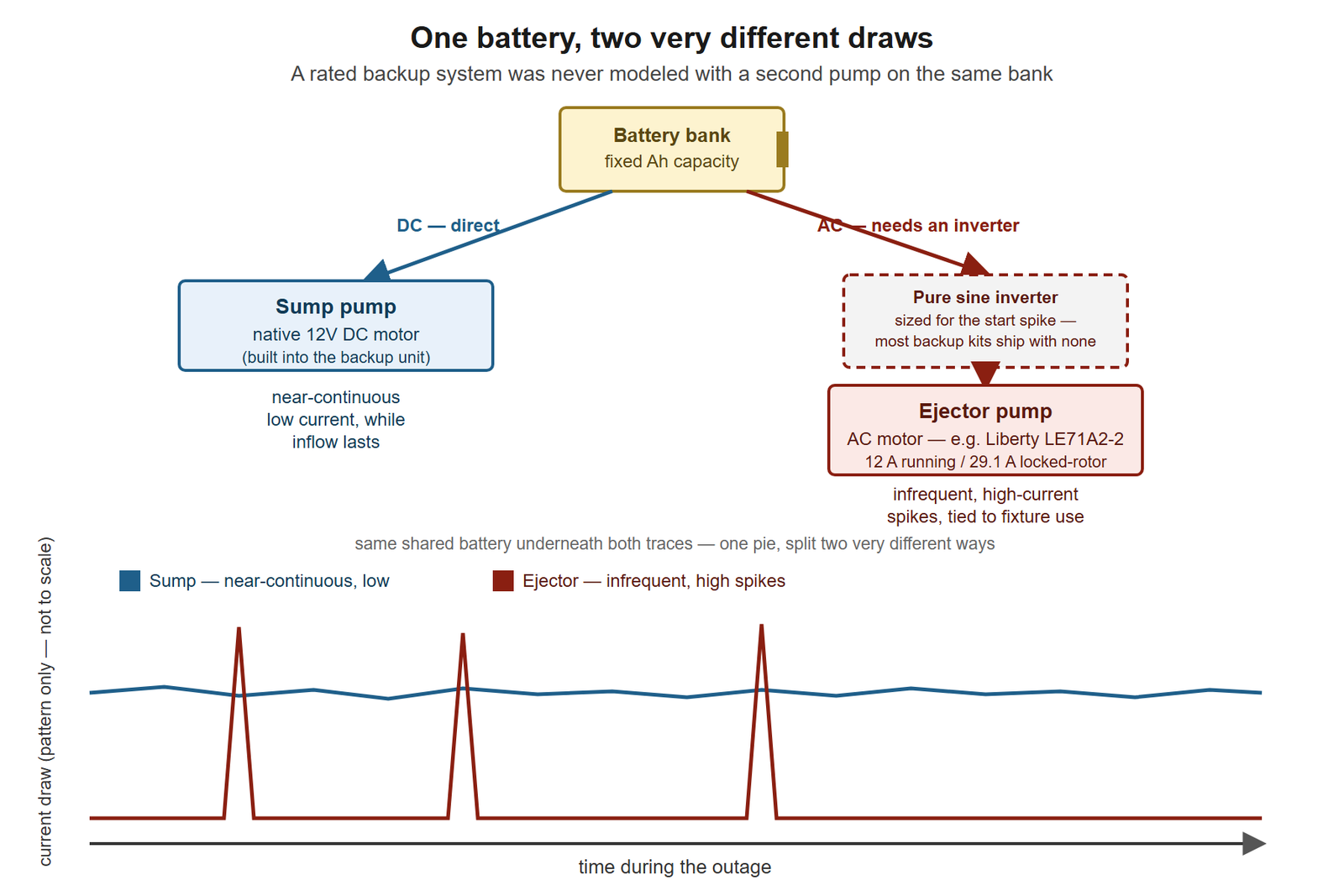
A sump pump’s draw during an outage is small but close to continuous — it cycles on and off for as long as groundwater keeps arriving, which during a real storm can mean running for most of the outage. That failure mode is slow: the battery drains gradually over hours, and you generally see it coming on a voltage or charge-level indicator before the pump actually quits.
An ejector or sewage pump’s draw is the opposite shape. It sits idle between uses and then pulls a large current for a short burst the instant someone flushes a toilet or runs a load of laundry into the basin. A Liberty LE71A2-2 — a 2-horsepower-class sewage pump already documented on this site — draws about 12 amps running but spikes to roughly 29.1 amps locked-rotor the instant it starts. That’s not a gradual drain. It’s a voltage sag that happens at one specific moment, and if the sump pump also happens to be mid-cycle when it lands, the two loads are asking the battery for their peaks at the same time.
So “will the shared battery keep up” isn’t one question. It’s two separate stress tests — a marathon and a sprint — stacked on the same fixed capacity.
Check this before you wire anything: during your next storm, time how long the sump actually runs per hour with a stopwatch or a plug-in cycle counter. Then think honestly about how often someone in the house actually flushes or runs water during a multi-hour outage. If both numbers are more than occasional, you’re not looking at a battery-capacity question — you’re looking at two loads that are statistically likely to overlap.
Where a Liberty ejector pump’s 12 running amps actually have to come from
This is the part that gets skipped, and it’s bigger than battery capacity.
A battery backup sump pump isn’t the same motor as your primary pump running off an inverter — it’s typically a dedicated low-voltage DC pump, built into the backup unit and wired straight to a 12-volt deep-cycle battery through a charger/controller. The battery never has to produce anything but DC. That’s a large part of why these systems are reliable: fewer conversion steps, nothing to fail between the battery and the motor.
A sewage ejector pump is a standard AC motor, built for a 115- or 230-volt branch circuit — the same category of motor whose locked-rotor spikes are also the reason a grinder pump trips its breaker under completely normal starting conditions, long before anyone adds a battery into the picture. Putting that motor on battery power at all means routing the battery through a pure sine inverter, and that inverter has to be sized for the locked-rotor spike — the 29.1 amps the LE71A2-2 demands for an instant at start, not the 12 amps it settles to once running. Most backup sump kits don’t include an inverter output of any kind; the whole unit is built around one DC pump and nothing else.
Practically, that means “sharing the battery” is rarely just a wiring question. It’s retrofitting an inverter sized for a sewage pump’s starting surge onto a system that was designed to never need one, which is a materially bigger job than running a second set of leads to the same terminals.
Check this before you wire anything: look at the pump head on your backup system. If it’s wired with two bare leads straight to the battery terminals and has no AC cord or plug anywhere on it, it’s DC-only — there’s no existing path for an AC ejector pump to draw from that battery without new equipment between them.
New wiring, new equipment — that part isn’t a DIY afternoon
Sizing and installing an inverter for a 29-amp starting spike, then running a correctly rated, dedicated circuit from it to a sewage pump sitting over a basin that can hold sewage gas, is mains-voltage electrical work next to standing water — not a battery swap. A licensed electrician can confirm the inverter is actually rated for the motor’s locked-rotor draw rather than just its running amps — 29.1 against 12, nearly two and a half times apart — and can make sure the circuit is installed and protected the way your local code requires rather than spliced onto whatever leads happened to be closest. Get the inverter sizing wrong and the symptom isn’t a slightly shorter runtime — it’s the ejector pump failing to start at all during the one event it exists for.
Two separate backups beat one shared bank
Given the math and the wiring both work against it, the straightforward answer is to stop trying to make one battery do both jobs. Size the sump’s backup for the sump alone — the method for that is the same one-pump-at-a-time approach what size battery for a backup sump pump already lays out — and decide separately how the ejector pump gets covered.
For the ejector side, a generator is usually the more direct answer than a battery. It sidesteps the DC-to-AC conversion question entirely: size it to the pump’s locked-rotor draw the same way running a sump pump on a generator sizes for a sump motor, and the generator can carry both pumps’ starting surges without an inverter in between at all. If you’re shopping for the sump’s own backup unit regardless of what you decide for the ejector, our guide to the best battery backup sump pumps covers which units’ published runtime claims are actually trustworthy for a single pump — the only configuration any of them were built and tested for.


