On this page
Last Updated on September 26, 2026 by Muhammad Toqeer
Temporarily yes, permanently it depends on the pump — and one manufacturer answers it directly. Superior prints the condition on its own product page: the pump “can be used as a sump pump by adding an optional float switch.”
That is the whole answer in miniature. It needs a switch it does not come with, and then it needs a duty rating that survives the job. Two of the three pumps checked below fail the second test on their own published limits.
What changes the moment it goes in a pit
Here is the part nobody writing about this mentions, and it matters because it invalidates the way you probably shopped for the pump.
Utility pumps are compared on drain-down depth — how close to dry they finish. It is the whole basis of ranking submersible utility pumps, and the spread runs from 1/16 of an inch to a full inch depending on the intake screen.
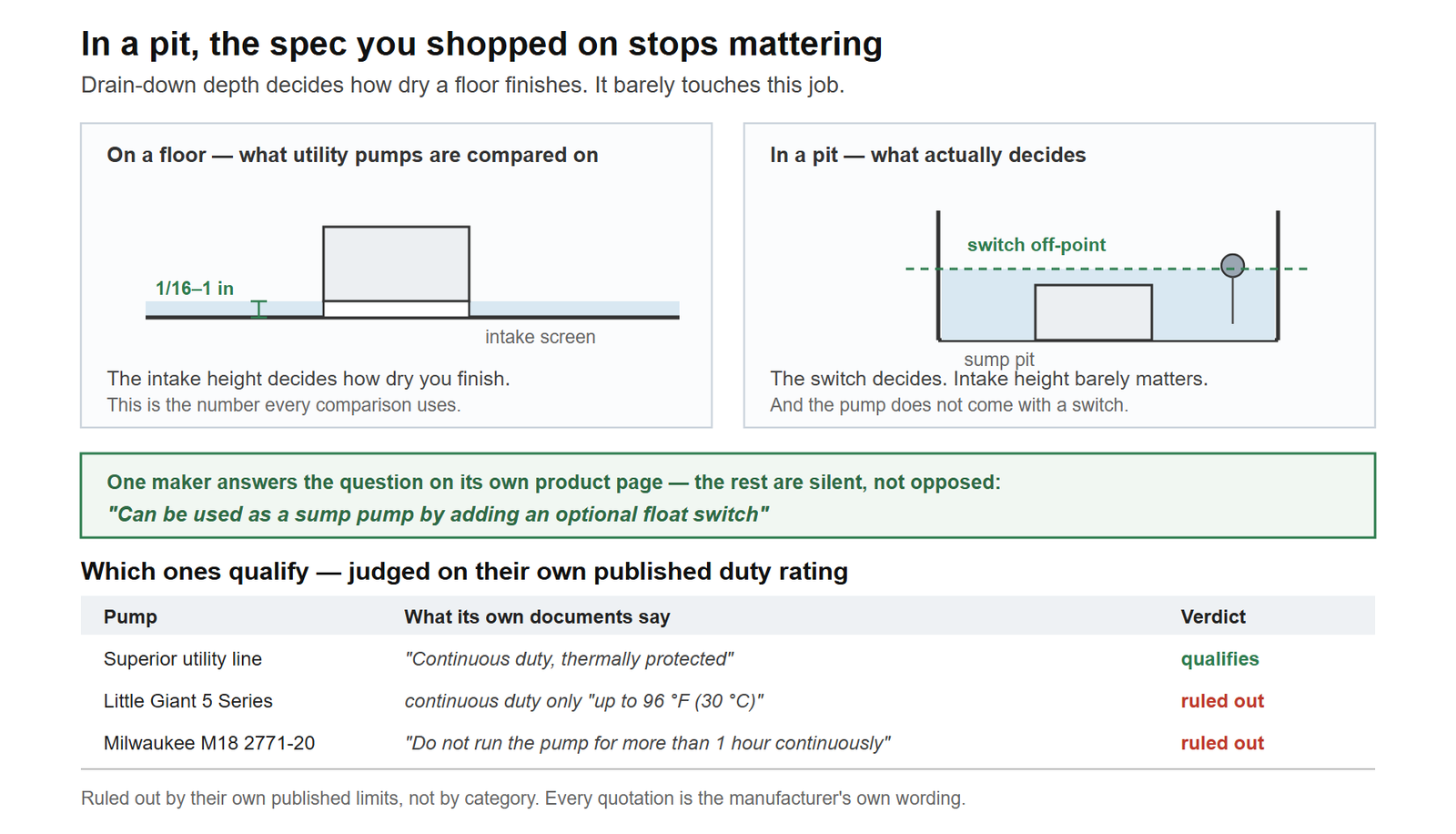
In a pit, that number is close to irrelevant. The pump is not chasing the last sixteenth of an inch off a floor. A float switch turns it off at a set level, and that level sits well above the intake. The switch decides how low the water goes, not the pump.
So the specification you compared on does not transfer, and the specifications that do decide it are ones most people never looked at.
The condition, in the manufacturer’s words
Superior’s 91250 page says it plainly:
“Can be used as a sump pump by adding an optional float switch”
Two things worth taking from that. The first is that it is permission — a manufacturer sanctioning the use, which is more than the internet’s usual “well, sort of”. The second is the condition: a float switch, sold separately.
Every other maker checked this session is silent on the question rather than opposed. None found forbids it. That is an absence of guidance, not a prohibition, and it is worth saying plainly rather than reading either way.
Which pumps actually qualify
Judge it on the duty rating, because a sump pump works unattended for years and a utility pump is a tool you stand next to. All three of these publish theirs:
| Pump | What its own documents say | Verdict |
|---|---|---|
| Superior utility line (incl. 91250) | “Continuous duty, thermally protected – split capacitor motor” | Qualifies |
| Little Giant 5 Series | Certified continuous duty only “up to 96 °F (30 °C)” | Ruled out |
| Milwaukee M18 2771-20 | “Do not run the pump for more than 1 hour continuously”, and “Do not allow this pump to operate unattended” | Ruled out |
Both exclusions come from the makers’ own documents, not from the category. The Milwaukee is a fine pump that explicitly forbids the one thing this job requires. The Little Giant’s ceiling is a temperature rather than a time, which is generous for a cold pit and a problem elsewhere.
The Superior also happens to have the rest of the shape right: 1/8 inch solids for the grit a pit collects, and a 1-1/4 inch discharge that matches ordinary sump plumbing. A 3/4 inch garden-hose pump does not, whatever its duty rating says.
When it is genuinely the right move
Worth being fair about, because the honest answer is not “never”.
As a temporary or backup pump, dropping one in a pit is sensible. If the installed pump has failed, if the pit is filling faster than it can clear, or if you are waiting on a permanent replacement, a portable pump in the pit is doing exactly what a portable pump is for. That is a real use and it needs no float switch — you are standing there.
As a permanent installation it is a different proposition, and the switch is only the first thing missing.
What you still do not have
A sump pump is not just a pump with a switch. Fitting one out properly means:
- A check valve on the discharge, so the column of water in the pipe does not run back into the pit every time the pump stops and trigger it again.
- Cord and receptacle arrangement that works — the 91250 ships with a 10 foot cord, and in a piggyback-switch setup the pump plugs into the switch, which plugs into the outlet.
- Somewhere legal and sensible for the water to go, which is its own decision — where the far end of the discharge lands matters more than most people expect.
- A pump that can tolerate what is in the pit. Grit is what a pit collects, and grit in an impeller is the noise that tells you something is wrong.
And the duty question does not go away once it is installed. A pump cycling hard in a wet season is doing the thing that makes a thermal protector trip, and the manufacturers’ limits above are why the rating matters more than the horsepower.
When this needs a pro
A permanently installed sump pump is a building system, not an appliance. Discharge routing, backflow, and what is permitted where you live are decisions with local rules attached, and this site is not going to guess at them for your jurisdiction.
If the pit is protecting a finished basement, the consequence of the arrangement failing is not a wet floor. Get the design looked at rather than assembled from parts.
If the existing sump pump has failed and water is rising now, use the portable pump, and treat that as the emergency measure it is rather than the fix.
And if there is no pit at all but water keeps arriving, the pump is the last question to ask — the utility and transfer pumps guide sets out what these tools are and are not for.
FAQ
Can a utility pump be used as a sump pump?
Superior says yes for its own pumps, with one condition: “Can be used as a sump pump by adding an optional float switch.” Other makers are silent rather than opposed. Whether a specific pump suits the job comes down to its published duty rating, not to the word “utility”.
What does a utility pump need to work as a sump pump?
A float switch it does not come with, a duty rating that permits unattended running, a discharge size that matches the plumbing, and a check valve so the discharge does not drain back into the pit and restart it.
Why doesn’t drain-down depth matter in a sump pit?
Because the float switch’s off-point sets the water level, and it sits well above the pump’s intake. Drain-down decides how dry a floor finishes; in a pit the switch decides, so the specification most utility-pump comparisons rest on stops applying.
Can I use my cordless transfer pump in a sump pit?
Not for unattended duty. Milwaukee’s M18 manual caps continuous running at one hour and says “Do not allow this pump to operate unattended” — which rules out exactly the job a sump pump does.
Is it alright to put a utility pump in the pit temporarily?
Yes, and it is a sensible thing to do if the installed pump has failed or the pit is overwhelmed. You are present, so the missing switch does not matter. It is the permanent version that needs the rest of the arrangement.


