On this page
Last Updated on September 30, 2026 by Muhammad Toqeer
Switch the pump off during heavy rain, let the water rise, and count the inches in one minute. In an 18-inch pit each inch is about 1.1 gallons, so six inches a minute is 6.6 gallons a minute arriving.
Double it for the water still coming in while the pump runs, and you have your number. It takes a minute and no tools — and it is the only figure on this subject that describes your house rather than an average of everyone’s.
The fill test
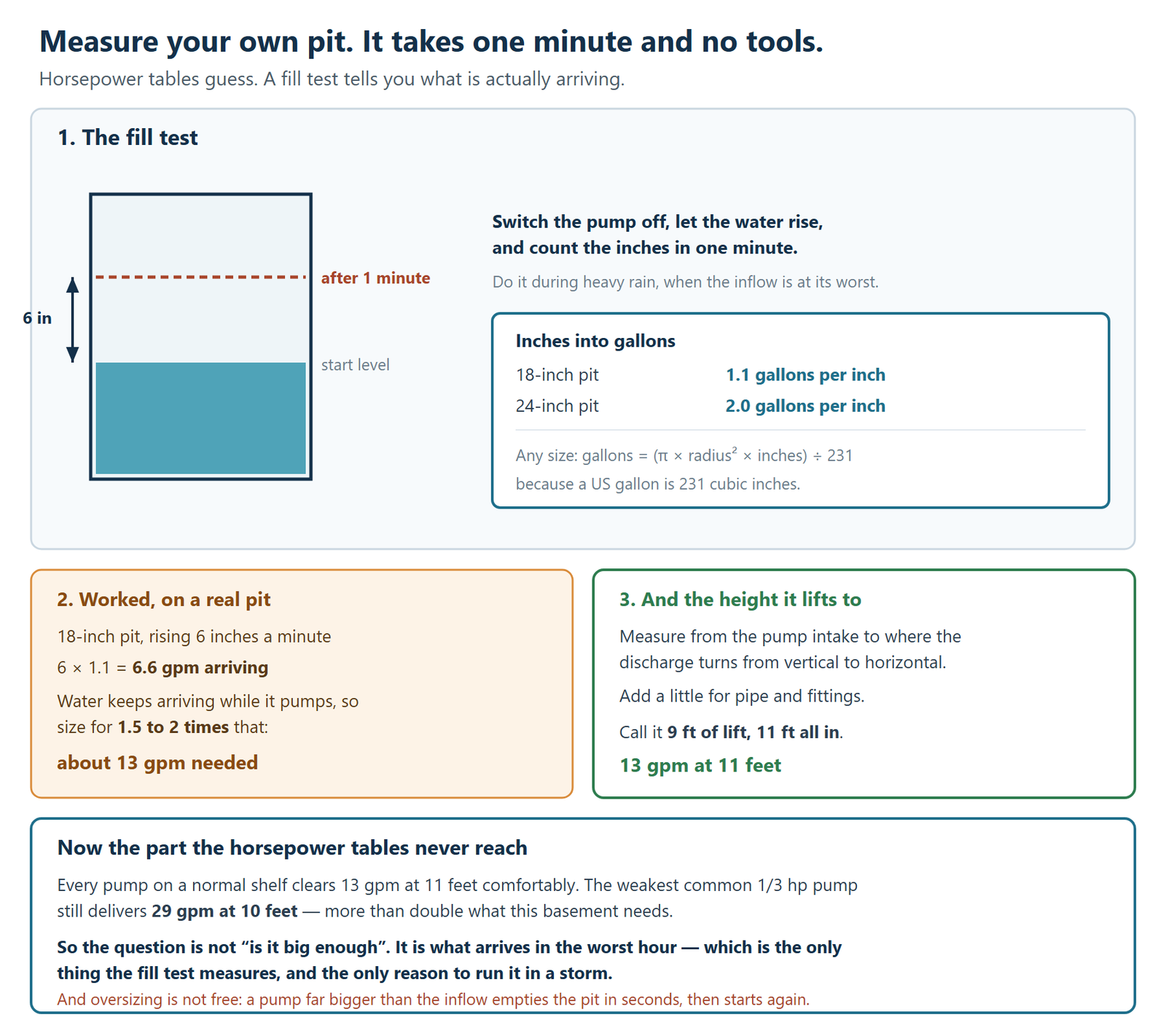
Do it in a storm. A dry-week reading tells you nothing about the hour that matters.
Switch the pump off — at the breaker, or at the plug if you can reach it without leaning over the pit. Mark the water level, wait a minute, and mark it again.
Then convert the rise into gallons:
| Pit diameter | Gallons per inch of depth |
|---|---|
| 18 inches | 1.1 |
| 24 inches | 2.0 |
Any other size: gallons = (π × radius² × inches) ÷ 231, because a US gallon is 231 cubic inches.
Inches per minute × gallons per inch = your inflow in gallons per minute.
Then plug the pump back in. This is not a test to start and walk away from — the pit is filling the whole time you are measuring it.
Add the margin
The pump does not get an empty pit to work on. Water keeps arriving while it runs, so the pump has to clear the standing water and keep up with the inflow at the same time.
Size for 1.5 to 2 times the measured figure. On 6.6 gallons a minute, that is about 13 gpm.
Then the height
Flow means nothing without the lift it was measured at. Two pumps with the same nameplate can differ by more than double at fifteen feet, so this is the number that makes the flow figure usable.
Measure from the pump intake to where the discharge turns from vertical to horizontal. That is the static lift.
Then add a little for the pipe and fittings. Friction is real, and on a long run or a small-diameter pipe it is worth getting properly from a friction chart or a supplier. On a short basement run with a couple of elbows, adding a foot or two is a reasonable allowance and honest about what it is.
Nine feet of lift and a short run lands around 11 feet all in.
So the requirement is roughly 13 gpm at 11 feet — one flow figure, at one stated height.
The part the horsepower tables never reach
Now look at what that requirement actually asks for.
Every common residential sump pump clears it comfortably. The weakest 1/3 hp pump in ordinary circulation still delivers 29 gpm at ten feet — more than double what this basement needs.
So for most houses the sizing question is not “is the pump big enough.” It is what arrives in the worst hour, and the fill test in a storm is the only thing that answers it. A pit that rises six inches a minute in ordinary rain may rise twenty in a downpour, and that is the number the pump has to survive.
And bigger is not automatically safer
A pump far larger than the inflow empties the pit in seconds and then starts again a minute later. That is short cycling, and starts are what wear a pump out — every one draws high current and heats the motor.
Oversizing trades a problem you do not have for one you will.
If the fill test gives a strange answer
A pit filling fast when it has not rained is not a sizing problem. Something is feeding it — most often the discharge line returning its own water — and a bigger pump will simply run that loop faster.
Measure first, and only then buy. A sizing figure taken during a dry spell from a pit with a recirculation problem will send you to entirely the wrong shelf.
What this does not decide
The switch type, which depends on the pit’s diameter and shape more than its flow.
Whether you need a backup, which is a question about consequence rather than capacity.
The discharge pipe size, which the pillar covers alongside what the pit is for.
When this needs a pro
A pit that cannot keep up even with a correctly sized pump. That is a drainage and waterproofing question, and a larger pump is treating a symptom.
Any long or complicated discharge run, where friction stops being a rounding allowance and becomes a calculation.
Electrical work, including switching the pump off at the breaker if you are not certain which one it is.
What you can do yourself: run the fill test in the next storm, write down the inches and the pit diameter, and measure the lift. Three numbers, and they turn a guess into a specification.
FAQ
What size sump pump do I need?
Measure the inflow with a fill test rather than guessing from the basement size. Count the inches the water rises in one minute with the pump off, convert to gallons using your pit diameter, then size for one and a half to two times that figure at your measured lift.
How do I calculate sump pit inflow?
Inches of rise per minute multiplied by the gallons per inch of your pit. An 18-inch pit holds about 1.1 gallons per inch and a 24-inch pit about 2.0. For any size, gallons equal pi times the radius squared times the inches, divided by 231.
Should I get a 1/3 hp or 1/2 hp sump pump?
Horsepower is the wrong index. Two 1/3 hp pumps can differ by more than double at fifteen feet, and a 3/10 hp pump can outperform a 1/3 hp one at working height. Compare published flow at your measured lift instead.
Is a bigger sump pump always better?
No. A pump far larger than the inflow empties the pit in seconds and restarts shortly after, which is short cycling. Starts are what wear a pump out, so oversizing creates a new problem rather than removing one.
How much head does a sump pump need?
Measure from the pump intake to where the discharge turns from vertical to horizontal, then add an allowance for pipe and fittings. A typical basement lands somewhere around ten to twelve feet all in.
When should I do the fill test?
During heavy rain, because that is when the inflow is at its worst and the worst case is what the pump has to survive. A reading taken in a dry week describes a situation the pump was never going to struggle with.


