On this page
- The two sensors, and what each one buys you
- The horn is the spec nobody shops on
- Latching or auto-resetting — opposite behaviours, same manufacturer
- The six worth knowing
- Side by side
- The float in the box is a control switch, and that is correct
- The thing to check in words, not in a voltage
- How to choose, in order
- When this needs a pro
- FAQ
Last Updated on October 2, 2026 by Muhammad Toqeer
Decide which moment you want to be told about. A float hung in the pit reports that the level is high — the water is still in the pit, and you have however long it takes to overflow. A probe or puck on the floor reports that water is already on the floor, which means the pit has already lost.
Both are sold as “high water alarms”, and one manufacturer sells both in the same accessory range. They are not competing products. They warn at different moments, and most people only find that out afterwards.
Then check the horn. Every maker publishes it with a distance attached, and the whole category sits between 82 and 88 dB at 10 feet — which is the spec that decides whether anything happens at three in the morning.
The two sensors, and what each one buys you
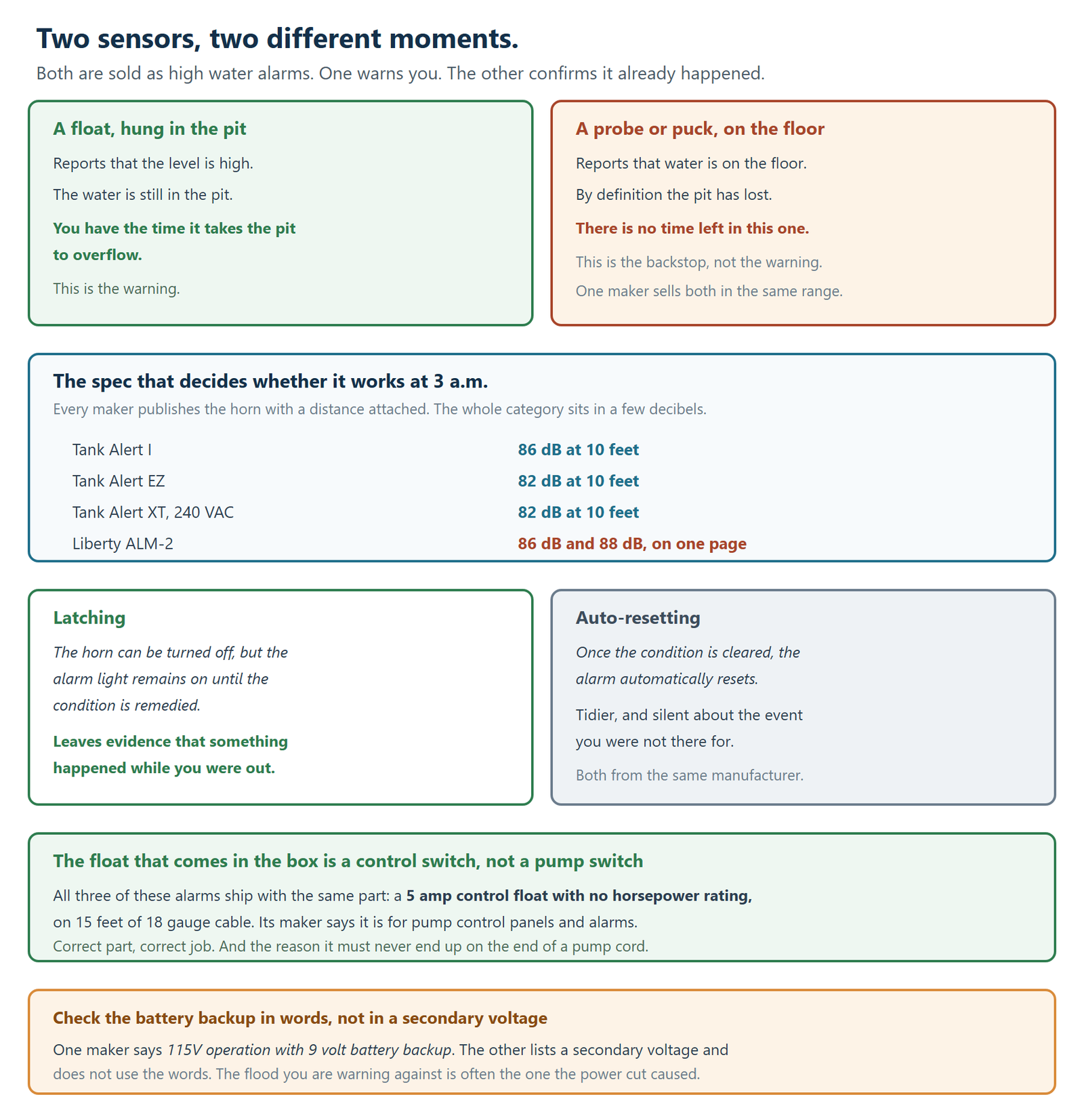
A float in the pit is the warning. It sits above the level your pump normally works between, so it only moves when the pump has stopped keeping up — which is a distinct problem from the pump not running at all. The water is contained while it sounds.
A probe or puck on the floor is the backstop. It cannot tell you anything until the water is outside the pit, at which point the alarm is reporting a flood rather than preventing one.
Neither is wrong. The float is what you want if you are buying one thing. The puck is what you add if the finished basement is worth a second line of defence, or if the risk is a washing machine hose as much as the pump.
One-minute decision: ask what you would do if it went off while you were home. If the answer is “go down and look at the pit”, buy the float. If the answer is “there is nothing I could do anyway, I just want to know”, the floor sensor is honest about that.
The horn is the spec nobody shops on
Every manufacturer page read publishes the decibel figure with a measuring distance, which is unusual and useful:
| Alarm | Published horn |
|---|---|
| SJE Tank Alert I | 86 dB at 10 feet |
| SJE Tank Alert EZ | 82 dB at 10 feet |
| SJE Tank Alert XT (240 VAC) | 82 dB at 10 feet |
| Liberty ALM-2 | 86 dB and 88 dB — both on the same page |
Ten feet is roughly the far side of the same room. Now put a closed door, a floor, and a staircase between that and a bedroom.
The whole category is within about six decibels, so the horn is not really a way to choose between these products — it is a reason to think about where the alarm goes and whether a horn alone is the right output. That is what the auxiliary contacts and the remote-notification models exist for.
On the Liberty figure: its own product page carries both 86 and 88 dB. Neither is quoted here as the rating, because the manufacturer has published two. The honest statement is that it sits in the mid-to-high 80s like everything else in the category, and the discrepancy does not change any decision.
Latching or auto-resetting — opposite behaviours, same manufacturer
This is the difference that decides what you learn after the fact.
Latching, from SJE’s Tank Alert I and XT:
“The horn can be turned off, but the alarm light remains on until the condition is remedied.“
Auto-resetting, from the Tank Alert EZ:
“the upper half illuminates and horn sounds when an alarm condition occurs. Once the condition is cleared, the alarm automatically resets.“
A latching alarm leaves evidence. You come home from a weekend, the light is on, and you know the pit went high while you were out even though it is fine now. An auto-resetting one tells you nothing.
Pro note: a latched alarm is exactly what produces the “alarm going off with a dry pit” complaint — the pit is dry because the problem already resolved, and the alarm is doing its job by refusing to forget. If that behaviour would annoy you, buy the auto-resetting one deliberately rather than discovering it.
The six worth knowing
SJE Tank Alert I — the plain indoor one
SJE-Rhombus Tank Alert I — 86 decibels at 10 feet. Enclosure 6 × 4 × 2.5 inches, NEMA 1 metal, indoor only. 120 VAC (“5 watts max. (alarm condition); Secondary: 12 VAC”) with a 230 VAC version. Supplied with an SJE SignalMaster control switch with mounting clamp, a 6-foot power cord and 15 feet of float cable. Latching: horn silences, light stays until remedied.
Who it is for: a dry, finished basement where the alarm can sit on a wall near the pit and be heard.
The honest drawback: a metal NEMA 1 enclosure in the dampest room in the house. It is rated for indoor use and nothing more, and a basement that floods is not a dry indoor environment by definition.
SJE Tank Alert EZ — weatherproof, and the one that forgets
SJE-Rhombus Tank Alert EZ — 82 decibels at 10 feet. Enclosure 6.7 × 5.3 × 2.5 inches, indoor/outdoor, weatherproof, thermoplastic, meeting the Type 3R water-tight standard. 120 VAC (“3.8 watts max.”, “Secondary: 9 VDC”) or 240 VAC (“3.58 watts max.”). SignalMaster control switch on 15 feet of 18 gauge cable. Alarm test / horn silence switch. Auto-resets once the condition clears.
Who it is for: anywhere damp, anywhere outdoors, and anyone who would rather the alarm cleared itself.
The honest drawback: the auto-reset. It is the quietest member of this list in both senses — 82 dB, and no record left of an event you missed.
SJE Tank Alert XT — the one with contacts for something else
SJE-Rhombus Tank Alert XT — the 240 VAC version publishes 82 decibels at 10 feet, enclosure 6.5 × 4.5 × 3.0 inches, indoor-outdoor weatherproof thermoplastic, Type 3R. 220–240 VAC, SignalMaster switch on 15 feet of cable. Horn plus a red beacon; the horn silences and the beacon stays on until remedied. Adds “auxiliary dry normally open contacts for easy attachment of remote devices”, an “automatic alarm reset, horn silence switch, and alarm test switch.”
Who it is for: anyone who wants the alarm to drive something else — a remote horn upstairs, a dialler, a smart-home contact sensor. Those dry contacts are the answer to the “I will never hear 82 dB from the bedroom” problem.
The honest drawback: the version documented here is the 240 VAC one. A 120 V XT exists and is widely listed with a different decibel figure; that page was not read, so take the rating off the exact model you are buying rather than off this row.
Liberty ALM-2 — the one that says battery backup in plain words
Liberty Pumps ALM-2 — NEMA 1 (indoor), 115 V operation with 9 volt battery backup, a wide angle float on a 20-foot cord, and a warning light to indicate a high water condition. Listed for “sump, effluent or sewage applications.” 3-year warranty. Horn published as both 86 and 88 dB.
Who it is for: the default residential choice, and specifically anyone who wants the alarm to survive the power cut.
The honest drawback: NEMA 1 indoor again, and the published horn rating contradicts itself on the manufacturer’s own page.
Liberty ALM-2-1 — the same thing on a shorter leash
Liberty Pumps ALM-2-1 — the ALM-2 with a 10-foot float cord instead of 20.
Who it is for: a pit close to where the alarm will mount, where twenty feet of cable is just something to coil and cable-tie.
The honest drawback: nothing it does, the ALM-2 cannot. You are choosing cable length, and the longer one is the safer mistake — you can shorten a run, you cannot lengthen it.
Liberty ALM-P1 — the other sensing method
Liberty Pumps ALM-P1 — an indoor 115 V alarm with 9-volt battery backup, using a “compact probe mounted sensor” — a snap-on sensor rather than a float. Liberty also lists an ALM-PK “Puddle Sensor Puck” in the same range.
Who it is for: the backstop role. Water where it should not be, rather than level in a pit.
The honest drawback: Liberty publishes no horn rating or enclosure rating on the page for this one, and nothing at all beyond a name for the ALM-PK. Those are specs to get in writing before buying, not to infer from the ALM-2 row above.
Side by side
| Alarm | Horn | Enclosure | Power | Sensor | On alarm |
|---|---|---|---|---|---|
| Tank Alert I | 86 dB @ 10 ft | NEMA 1 metal, indoor | 120 or 230 VAC | SignalMaster float, 15 ft | latches |
| Tank Alert EZ | 82 dB @ 10 ft | Type 3R, in/outdoor | 120 or 240 VAC | SignalMaster float, 15 ft | auto-resets |
| Tank Alert XT (240 V) | 82 dB @ 10 ft | Type 3R, in/outdoor | 220–240 VAC | SignalMaster float, 15 ft | latches, dry contacts |
| Liberty ALM-2 | 86 / 88 dB | NEMA 1, indoor | 115 V + 9 V battery | wide angle float, 20 ft | warning light |
| Liberty ALM-2-1 | 86 / 88 dB | NEMA 1, indoor | 115 V + 9 V battery | wide angle float, 10 ft | warning light |
| Liberty ALM-P1 | not published | not published | 115 V + 9 V battery | snap-on probe | not published |
All six are current catalogue items on the manufacturers’ own sites, checked 2 October 2026.
The float in the box is a control switch, and that is correct
All three Tank Alert models ship with the same part, named on each page: an SJE SignalMaster control switch with mounting clamp, on 15 feet of flexible 18 gauge, 2 conductor SJOW cable.
That switch is rated 5 amps with no horsepower rating, and its maker describes it as activating “pump control panels and alarms.”
Which is exactly the right part here. An alarm float switches a signal, not a motor. It is also precisely why that same float must never end up on the end of a pump cord — it is doing the job it was built for, and the pump’s job would destroy it.
The thing to check in words, not in a voltage
Battery backup is the one spec where the two manufacturers document differently, and it matters more than any other on this page.
Liberty states it plainly: “115V operation with 9 volt battery backup”, and the same on the ALM-P1.
SJE’s pages list a secondary voltage instead — “Secondary: 12 VAC” on the Tank Alert I, “Secondary: 9 VDC” on the EZ — without using the words battery backup.
This page does not interpret those figures either way, because the pages do not say. If battery backup is what you are buying, confirm it in the manufacturer’s own words for the exact model.
Why it matters so much here: the flood a sump alarm exists to warn about is very often the one a power cut caused. An alarm that needs mains power to sound cannot report the event that created the problem — which is the same point the site already makes about an alarm that can sound while your lights are on.
How to choose, in order
First, which moment do you want told about? Level high in the pit, or water on the floor. That picks the sensor, and it is the only genuinely architectural decision here.
Second, will it survive where it is going? NEMA 1 indoor, or Type 3R weatherproof.
Third, does it need to work in a power cut? If yes, buy only from a page that uses the words battery backup.
Fourth, latching or auto-resetting? Latching if you want to know what happened while you were out.
Fifth, will anyone hear it? If the honest answer is no, you want the model with dry contacts and something else on the end of them, not a louder horn — because there isn’t one.
And last, cord length, which is the easiest thing to get wrong and the easiest to over-buy safely.
When this needs a pro
Any hard-wired installation. The outdoor-rated units in this class are commonly direct-wired rather than plugged in, and that is an electrician’s job in a damp location.
Anything on a 230 or 240 volt circuit. Several of these have 230/240 V variants and they are not interchangeable with the 115 V ones.
Mounting the float at the right height. It has to sit above the pump’s normal working range and below the point where the pit overflows, and getting that wrong produces either nuisance alarms or no warning at all.
And an alarm is not a second pump. It buys you the time to act, not the capacity to cope — which is a separate decision about the pit, the pump and what the house actually needs.
And if the alarm is already sounding, that is a different question from buying one — the four things that alarm, and what each means, is its own page, and a pump that is not running at all has its own diagnosis.
What you can do yourself: decide float or floor sensor, measure from the pit to where the alarm will mount, and work out whether anyone would hear a horn from there. Three decisions, one tape measure — and they rule out most of this list before you read a single specification.
FAQ
What is the best sump pump alarm?
It depends which moment you want to be warned at. A float hung in the pit tells you the level is high while the water is still contained. A probe or puck on the floor only reports once water is already out of the pit. They are complementary rather than competing, and one manufacturer sells both.
How loud is a sump pump alarm?
Manufacturers publish the horn with a distance attached, and the category sits between about 82 and 88 decibels at 10 feet. That is loud in the same room and much less so through a closed basement door, which is why models with auxiliary dry contacts for a remote device exist.
Do sump pump alarms have battery backup?
Some state it plainly and some do not. One manufacturer publishes “115V operation with 9 volt battery backup”; another lists only a secondary voltage without using the words. Since the flood you are warning against is often caused by a power cut, confirm it in the maker’s own wording for the exact model.
Why does my alarm light stay on after the water has gone?
Because it is a latching alarm, and that is deliberate. Two models state that the horn can be silenced but the light remains on until the condition is remedied. It is how you learn that the pit went high while you were out. Other models auto-reset once the condition clears.
Can I use the alarm float as a pump switch?
No. The float supplied with these alarms is a 5-amp control switch with no horsepower rating, described by its maker as being for pump control panels and alarms. Switching a pump motor is a different duty with a far higher starting current, and needs a float rated for it.
Should the alarm be indoor-rated or weatherproof?
Check the enclosure. Some of these are NEMA 1 — indoor only, and in one case a metal box — while others meet the Type 3R water-tight standard and are rated indoor/outdoor. A basement that floods is not a dry indoor environment, which is worth weighing against the indoor-only models.


