On this page
Last Updated on October 6, 2026 by Muhammad Toqeer
Check your own pump’s maximum liquid temperature before you run a hose to the pit, because the figure is not what this site has been assuming.
One sump pump manufacturer publishes this, as the remedy for excessive water temperature: “Pump should not be used for water above 77º F.”
A domestic water heater is commonly set to 120 °F. And this site has repeatedly quoted 130 °F as the maximum liquid temperature from a different manufacturer — so two makers in the same product category are 53 degrees apart, and your tank sits above one of them by 43.
And the published consequence is not a damaged pump. It is a pump that stops.
The three temperatures
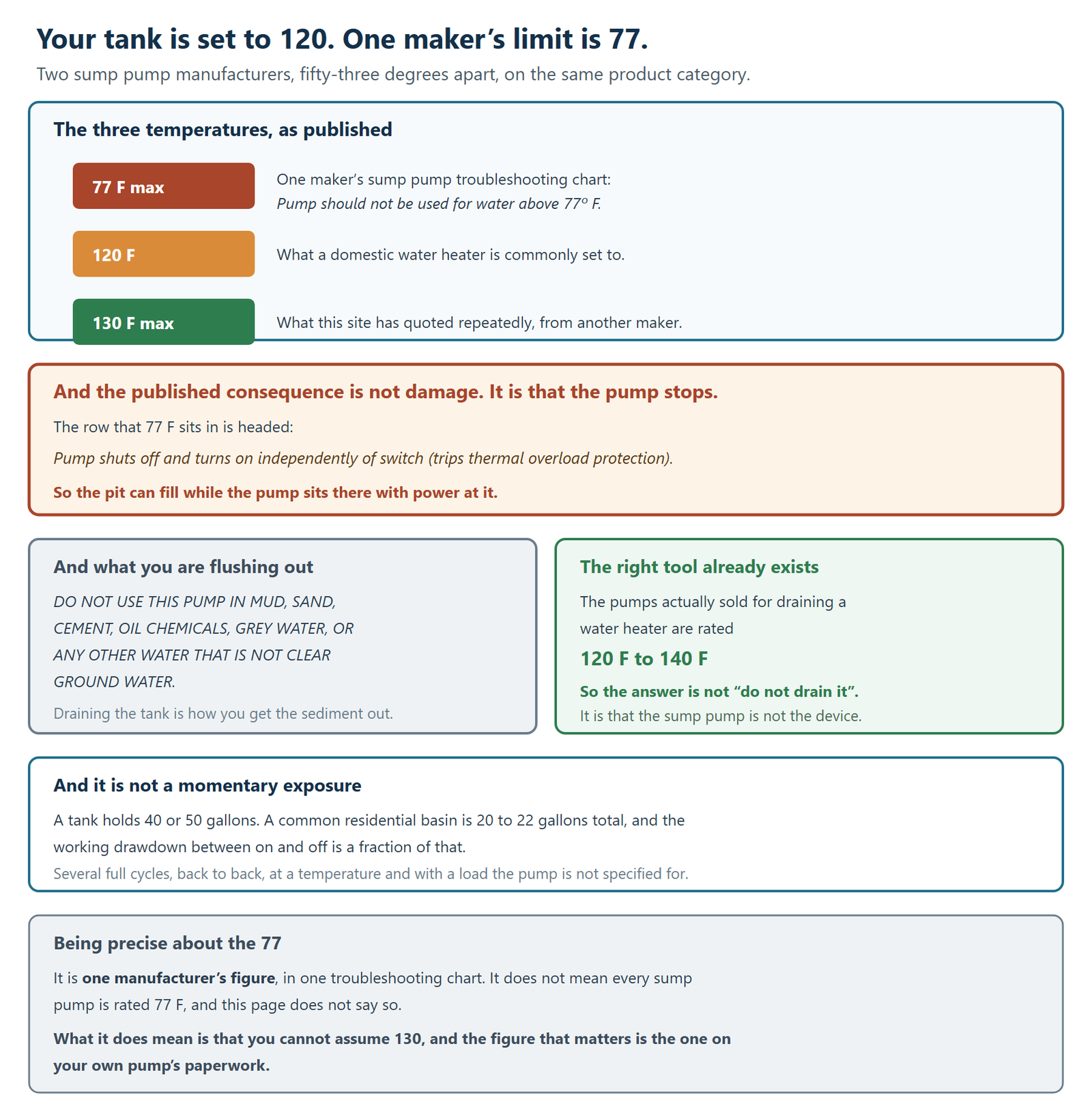
From one manufacturer’s troubleshooting chart, as remedy 1 against the cause “Excessive water temperature”:
“Pump should not be used for water above 77º F.“
From another manufacturer, quoted repeatedly on this site: a maximum liquid temperature of 130 °F, with a note to consult the factory above it.
And from your own airing cupboard: a domestic tank is commonly set at 120 °F, and plenty run at 140 because somebody turned it up.
Let me be precise about the 77, because it is the figure that will get repeated. It is one manufacturer’s, in one troubleshooting chart. It does not mean every sump pump is rated 77 °F and this page is not saying so. What it does mean is that you cannot assume 130 — the spread in this category is wide enough that the only figure that matters is the one in your own pump’s paperwork.
The consequence is the part that matters
Look at which row that 77 °F sits in. It is not a warranty note and it is not a warning about damage. The symptom heading is:
“Pump shuts off and turns on independently of switch (trips thermal overload protection).“
Excessive water temperature is listed as the first cause of a pump taking itself offline.
And “independently of switch” is the phrase to sit with. The float is irrelevant. The pit can fill, the float can call for the pump, and the pump will not answer — because it has protected itself and is waiting to cool.
That is the worst failure mode a sump pump has, and hot water is a published trigger for it.
One-minute check: go and look at your water heater’s thermostat before anything else. If it reads 120 or higher, you already know more than the hose does.
And the sediment is the reason you are draining it
The temperature is only half the objection.
From the same manual:
“DO NOT USE THIS PUMP IN MUD, SAND, CEMENT, OIL CHEMICALS, GREY WATER, OR ANY OTHER WATER THAT IS NOT CLEAR GROUND WATER.“
You drain a water heater to flush the sediment out of the bottom of the tank. That is the entire purpose of the job — so the water arriving at the pit is deliberately the dirtiest water the tank contains, and it is arriving at a pump specified for clear ground water.
Two separate objections, then, and they do not cancel out: how hot it is, and what is in it.
It is not a momentary exposure either
A domestic tank holds 40 or 50 gallons.
A common residential basin is 20 to 22 gallons in total, and the working drawdown — the depth between the on and off levels — is a fraction of that.
So a tank drain is several full pump cycles back to back, not a splash. That rate of starting is its own problem, but here it mostly means the exposure lasts as long as the job does.
So what should you do instead?
The useful answer is not “don’t drain your water heater.” It is that a sump pump is not the device for moving that water, and the right one already exists.
The pumps actually sold for this job are rated 120 °F to 140 °F — this site went through five of them, and the temperature rating is the first spec that matters rather than the flow.
And if the tank can simply drain to a floor drain or outside by gravity, it should. A hose and a slope beats a pump every time.
The nearest published procedure on this site is for a hot tub, and the shape is the same: power off first, work out where the water is allowed to go, then move it with something rated for it.
How this differs from the laundry question
Worth separating, because the site covers both.
A washing machine draining into a sump pit is about lint and about being on the wrong side of the house — it is grey water going to a clear-water pit, and the temperature point there concerns an occasional hot wash.
A water heater drain is a bigger, hotter, dirtier, deliberate event. It is also a one-off rather than a plumbed arrangement, which is the one thing in its favour — nobody is proposing to pipe a water heater to the sump permanently.
But “it is only once a year” is exactly the argument that gets a pump to trip its overload on the day you are not watching it.
When this needs a pro
Draining the water heater itself. It is scalding water out of a gas or electric appliance, and this page deliberately does not describe it — the appliance’s own instructions govern that.
Anything where the drain water cannot reach a floor drain or the outside by gravity. That is a pumping problem with a temperature specification attached, and it is worth asking rather than improvising.
A sump pump that has already been used this way and is now behaving oddly. If it has been tripping its overload, that is a published symptom and not a coincidence.
What you can do yourself: read the thermostat on the water heater, find the maximum liquid temperature in your sump pump’s manual, and compare the two numbers. Two figures, no tools — and they answer the question before you uncoil a hose. If the pit, the pump and what you send to it have never been considered together, that is the larger question.
FAQ
Can I drain a water heater into a sump pit?
Check your pump’s maximum liquid temperature first. One manufacturer publishes “Pump should not be used for water above 77 °F” and another publishes 130 °F, while a domestic tank is commonly set to 120 °F. The figure that matters is the one in your own pump’s paperwork.
What happens if hot water goes into a sump pit?
On one manufacturer’s chart, excessive water temperature is the first listed cause of the pump tripping its thermal overload — shutting off and restarting independently of the switch. The pit can then fill while the pump sits there with power at it, waiting to cool.
What is the maximum water temperature for a sump pump?
It varies far more than people assume. This site has quoted 130 °F repeatedly from one maker, and another publishes 77 °F in its troubleshooting chart. A 53-degree spread in one product category means the only reliable figure is your own model’s.
Why does the sediment matter?
Because flushing it out is the point of draining the tank. One manual states the pump must not be used in mud, sand, cement, oil, chemicals, grey water or anything that is not clear ground water — and a tank drain is deliberately carrying the dirtiest water in the tank.
What should I use to pump out a water heater?
A transfer pump rated for the temperature. The pumps sold for this job publish ratings from 120 °F to 140 °F, and this site compares five of them. If gravity to a floor drain or outside is available, that is simpler than any pump.
Is it fine if I only do it once a year?
That is the argument that ends with a pump tripping its overload on a day nobody is watching. The exposure is also longer than it sounds — a 40 to 50 gallon tank against a 20 to 22 gallon basin is several full pump cycles back to back.


