On this page
Last Updated on September 30, 2026 by Muhammad Toqeer
If it bangs once, just as the pump stops, it is the check valve — but not in the way it sounds. The noise is not the flapper landing. It is a column of water that had started falling back down the pipe being stopped dead.
And that matters, because it changes the cure. The valve that fixes this does not close more gently. It closes faster.
What actually happens in that half-second
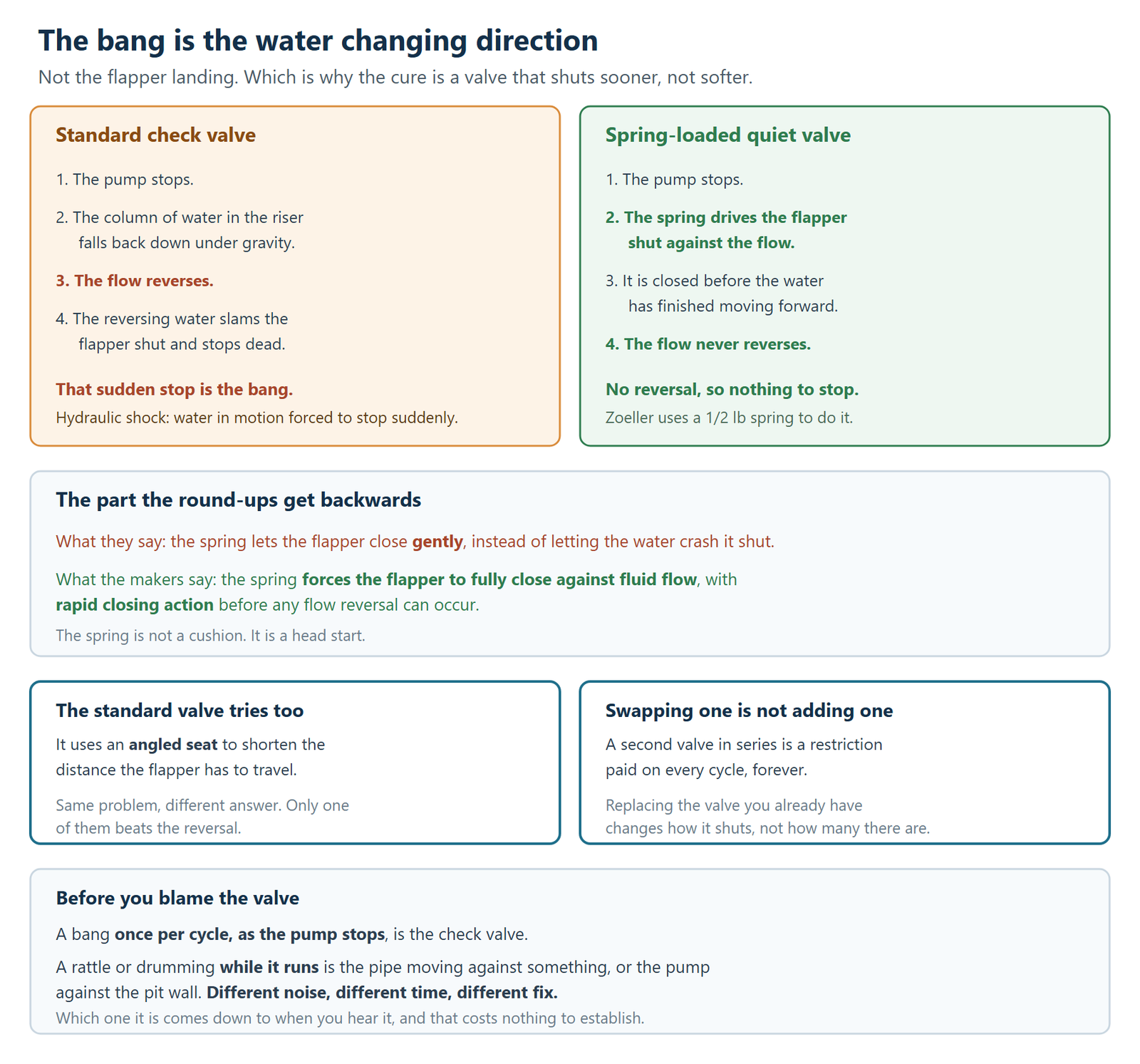
When the pump shuts off, there is a column of water standing in the vertical discharge pipe above it. Gravity starts pulling it back down.
A standard check valve is a flapper hanging in the pipe. It does not close until that falling water pushes it closed — so the water has to be moving backwards before the valve reacts.
Then the flapper hits its seat and the moving column stops in an instant. That is the bang. It has a name: hydraulic shock, which a valve manufacturer defines plainly as “water in motion is forced to stop or change direction suddenly.”
The flapper is not what you are hearing. You are hearing several feet of water being brought to a halt against it.
The thing nearly every article gets backwards
Search this problem and you will be told to fit a “silent” or “spring-loaded” check valve. The advice is right. The explanation is wrong, and the wrong explanation is why people fit them and then wonder what the spring is for.
What the round-ups say: the spring lets the flapper close gently, instead of letting the weight of the water crash it shut.
What the people who make the valves say:
“a spring-loaded hinged flapper mechanism which forces the flapper to fully close against fluid flow as the pump shuts down”
“rapid closing action against pressure before any flow reversal can occur, eliminates noise caused by hydraulic shock”
Read that again: against the flow, before any reversal. The spring does not soften the landing. It shuts the valve early, while the water is still moving forward, so the reversal that does the banging never gets started.
The same manufacturer is explicit that with a spring valve “there is no flow reversal when the pump stops.”
That is the whole mechanism. There is no bang because there is nothing left moving to stop.
The standard valve is trying to solve it too
Worth knowing, because it explains why some installations are quieter than others without anyone having chosen a quiet valve.
A standard check valve is built with an angled seat, which shortens the distance the flapper has to travel from open to closed. Less travel, less time for the reversal to build, less noise.
It is the same problem attacked from the other end — shorten the trip rather than start it early. It helps. It does not beat the reversal, which is why the valve still bangs.
Doesn’t this site say not to add a check valve?
It does, and both things are true. Worth setting out plainly rather than leaving two pages to appear to disagree.
The warning is about adding a *second* valve in series — above a pump that already has one built into its outlet. That is a restriction the pump pays on every cycle for the rest of its life, and it lands hardest on a backup pump that only runs when it is the only pump running.
Swapping the valve you already have is a different thing entirely. The count does not change. Only the closing behaviour does, and both manufacturers describe the quiet valve as a full-flow design.
One is adding a restriction. The other is replacing a component.
What the quiet valve actually is
Real specifications, so you know what you are looking at. Zoeller’s 1½ inch quiet check valve:
- A 1/2 lb spring, which is the entire difference and is named in the product’s own title
- Rated 50 PSI, equivalent to 115 feet of head — far beyond anything a sump discharge asks of it
- Fits horizontally or vertically, so it suits the pipe you already have
- PVC body, solvent-weld ends with unions, which is what makes it a swappable part
- Full-flow, non-clog design
- Zoeller says to consult the factory for use above 130°F, which no sump discharge will reach
The union fittings are the part worth noticing. They are why this is a component swap rather than a pipe rebuild.
Before you blame the valve: when do you hear it?
This is the free diagnostic, and it takes one cycle.
A single bang, at the moment the pump stops. That is the check valve, and everything above applies.
A rattle, buzz or drumming while the pump is running. That is not the valve — a valve makes no noise while water flows through it. That is pipe moving against a joist or a wall, or the pump itself moving against the side of the pit.
A gurgle or slurp at the end of the cycle. That is air, and it is normal on a pump drawing down to its shutoff level.
Repeated banging, several times in a row, with no rain. That is a different article: a pump cycling on its own returned water bangs every time it stops, and the noise is the symptom rather than the fault. Fix the cycling and the noise goes with it.
Different noise, different time, different fix. Establishing which one you have costs nothing and stops you buying a valve for a bracket problem.
When this needs a pro
The valve swap itself. It means cutting into the discharge line on the system that keeps water out of the basement, and doing it on a pipe that has water standing in it.
Anything where the discharge is not accessible, or where the existing valve is not a union fitting — at which point it stops being a swap.
A pit you cannot see into properly. The lid should be gas-tight and fastened down, so a proper look is a job rather than a glance.
What you can do yourself: listen through one full cycle and note when the noise happens, then follow the discharge pipe by hand and see whether it is fastened to anything. Two observations, no tools, and they decide whether this is a valve question at all.
And if the pump is due for replacement anyway, check the flow at your actual lift before choosing one — a quieter installation is not a reason to fit a pump that cannot keep up.
FAQ
Why does my sump pump bang when it shuts off?
Because the column of water standing in the discharge pipe starts falling back down when the pump stops, and the check valve stops it dead. The bang is several feet of moving water being brought to a halt, not the flapper touching its seat.
Does a silent check valve close more slowly?
No — it closes faster. Manufacturers describe a spring that forces the flapper fully shut against the flow, before any reversal can occur. It is quiet because the reversal never happens, not because the closing is cushioned.
Will a quiet check valve slow my sump pump down?
Both manufacturers describe theirs as a full-flow design, and swapping one valve for another does not change how many the pump has to push through. The advice against extra check valves applies to fitting a second one in series, not to replacing the one already there.
What is water hammer in a sump pump?
It is the pressure surge when water in motion is forced to stop or change direction suddenly. In a sump discharge it happens at shutoff, when the falling column of water meets a closing check valve.
My sump pump rattles while it runs — is that the check valve?
Unlikely. A check valve is silent while water is flowing through it. Noise during the run is usually the discharge pipe moving against a joist or wall, or the pump shifting against the side of the pit.
Can I fit a quiet check valve myself?
It means cutting into the line that protects your basement, on a pipe holding standing water. The union fittings make it a straightforward swap for someone who does this work, which is a different thing from it being a beginner job.


