On this page
Last Updated on October 8, 2026 by Muhammad Toqeer
Before you look at a single cause, settle one thing: what actually went off?
There are three protective devices between your panel and that pump, and they are not interchangeable. The breaker in the panel. The GFCI in the receptacle. And a thermal overload inside the motor itself.
The quickest way to tell them apart costs nothing. If the pump stopped and then started again on its own, nothing in your panel tripped at all — you have the one inside the motor, and that device has its own published cause list.
The manufacturer prints two of these as separate troubleshooting rows with completely different causes. Every article currently ranking for this problem merges all three into one list of six.
The three devices, and how to tell which one you have
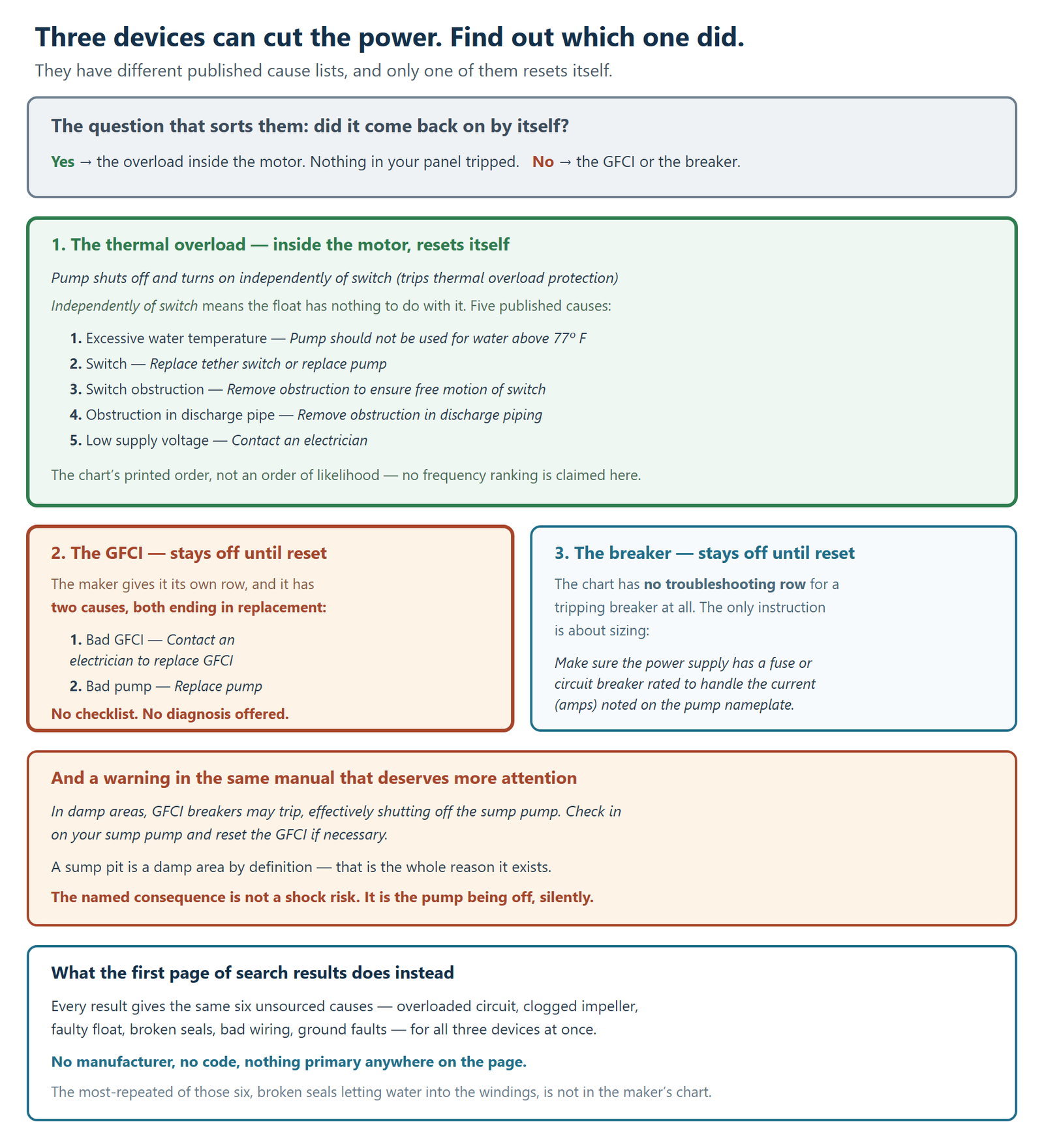
Work out which one you are dealing with before anything else, because the cause lists do not overlap.
The thermal overload is inside the motor. It is automatic — it cuts the motor when it gets too hot and lets it run again once it cools. You cannot see it, and you never reset it.
The GFCI is in the receptacle or the panel. It stays off until somebody pushes the button.
The breaker is in the panel. It also stays off until somebody resets it.
So the question that sorts them is simply: did it come back on by itself?
If yes — the pump stopped, then started again later with nothing touched — that is the overload. Nothing in your panel has tripped, and walking downstairs to look at the breaker will tell you nothing.
If no — something is physically off and you reset it — then look at which one. The GFCI has a button on it. The breaker is in the panel.
If it resets itself: the overload row
The manufacturer’s wording for this symptom is precise, and it is worth reading carefully:
“Pump shuts off and turns on independently of switch (trips thermal overload protection)”
“Independently of switch” means the float has nothing to do with it. The pump is not following the water level any more. It is following its own temperature.
The five published causes, with the maker’s own remedies:
1. Excessive water temperature — “Pump should not be used for water above 77º F”
2. Switch — “Replace tether switch or replace pump”
3. Switch obstruction — “Remove obstruction to ensure free motion of switch”
4. Obstruction in discharge pipe — “Remove obstruction in discharge piping”
5. Low supply voltage — “Contact an electrician”
These are in the manufacturer’s printed order, not in order of likelihood. No forum research was done for this page, so no frequency ranking is implied — the order above is the chart’s, and that is all it is.
Two of them are worth expanding, because they are the ones that surprise people.
Cause 4, an obstruction in the discharge pipe, makes the motor work against a wall. The pump is running, the water is not going anywhere, and the energy goes into heat instead of flow. That is what the overload is there to catch.
And cause 5, low supply voltage, is the counter-intuitive one. People assume a motor trips protection by drawing too much. A motor on too little voltage also draws more current to do the same work — and that is a wiring and supply question rather than a pump fault, which is why the remedy is simply “Contact an electrician.”
This site has already published the figure that cause 5 turns on — the maker’s own threshold for when low line voltage becomes a wiring problem. And the arithmetic for how an extension cord gets you there, which is the most common way a perfectly good circuit arrives at the pump as a poor one.
Cause 1 has its own page too. Seventy-seven degrees is a startlingly low ceiling and one maker’s own figure — worth knowing if anything warm drains into your pit.
If you are resetting a GFCI: a much shorter list
Here is where the published answer and the internet diverge most sharply.
The manufacturer gives the GFCI its own row, and it has two causes:
1. Bad GFCI — “Contact an electrician to replace GFCI”
2. Bad pump — “Replace pump”
That is the entire row. Two causes, and both remedies are replacement.
There is no checklist here. The maker is not offering you six things to inspect — it is saying that one of two components has failed and needs changing, and one of those jobs is an electrician’s.
Which is a genuinely useful thing to know before an afternoon of poking around, because the pages telling you to check the impeller, the float and the wiring for a tripping GFCI are describing a diagnosis the manufacturer does not offer.
The damp-basement warning in the same manual
And one note that deserves more attention than it gets:
“In damp areas, GFCI breakers may trip, effectively shutting off the sump pump. Check in on your sump pump and reset the GFCI if necessary.”
A sump pit is a damp area by definition. That is the whole reason it exists.
So the manufacturer is acknowledging that the protective device may trip because of where the pump has to live — and the consequence it names is not a shock risk. It is “effectively shutting off the sump pump.”
That is a protection failure mode that leaves you unprotected silently. The pump is fine, the water is rising, and the only sign is a button that nobody looked at.
Which is why the instruction is to go and check. One-minute habit worth forming: when you are near the pit anyway, look at the GFCI as well as the pump. A tripped GFCI announces itself to nobody.
The code side of GFCI protection for sump pumps is covered elsewhere on this site, on the condensate silo’s GFCI page — it is the same requirement and there is no sense in writing it twice.
And the breaker itself
What does the manufacturer say about the circuit breaker? Almost nothing — and what it does say is about sizing rather than diagnosis:
“MAKE SURE THE POWER SUPPLY HAS A FUSE OR CIRCUIT BREAKER rated to handle the current (amps) noted on the pump nameplate or cord tag.”
Matched to the nameplate. Not to what seems reasonable, not to what was already there when you bought the house.
There is no troubleshooting row for a tripping breaker in this chart at all, which is itself informative: a breaker that trips repeatedly on a correctly sized circuit is an electrical problem rather than a pump problem, and it belongs to whoever works on the panel.
What you can read for yourself: the amps are printed on the pump nameplate or the cord tag. Knowing that number is also the starting point for any replacement decision, because a different pump may not suit the circuit that is there.
When this needs a pro
Anything that ends at the panel. A repeatedly tripping breaker on a correctly rated circuit, and every instance of cause 5.
Replacing a GFCI. The manufacturer’s own remedy names an electrician.
Deciding between “bad GFCI” and “bad pump”. Those are the only two published causes for a tripping GFCI, and distinguishing them means testing rather than guessing.
And a pump that keeps overheating after the obvious causes are cleared. The pit, the discharge, the switch and the circuit are one system, and a motor repeatedly reaching its own thermal limit is telling you something that has not been found yet.
What you can do yourself: establish whether it restarts on its own, look at the discharge pipe for an obstruction, check the float moves freely, and read the amps off the nameplate. Four observations, no tools — and they put you in the right one of three cause lists instead of working through all six items of a list that belongs to none of them.
FAQ
Why does my sump pump keep tripping the breaker?
First establish whether the breaker is actually what tripped. If the pump stops and starts again on its own, that is the thermal overload inside the motor and nothing in the panel has tripped. The three devices have different published cause lists.
What is the difference between the thermal overload and the breaker?
The thermal overload is inside the motor and resets itself once the motor cools, so the pump restarts without anyone touching anything. A breaker or GFCI stays off until a person resets it. The manufacturer describes the overload symptom as the pump shutting off and turning on independently of the switch.
What causes a sump pump to trip its thermal overload?
The manufacturer lists five: excessive water temperature, the switch, a switch obstruction, an obstruction in the discharge pipe, and low supply voltage. They are given here in the chart’s printed order rather than by how often each one occurs.
Why does my sump pump trip the GFCI?
The manufacturer’s row for this has only two causes — a bad GFCI or a bad pump — and both remedies are replacement rather than inspection. It also notes separately that in damp areas a GFCI may trip simply because of the conditions.
Can low voltage make a pump trip out?
It is listed as a cause, and the published remedy is to contact an electrician. A motor running on too little voltage draws more current to do the same work, which is the opposite of what most people assume about overload trips.
What size breaker does a sump pump need?
The manufacturer does not give a figure — it says to make sure the fuse or circuit breaker is rated to handle the current in amps noted on the pump nameplate or cord tag. That number is specific to your pump and is printed on it.


