On this page
Last Updated on October 14, 2026 by Muhammad Toqeer
A private well system is four parts: a pump, the pipe it feeds, a pressure switch, and a pressure tank. Everything that goes wrong is one of those four, and which pump you have decides most of the rest.
The quickest way to know which you have: if there is a pump you can see and touch, it is a jet pump. If the only thing above ground is a capped pipe, the pump is down the well.
Where the pump sits, and why it decides everything
There are two arrangements, and they are not variations on a theme. They work on opposite principles.
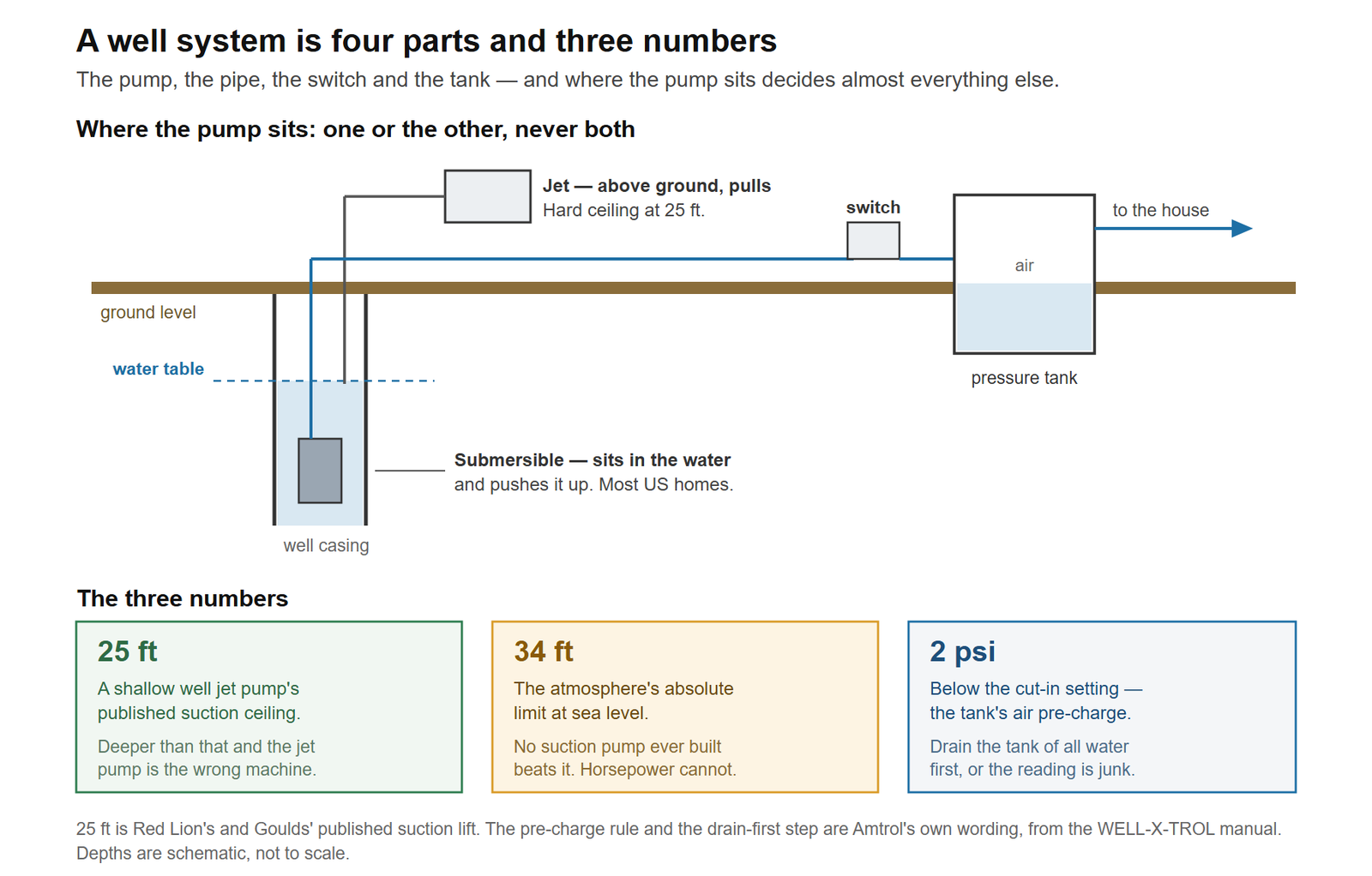
A submersible pump sits in the water and pushes. It hangs on the end of the drop pipe, below the water table, and it is the common arrangement in American homes. Pushing is limited by the motor, so depth is mostly a question of buying enough pump.
A jet pump sits above ground and pulls. It draws water up a suction pipe. That makes it easy to reach and easy to service — and it gives it a hard ceiling that no amount of horsepower moves.
The 25-foot line
Red Lion’s shallow well jet pumps are sold for wells “that have suction lifts down to 25′.” Goulds gives the same figure for its JS series. Twenty-five feet is not a marketing choice; it is close to the physical limit.
Here is why, and this site has already published the reason in a different silo: a pump does not pull water at all. It lowers the pressure at its inlet and lets the atmosphere push water up into the gap. At sea level the atmosphere can support a column of water about 34 feet high, and that is the hard ceiling for any suction pump ever built. Friction and the pump’s own efficiency eat the difference, which is how 34 becomes a practical 25.
So the decision tree is short:
- Water within about 25 feet of the surface — a shallow well jet pump will work.
- Deeper than that — you need either a convertible jet pump with a two-pipe ejector down the well (quoted to around 90 feet), or a submersible.
- Properly deep — submersible, and it is the normal answer.
A jet pump that cannot reach is not underpowered. It is the wrong machine.
The pressure tank, and the number it arrives wrong
This is the part of the system homeowners understand least and the part that causes the most misdiagnosis.
The tank is not storage. It is a cushion of compressed air separated from the water, which lets you draw a glass without starting the pump. The air side is charged before installation, and the charge has to match the switch.
Amtrol’s WELL-X-TROL manual gives the rule in one line:
“Release or add air as necessary to make the precharge pressure 2 psig below the pressure switch pump cut-in setting.”
Two pounds below cut-in. Now the part almost nobody mentions — the tank does not arrive set for most houses. Amtrol’s own manual says it ships at 38 psig, and gives this worked example:
“(Example, if you have a WX-202XL with a precharge of 38 psig, and you have a pressure switch setting of 30/50 psig, adjust precharge of your WX-202XL from 38 psig to 28 psig.)”
38 psig is correct for a 40/60 switch. On a 30/50 system — the common residential setting — the factory charge is ten pounds too high until somebody lets air out. A tank bolted on out of the box and never adjusted is wrong before any water has been used, and the symptoms that produces get blamed on the pump.
And the reading is worthless unless you drain it first
Amtrol’s procedure for an installed tank starts here:
“Drain tank of all water. Check precharge pressure in the Well-X-Trol Tank.”
Put a gauge on the Schrader valve of a tank with water in it and you are reading system pressure, not air charge. That is why people check it, see something plausible, and conclude the tank is fine.
Amtrol also asks for the whole system to be looked at “yearly and more frequently as the system ages” by a qualified professional — a maintenance interval for a component most people never touch.
And that 2 psi is a floor rather than a target — a second manufacturer says it is not enough above a 20/40 switch, and the maker warns against adding air to a corroded tank at all.
The pressure switch
A small box, usually mounted on the tank tee, with two numbers on it: cut-in and cut-out. The pump starts at the first and stops at the second.
Two settings dominate residential systems: 30/50 and 40/60. Which one is right depends on the house — the height water has to reach, the fixtures, and what the pump can actually deliver at that pressure. The switch also sets the tank’s pre-charge, as above, so the two are never decided separately.
That choice is also part of sizing the pump, and it is the largest single term in the calculation: a 60 psi cut-out asks the pump for 138.6 feet of head where 50 psi asks for 115.5. How to size a well pump — the three numbers, and why the calculators only compute two.
What actually goes wrong
Most well-system faults are one of a short list, and they are told apart by what you observe rather than by what is broken:
- The pump cycles on and off rapidly while water is running — almost always the tank, not the pump. What counts as too short, and the five causes in order.
- The pump runs but no water arrives — a jet pump that has lost its prime, or a submersible with a problem down the well. Very different repairs, and the two lists share almost nothing.
- Water pressure is low everywhere — switch settings, a clogged screen, or a pump that is losing capacity. Usually it is flow rather than pressure, and a gauge tells you which.
- The pump will not shut off — urgent, because a pump running on overheats. One gauge reading says whether the switch is even the problem.
- Air spits from the taps — the well is drawing air, and the reason matters. On an older bladderless tank it may be the tank doing it on purpose.
- The pump clicks but will not start — electrical, and the switch contacts are the first suspect. The click is a contact closing, and every contact is at the surface.
- Nothing at all — a tripped breaker or a dead pump, and telling those apart takes a minute. Start with the breaker, and know which of the three resets you actually have.
- The breaker keeps tripping — and when it trips names the fault. A 1 hp pump runs on 8.2 amps and starts on 48.7, which a breaker tolerates only briefly.
Each of those is its own article, and this guide will link to them as they are written. This silo is new; the cluster is being built underneath this page.
When this needs a pro
Anything down the well. Pulling a submersible pump means handling hundreds of feet of pipe, wire and water. It is not a solo job and it is not a first-attempt job.
Anything inside the pressure switch with the power on. The switch is line voltage, often 240 V, in a small box in a damp place.
A pressure tank that has burst, bulged or is weeping at a seam. Amtrol’s own warning is that a pressurised vessel “may over time corrode, weaken and burst” — that is not a repair.
Any question about water quality. A pump moves whatever is in the well. What is in the well is a separate profession.
And if your wellhead sits in a pit with water standing in it, the question is whether that water reached the top of the casing — new well pits are prohibited outright, and pumping one out settles nothing.
And if the well itself is the problem — the level dropping, the yield falling, sediment arriving — that is a well driller’s question, not a pump question.
Choosing a pump. Shallow wells are the half a homeowner buys and fits themselves — and the flow figures on the listings are measured at different pressures, so they need restating before they compare.
And below 25 feet it is a submersible instead — where horsepower buys depth rather than water, and the model number already fixes the flow.
And the tank is sized from the pump, not the house — its drawdown has to be at least your pump’s GPM, which rules out the tank most guides recommend.
Unless the pump can vary its speed, in which case the rule the tank is sized by stops applying altogether — and so do the pre-charge and generator rules above it.
And on a three-wire motor there is a box on the wall that has to match it exactly. The maker says a mismatch in horsepower or voltage means premature failure of the box or the motor should be expected — and each box publishes nominal and maximum amps, which is the figure it is really specified against.
And there is a device on that circuit most owners have never heard of. The motor maker states that all submersible motors require a dedicated surge arrestor — and it has to be grounded below the lowest drawdown water level, which is a grounding spec referenced to a water level rather than to a rod.
And the control box can be tested on its own bench. Its three-wire leads can be identified by resistance alone when the colours have faded — the highest of the three readings is main plus start in series, so the lead missing from that pair is the common.
And a bang rather than a growl points somewhere else entirely. If the lowest check valve sits more than 30 feet above the standing water level, the makers say it hammers on every start — and a duller thud at shutoff points at the tank’s air cushion instead.
And a pump that quits and restarts by itself is a thermal trip, not a dead motor. Where that overload lives depends on your wire count — inside the motor on a 2-wire, in the control box on a 3-wire — and the maker publishes a daily start ceiling of 300 up to 0.75 hp, dropping to 100 from 1 hp up.
And the cable feeding it is sized on two distances added together. The run is the trench to the wellhead PLUS the drop to the motor — on a 230 V 1 hp motor that is 14 AWG to 250 feet, 12 AWG to 400, 10 AWG to 630.
And if a sump pump shares the well pump’s breaker, the problem is when the two starting surges land together — a power blink restarts both at once, and a 1 hp well motor alone draws 48.7 amps locked-rotor against 8.2 running.
And the switch itself has two nuts, which do different things. The range nut moves cut-in and cut-out together; the differential nut moves cut-out alone — and many residential switches have only the first of the two.
And a grinding sound has a measurement behind it. Continuous running below rated head puts the thrust bearing into upthrust — and a 4-inch motor is worn once free end-play exceeds 0.045 in, which is measured rather than guessed at by ear.
And before anyone pulls a pump on suspicion, there is a reading that settles it from the surface. The motor maker publishes two minimums for the same insulation test — 200 megohms before submerging, 0.5 after — and a low reading still does not say whether it is the windings or the cable.
And on a constant-pressure system, less water does not always mean a failing pump. Under heavy load this class of pump reduces its own speed rather than stopping — cutting out only below 3000 rpm, with reduced speed listed as an alarm state in its own right.
And what holds the whole assembly up is specified too. The motor maker publishes a minimum joint torque of ten foot-pounds times the nameplate horsepower — a figure that scales with the motor, because the motor is what twists the joints every time it starts.
And how deep the pump sits is a cooling question as well as a hydraulic one. The maker asks for ten feet of clear water below the motor, and for all inflow to enter below it — because water entering above the motor reaches the intake without ever passing it, and the well looks full the whole time.
And a jet pump that loses prime slowly rather than all at once points at the nozzle and venturi inside the pump housing — on a single-pipe shallow-well pump that assembly is above ground and probeable, which is not true of a two-pipe deep-well setup.
FAQ
How do I know if I have a jet pump or a submersible?
Look at the wellhead. A jet pump is a visible pump above ground, usually near the tank. If the only thing above ground is a capped pipe and the tank, the pump is down the well and it is a submersible.
How deep can a shallow well jet pump go?
About 25 feet of suction lift — Red Lion and Goulds both publish that figure. It is set by atmospheric pressure rather than by the motor, so a bigger jet pump does not reach deeper. Past that you need a convertible jet with a down-well ejector or a submersible.
What should my pressure tank be set to?
Two psi below the pump’s cut-in setting, per Amtrol’s manual. For a 30/50 switch that is 28 psi; for a 40/60 switch it is 38. Tanks commonly ship at 38 psi, which is wrong for a 30/50 system.
Why does my pressure gauge read fine but the tank still seems wrong?
Because a tank with water in it reads system pressure, not air pre-charge. Amtrol’s procedure is to drain the tank of all water first, then read the Schrader valve.
Is 30/50 or 40/60 better?
Neither is universally better. It depends on how high the water has to go in the house, what the fixtures need, and what the pump can deliver at the higher setting. Whichever you use, the tank’s pre-charge has to be set to match it.


