On this page
Last Updated on September 27, 2026 by Muhammad Toqeer
A well pump is sized on two numbers: the flow it must deliver in gallons per minute, and the total dynamic head in feet it must pump against. Depth alone tells you almost nothing.
There is a third number that overrides both, and most sizing calculators treat it as a footnote: what your well can actually give. If the well makes less than the house wants, no pump fixes that.
Notice what is not on that list. Horsepower is the answer, not one of the questions — it falls out of the arithmetic once you know the flow and the head, and which type of pump you need is decided by depth before sizing starts. Every depth-to-horsepower table on this subject is working backwards.
Number one: what the house needs
Peak demand, not daily use. Count the fixtures that might realistically run at once — a shower, a washing machine, a kitchen tap — and add them up.
The common trade starting point is about 1 GPM per fixture, which puts a typical three-bedroom house somewhere around 8–12 GPM. Treat that as a starting estimate rather than a specification; nobody publishes it as one, and your house is not typical in whatever way matters.
What actually settles it is your own fixture count and how your household behaves. A family that showers in sequence needs less than one that overlaps.
Number two: total dynamic head
This is where the sizing is won or lost, and it is a stack of four things added together.
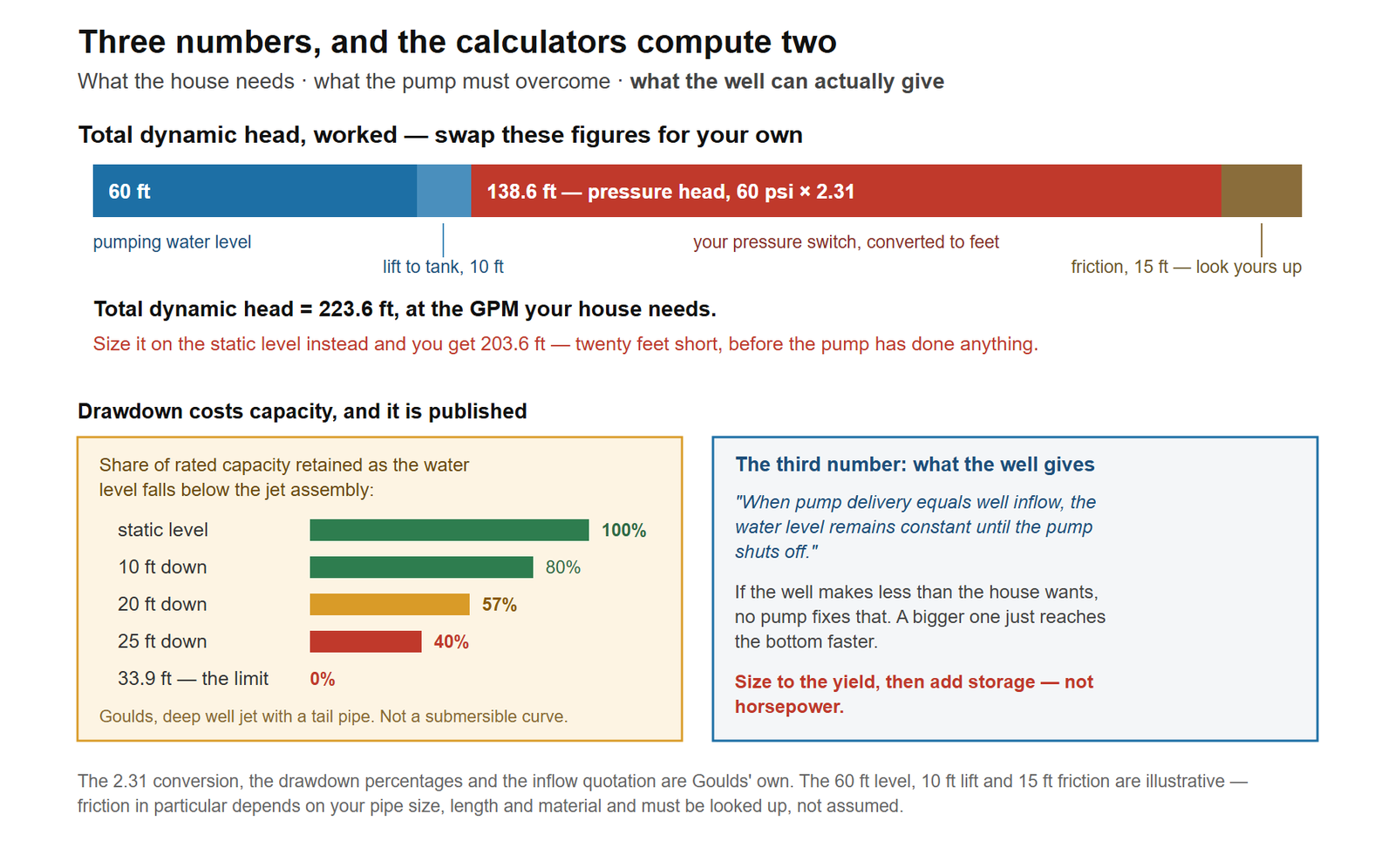
A worked example, and the figures are there to be replaced with yours:
| Component | Example |
|---|---|
| Pumping water level | 60 ft |
| Lift from wellhead to the tank | 10 ft |
| Pressure head (60 psi cut-out) | 138.6 ft |
| Friction loss in the pipe | 15 ft |
| Total dynamic head | 223.6 ft |
So the pump has to deliver your GPM at 223.6 feet, not at zero. That is the number you take to a pump curve.
Your pressure switch is head, and it is the biggest term
That 138.6 feet is not a measurement. It is your switch setting converted, using Goulds’ own formula:
“Discharge Head (in feet of fluid pumped) = Discharge Pressure (psi) x 2.31 / Sp. Gr. of Fluid Pumped”
60 psi × 2.31 = 138.6 feet. A 30/50 switch asks for 115.5 feet instead — about 23 feet less work, simply because you chose a lower cut-out.
And it compounds, because flow falls as pressure rises. The same switch choice that adds 23 feet of head also takes away most of the flow at the top of the cycle — a double penalty that neither number shows on its own.
Use the pumping level, not the static level
This is the most common sizing error, and it is built into several online calculators.
The static level is where the water sits when nothing is running. The pumping level is where it settles once the pump is working, after drawdown. The pump works against the second one.
In the example above, a static level of 40 feet with 20 feet of drawdown gives a pumping level of 60. Size it on the static figure and you compute 203.6 feet instead of 223.6 — twenty feet short before the pump has done anything.
Drawdown also costs capacity directly. Goulds publishes the loss for a deep well jet pump with a tail pipe:
| Water level below the jet | Rated capacity retained |
|---|---|
| Static level | 100% |
| 10 ft | 80% |
| 15 ft | 70% |
| 20 ft | 57% |
| 25 ft | 40% |
| 33.9 ft | 0% |
In Goulds’ words, “if water level falls below that, flow decreases in proportion to drawdown.” That table is for a jet pump with a tail pipe, not a submersible — but the lesson transfers: a moving water level is part of the specification, not a detail.
It also shows why depth decides the pump type before it decides the size. A jet pump is pulling water up, and suction has a hard physical ceiling that no amount of horsepower moves. Past that depth the pump goes down the well instead.
Friction is the one term you must look up. It depends on pipe diameter, length and material, and the 15 feet in the example is a placeholder. A long run of undersized pipe can add more head than the lift does.
Number three: what the well can give
Everything above sizes a pump for your house. None of it asks whether the well can keep up.
Goulds states the equilibrium in one line:
“When pump delivery equals well inflow, the water level remains constant until the pump shuts off.”
Below that inflow rate, the level holds and the pump works. Above it, the level keeps falling — and a bigger pump simply reaches the bottom faster. An oversized pump on a low-yield well does not deliver more water. It draws the level down, runs dry, and damages itself.
Finding your yield: the well log from the driller records it, along with the static level and the casing diameter. If you do not have the log, the field method is to throttle a valve to hold a target flow and run it for an hour. If the flow collapses, the well cannot sustain that rate — back it off and try again until it holds. Standard practice rather than a manufacturer procedure, but it produces the number.
And if the yield is below what the house needs, the answer is not horsepower. It is a pump matched to the yield plus storage, so the well refills between draws. That is a design decision rather than a purchase, and it is the point at which this stops being a DIY calculation.
What a professional asks first
Worth seeing, because it is a better checklist than any calculator. Before recommending anything, a pump specialist on Terry Love’s forum asked for:
- the well depth
- the static water level
- the depth the pump will be set at
- the flow and pressure required
- how much of the well’s storage capacity you intend to use
That last one appears on no calculator, and it is the difference between a pump sized for a house and a pump sized for a well.
The same thread shows why setting depth matters so much: at a 500-foot setting the discussion cites around 260 psi of backpressure, against roughly 130 psi at 300 feet. And on a 4 GPM well, going up a horsepower was discouraged outright — it added control complexity without solving the yield limit.
When this needs a pro
Choosing the actual pump from a curve. The arithmetic above gets you to GPM at a head figure. Matching that to a specific model, at your voltage, with the right motor, is where a supplier earns their money.
Anything involving the well’s yield. Whether a low figure is seasonal or permanent is a driller’s judgement, and it changes the design rather than the part number.
Setting depth. Too shallow and you lose capacity to drawdown; too deep and you add head and backpressure for nothing. It is decided from the well log.
The forum thread shows what that looks like in practice: sizing was argued from whether the water level would stay above 350 feet, not from the well’s total depth. Worst case, not nominal.
And if you are replacing a pump that failed early, size the replacement from scratch rather than matching the old one — an undersized or over-pressured pump cycles, and cycling is what kills them.
Once you have your GPM and your head figure, here is how the published flow numbers actually compare — they are measured at different pressures and lifts, so they need restating before they mean anything.
FAQ
How do I know what size well pump I need?
Two numbers: the GPM your house needs at peak, and the total dynamic head in feet the pump must overcome. Head is the pumping water level, plus the lift to the tank, plus your pressure setting converted at 2.31 feet per psi, plus friction.
How do I convert psi to feet of head?
Multiply by 2.31. Goulds publishes it as a formula, so a 60 psi cut-out is 138.6 feet of head and a 50 psi cut-out is 115.5.
Should I use the static water level or the pumping level?
The pumping level. The static level is where water sits at rest; the pump works against where it settles once running. Using the static figure under-sizes the head by exactly the drawdown.
Is a bigger well pump always better?
No. If the pump delivers more than the well produces, the water level keeps falling and the pump runs dry. On a low-yield well the correct answer is a pump matched to the yield plus storage, not more horsepower.
Does my pressure switch setting affect pump sizing?
Yes, and more than people expect. A 40/60 switch asks for 138.6 feet of head where a 30/50 asks for 115.5 — about 23 feet more — and flow falls as pressure rises, so the higher setting costs you twice.


