On this page
Last Updated on October 4, 2026 by Muhammad Toqeer
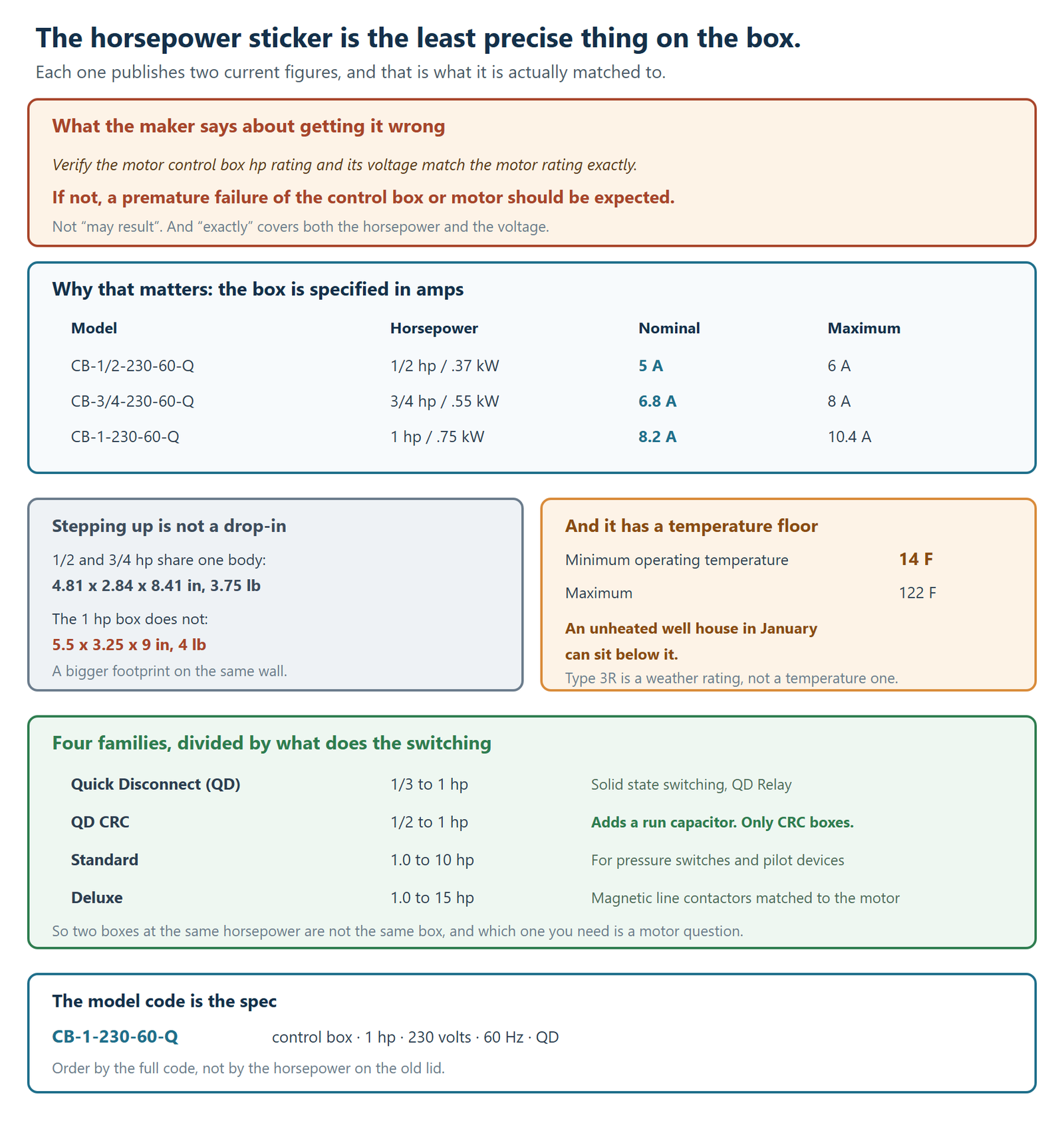
Order by the full model code, not by the horsepower on the old lid. The manufacturer is unusually blunt about why:
“Verify the motor control box hp rating and its voltage match the motor rating exactly. If not, a premature failure of the control box or motor should be expected.“
**Not “may result.” Should be expected** — and exactly covers both the horsepower and the voltage.
The reason that warning is so firm is on the spec pages: each box publishes two current figures. A ½ hp box is 5 amps nominal, 6 maximum. A ¾ hp box is 6.8 and 8. A 1 hp box is 8.2 and 10.4. The box is matched to a motor’s current with a defined headroom, which is not something a horsepower sticker can tell you.
What the box is actually specified against
A control box is not a generic enclosure. It holds the start components for a 3-wire submersible motor, and the manufacturer describes these as “designed and optimized specifically for Franklin three-wire, single-phase motors rated 1/3 to 15 hp.”
Which is why the matching is exact rather than approximate.
And the model code carries the whole specification:
CB-1-230-60-Q — control box · 1 hp · 230 volts · 60 Hz · QD
One-minute check before ordering: open the existing box and read the code off the label inside, rather than working from the horsepower stamped on the lid. If the box has already been replaced once with the wrong one, the lid is the least reliable thing in the installation.
The amp ladder, and why it is the real spec
| Model | Horsepower | Nominal amps | Maximum amps |
|---|---|---|---|
| CB-1/2-230-60-Q | 1/2 hp / .37 kW | 5 A | 6 A |
| CB-3/4-230-60-Q | 3/4 hp / .55 kW | 6.8 A | 8 A |
| CB-1-230-60-Q | 1 hp / .75 kW | 8.2 A | 10.4 A |
Each step up is a few amps, and the gap between nominal and maximum is the headroom. That is the quantity the box is engineered around.
A note on one of those figures. This site has published, from the motor maker’s own data, that a 1 hp two-wire submersible runs on 8.2 amps — and the 1 hp control box’s nominal figure is also 8.2 A. These boxes serve three-wire motors, so this page is not claiming the two numbers describe the same machine. It is simply worth knowing that the box is specified in the same units the motor is.
The five worth knowing
CB-1/2-230-60-Q — the common residential size
Franklin Electric CB-1/2-230-60-Q, item 2801054915 — 1/2 hp / .37 kW, 230 VAC single-phase, 60 Hz, 5 A nominal / 6 A max. Enclosure Type 3R. 4.81 × 2.84 × 8.41 in, 3.75 lb. Operating range 14 °F to 122 °F, storage −13 ° to 144 °F. UL listed. Warranty 12 month install / 24 month manufacturing.
Who it is for: the most common residential three-wire submersible, and a straight like-for-like replacement when the old box has failed.
The honest drawback: 6 amps maximum is not much headroom, and it is the figure to check against your motor rather than assuming the horsepower match is sufficient.
CB-3/4-230-60-Q — the same body, one step up
Franklin Electric CB-3/4-230-60-Q, item 2801074915 — 3/4 hp / .55 kW, 230 VAC, 6.8 A nominal / 8 A max, Type 3R, 4.81 × 2.84 × 8.41 in, 3.75 lb, UL, same 12/24 warranty.
Who it is for: a 3/4 hp three-wire motor, and anyone replacing a ½ hp box after a pump upgrade within the same body size.
The honest drawback: it shares dimensions with the ½ hp box, which makes it easy to fit the wrong one of the two — they look identical on the wall and the difference is on the label.
CB-1-230-60-Q — the one that needs a bigger footprint
Franklin Electric CB-1-230-60-Q, item 2801084915 — 1 hp / .75 kW, 230 VAC, 60 Hz, 8.2 A nominal / 10.4 A max, Type 3R, 5.5 × 3.25 × 9 in, 4 lb, UL, 12/24 warranty.
Who it is for: a 1 hp three-wire motor, which on a residential well usually means a deeper setting or a higher demand.
The honest drawback: it is physically larger than the two below it. Stepping up from ¾ to 1 hp is not a drop-in on the same backboard — check the space before the pump goes in, not after.
The QD CRC line — when the motor needs a run capacitor
Franklin Electric QD CRC control boxes — 1/2 to 1 hp, 230 VAC. These add “Capacitor Start” and a “Run Capacitor”, and the manufacturer’s own page notes that the run capacitor is “Only CRC Boxes.”
Who it is for: motors specified to run with a run capacitor. That is a motor requirement, not an upgrade — the box has to suit what the motor expects.
The honest drawback, and it is the trap in this whole category: a CRC box and a plain QD box can carry the same horsepower and are not interchangeable. The horsepower match that people check is the one thing that will not tell them apart.
The Deluxe line — contactors built in
Franklin Electric Deluxe control boxes — 1.0 to 15 hp, 230 VAC, with “magnetic line contactors carefully matched to the motor rating, eliminating the need for external line contactors.”
Who it is for: larger systems, and installations that would otherwise need a separate contactor on the wall beside the box.
The honest drawback: it is well beyond a typical residential well at the top of its range, and the Standard line (1.0 to 10 hp, for pressure switches, level switches or other pilot devices) covers much of the same ground without the built-in contactors.
Side by side
| Model or line | HP | Volts | Nominal / max amps | Enclosure | Distinguishing feature |
|---|---|---|---|---|---|
| CB-1/2-230-60-Q | 1/2 | 230 | 5 / 6 A | Type 3R | QD solid-state relay |
| CB-3/4-230-60-Q | 3/4 | 230 | 6.8 / 8 A | Type 3R | same body as the ½ hp |
| CB-1-230-60-Q | 1 | 230 | 8.2 / 10.4 A | Type 3R | larger body |
| QD CRC line | 1/2–1 | 230 | not published per line | — | run capacitor, CRC only |
| Deluxe line | 1.0–15 | 230 | not published per line | — | magnetic line contactors |
All are current catalogue items on the manufacturer’s own site, checked 4 October 2026. This guide is single-brand — but less arbitrarily than usual, because these boxes are described as designed specifically for that maker’s own three-wire motors. The brand is part of the specification rather than a preference.
The spec nobody checks: how cold the box gets
Published operating range on the ½ hp box: 14 °F minimum, 122 °F maximum, with a storage range of −13 ° to 144 °F.
Fourteen degrees Fahrenheit is a floor, and a control box lives wherever the installer put it — a well house, a detached pump house, an unheated basement, occasionally a pit.
And the enclosure rating does not cover this. Type 3R is a weather rating — rain, sleet, external ice formation. It says nothing about how cold the electronics inside may get. Those are two different specifications and it is easy to read one as covering the other.
One-minute check: if the box is somewhere that goes below about 14 °F in winter, that is worth raising with whoever services the system — not because the box will fail tonight, but because it is outside its published range and that is a different conversation from “it broke.”
When the box is the fault, and when it is not
A control box is a common suspect and an uncommon culprit, so it is worth knowing which symptoms point at it.
A click with no start is the classic — the box is doing something and the motor is not following.
A breaker that trips has a different shape, and on a three-wire motor the box is part of the protection rather than the problem.
A pump that runs and delivers nothing is usually not electrical at all, and replacing the box will not change it.
And resetting the system has three meanings, one of which involves the box — worth being clear which one you are doing before you buy a part.
How to choose, in order
First, read the model code off the existing box, not the lid, and not from memory.
Second, confirm the motor’s horsepower and voltage from the motor’s own documentation if you have it — the box must match both exactly.
Third, find out whether the motor needs a run capacitor, because that decides QD against CRC and the horsepower will not.
Fourth, check the amp figures against what the motor actually draws.
Fifth, measure the space if you are stepping up to 1 hp, because the body gets bigger.
And last, look at where it lives — the published floor is 14 °F.
When this needs a pro
All of the wiring. A control box is 230 volts, and the terminals inside it are live when the circuit is on.
Anything involving the motor’s own specification. Matching the box to the motor exactly means knowing the motor exactly, and on an existing installation that often means records rather than guesswork.
Diagnosing whether the box has actually failed. It contains a start capacitor, which stores charge, and testing it is not a multimeter-and-hope job.
And any installation where the existing box is the wrong one. If a previous replacement mismatched the hp or voltage, the motor has been running outside its design conditions, and that is worth knowing before another box goes on the wall.
What you can do yourself: read the model code, note the voltage, and look at where the box is mounted and how cold that place gets. Three facts, no tools — and they let whoever you call order the right part first time.
FAQ
Does a well pump control box have to match the motor exactly?
Yes, and the manufacturer says so in those terms: the control box hp rating and its voltage must match the motor rating exactly, or a premature failure of the control box or motor should be expected. That is firmer language than most specifications use.
What size control box do I need for my well pump?
Match it to the motor rather than to a rule of thumb, and order by the full model code — for example CB-1-230-60-Q, which reads as control box, 1 hp, 230 volts, 60 Hz, QD. The horsepower on the old lid is the least reliable guide if the box has been swapped before.
What is the difference between a QD and a CRC control box?
The CRC boxes add a capacitor start and a run capacitor, and the manufacturer notes the run capacitor is on CRC boxes only. Both families cover similar horsepowers, so two boxes with the same rating can be different devices — which one you need is determined by the motor.
Do control boxes have an amp rating?
Each one publishes two: a nominal figure and a maximum. A ½ hp box is 5 A nominal and 6 A maximum, a ¾ hp box 6.8 and 8, and a 1 hp box 8.2 and 10.4. That pair, not the horsepower label, is what the box is engineered around.
Can I put a control box in an unheated well house?
Check the published temperature range before assuming so. One of these boxes lists a minimum operating temperature of 14 °F and a maximum of 122 °F. The Type 3R enclosure rating covers weather, not cold — those are separate specifications.
Is a bigger control box a safe upgrade?
No. Oversizing is a mismatch in the same way undersizing is, and the manufacturer’s warning covers both directions by asking for an exact match. A larger box is also physically larger — the 1 hp body is bigger than the ½ and ¾ hp ones, which share a case.


