On this page
Last Updated on October 12, 2026 by Muhammad Toqeer
There is one meter reading that tells you whether the motor three hundred feet down is still good — and you take it from the surface, without pulling anything.
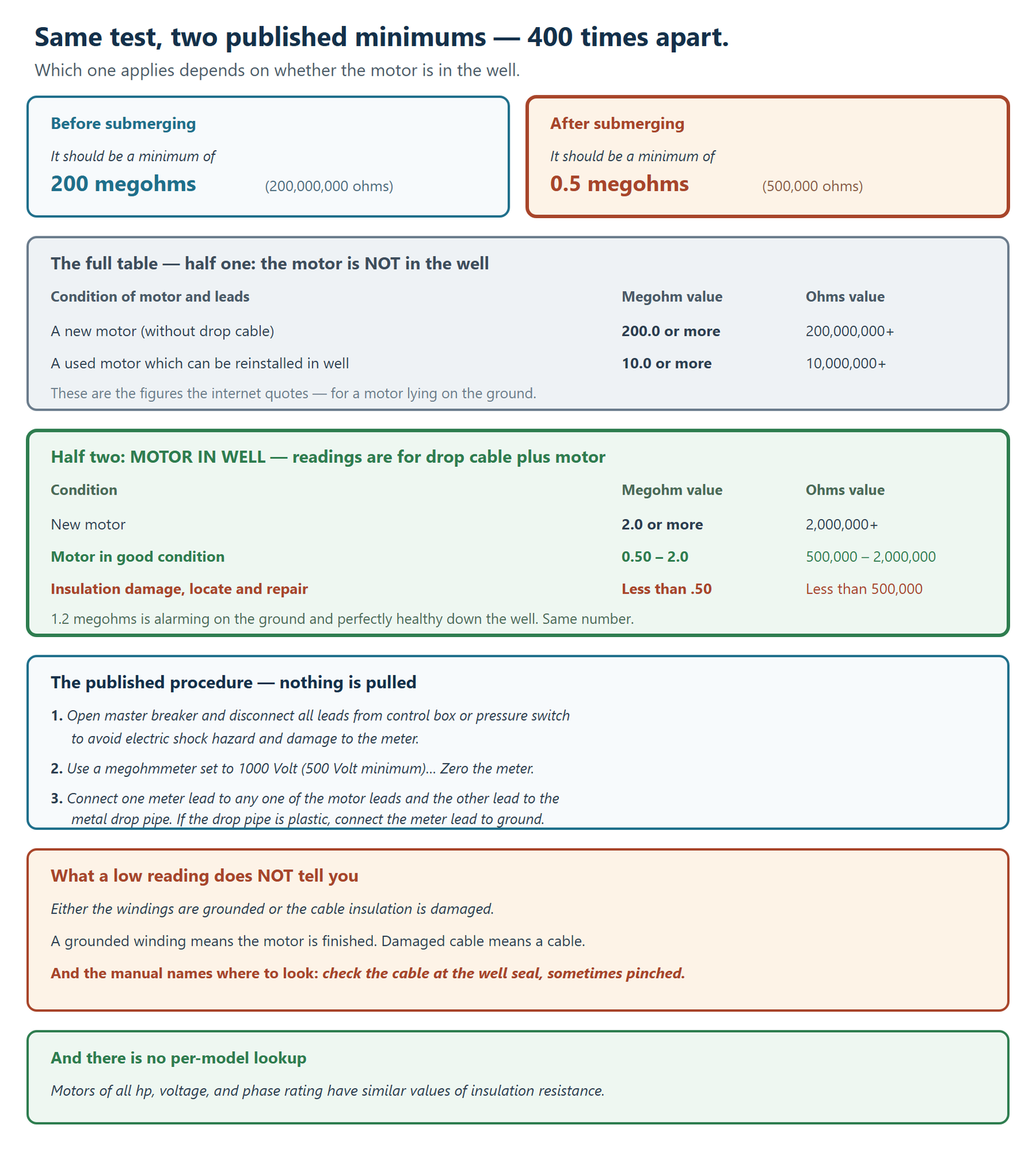
The trouble is the number you compare it against. The motor maker publishes two minimums for the same test:
“before submerging… a minimum of 200 megohms”
“after submerging… a minimum of 0.5 megohms”
Four hundred times apart. Same test, same motor, same meter — and which figure applies depends entirely on whether the pump is in the hole.
Read the wrong one and you condemn a working pump, or leave a damaged one down there.
Tools, and the safety step that comes first
Tools: a megohmmeter — a megger — or an ohmmeter that reaches high resistance. That is the whole list. No pipe wrenches, no hoist, nothing pulled.
The manufacturer’s step 1 is the safety step, and it is quoted here rather than paraphrased:
“Open master breaker and disconnect all leads from control box or pressure switch (QD type control, remove lid) to avoid electric shock hazard and damage to the meter.”
Note that it protects two things. You, from a 230-volt circuit — and the meter, which a megger will not survive being connected to live wiring.
If you are not comfortable opening a control box or a pressure switch, stop here. A control box contains a start capacitor and is not a casual place to go, and this measurement is a service technician’s routine job rather than a homeowner’s. The box itself has a separate bench test of its own, which is a different measurement on a different component.
The procedure, in the manufacturer’s own three steps
1. Open the master breaker and disconnect all leads from the control box or pressure switch. On a QD-type control, remove the lid.
2. Set the meter. “Use a megohmmeter set to 1000 Volt (500 Volt minimum). If using an ohmmeter, set to R X 100k. Zero the meter.”
3. Connect the leads. “Connect one meter lead to any one of the motor leads and the other lead to the metal drop pipe. If the drop pipe is plastic, connect the meter lead to ground.”
That is it. One reading, taken from the wellhead or the control box, with the pump exactly where it is.
The drop pipe detail matters and is easy to get wrong. On steel pipe the pipe itself is your ground reference. On plastic pipe it is not — you have to go to an actual ground, and a reading taken against plastic is a reading against nothing.
Now the table you compare it against
This is the part the rest of the internet gets muddled, so it is worth laying out in full. The manufacturer publishes two halves.
Half one — the motor is NOT in the well:
| Condition of motor and leads | Megohm value | Ohms value |
|---|---|---|
| A new motor (without drop cable) | 200.0 (or more) | 200,000,000 (or more) |
| A used motor which can be reinstalled in well | 10.0 (or more) | 10,000,000 (or more) |
Half two — the motor IS in the well. The manufacturer’s own heading: “MOTOR IN WELL. READINGS ARE FOR DROP CABLE PLUS MOTOR.”
| Condition | Megohm value | Ohms value |
|---|---|---|
| New motor | 2.0 (or more) | 2,000,000 (or more) |
| Motor in good condition | 0.50 – 2.0 | 500,000 – 2,000,000 |
| Insulation damage, locate and repair | Less than .50 | Less than 500,000 |
Read the two halves against each other and the whole confusion resolves.
A reading of 1.2 megohms is alarming if the motor is on the ground in front of you — a used motor fit to go back in should manage ten. The same 1.2 megohms is squarely healthy if the motor is already down the well, because the figure now covers hundreds of feet of drop cable as well.
And one line removes the last worry: the manufacturer states that “motors of all hp, voltage, and phase rating have similar values of insulation resistance.” There is no per-model lookup. The table is the table.
What a low reading does not tell you
This is the honest limit of the test, and the manual states it plainly:
“If the ohms value is below normal, either the windings are grounded or the cable insulation is damaged.”
One reading, two possible culprits — and they are not remotely equivalent. A grounded winding means the motor is finished. Damaged cable insulation means a cable, which is a far smaller job.
So a bad reading is the beginning of the diagnosis, not the end of it. Anyone who tells you the number alone proves the motor is dead is skipping the manufacturer’s own caveat.
And the manual points at where to look first:
“Check the cable at the well seal as the insulation is sometimes damaged by being pinched.”
The well seal. A specific, reachable, above-ground location — and much the less serious of the two answers. That is worth an inspection before anyone quotes for a motor.
What to do with the number you get
Above 0.50 megohms, motor in the well: the manufacturer’s table calls that good condition, and the insulation is not your problem. Look elsewhere — a breaker that keeps tripping or a pump that runs and delivers nothing both have causes that have nothing to do with insulation.
Below 0.50 megohms: insulation damage, per the table. Inspect the cable at the well seal before accepting that the motor is the problem.
And if the cable checks out and the reading is still low, the motor is the remaining candidate and replacement becomes the conversation — at which point you are pulling the pump anyway, and the first half of the table becomes the one that applies.
When this needs a pro
Most of it, and the threshold is lower than usual for this site.
Any work inside a control box or pressure switch. Step 1 requires disconnecting leads, and that is the step where people get hurt.
Owning and using a megohmmeter correctly. It applies 500 to 1000 volts deliberately. It is a test instrument with real hazards, not a multimeter.
Interpreting a borderline reading. A figure sitting right on 0.50 is a judgement call about a component you cannot see.
And pulling the pump on the strength of one number. Setting and pulling a submersible is the biggest job on a domestic well, and the manual’s own caveat is that the reading does not say which half of the circuit failed.
What you can do yourself: know that this test exists, know that the number depends on whether the pump is in the well, and ask whoever quotes you for a motor what reading they got and against which half of the table. That one question is worth having.
FAQ
What is an acceptable insulation resistance for a submersible well pump?
It depends on where the motor is. The manufacturer publishes a minimum of 200 megohms before submerging and 0.5 megohms after. For a motor already in the well, its table calls 0.50–2.0 megohms good condition and anything below 0.50 insulation damage.
Why do different sources give such different megohm figures?
Because they are answering different questions without saying so. The 200 megohm figure is for a motor on the ground with no drop cable attached; the 0.5 figure is for a motor in the well with hundreds of feet of cable in the circuit. The two are 400 times apart.
Can I test a well pump motor without pulling it?
Yes — that is the point of this test. It is taken at the control box or pressure switch with the pump still down the well, and the reading covers the drop cable plus the motor together.
Does the reading depend on my pump’s horsepower?
No. The manufacturer states that motors of all hp, voltage and phase rating have similar values of insulation resistance, so there is no per-model lookup.
A low reading — is the motor dead?
Not necessarily. The manual says a below-normal value means either the windings are grounded or the cable insulation is damaged, and it suggests checking the cable at the well seal, where it is sometimes pinched. The cable is the repairable one.
What meter do I need?
The published procedure calls for a megohmmeter set to 1000 volts, with 500 volts as the minimum, or an ohmmeter set to R × 100k, zeroed first. It is a test instrument that applies high voltage deliberately, which is part of why this is usually a technician’s job.


