On this page
Last Updated on October 6, 2026 by Muhammad Toqeer
Yes, and the motor manufacturer does not hedge about it:
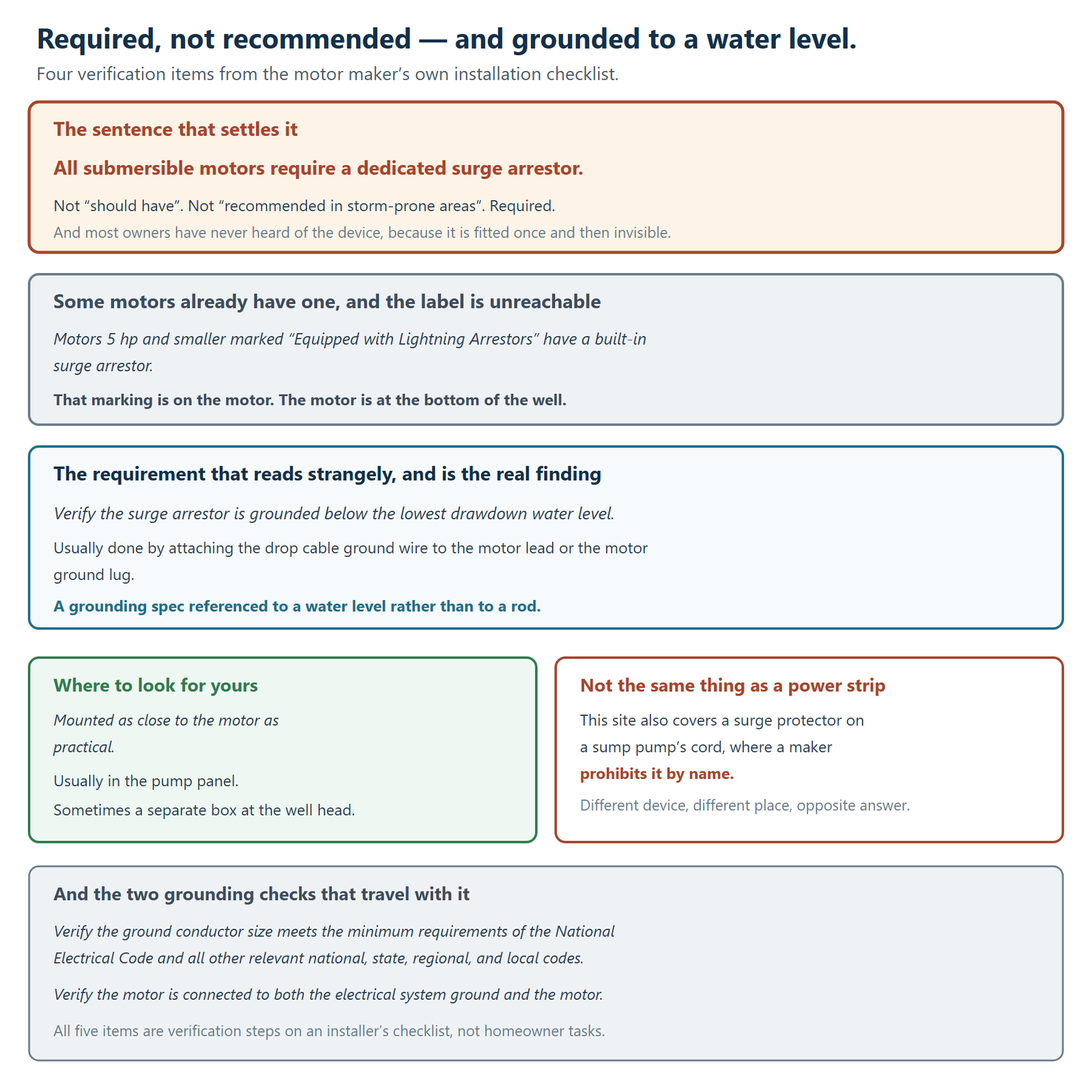
“All submersible motors require a dedicated surge arrestor.”
Not “should have.” Not “recommended in storm-prone areas.” It sits in the manufacturer’s installation checklist as a verification item, alongside the ground conductor size and the motor’s earthing.
And most people with a well have never heard of the device, because it is fitted once by whoever installed the pump and is invisible afterwards.
The strangest part is how it has to be earthed, which is the detail worth the whole page: grounded below the lowest drawdown water level.
What the checklist actually says
From Franklin Electric’s AIM Manual, section 5.0, High Surge Protection:
5.1 “Verify the submersible motor has a dedicated surge arrestor. All submersible motors require a dedicated surge arrestor. Motors 5 hp and smaller marked ‘Equipped with Lightning Arrestors’ have a built-in surge arrestor.”
5.2 “Verify the surge arrestor is mounted as close to the motor as practical. The location is usually in the pump panel, but sometimes it is placed at the well head in a separate electrical box.”
5.3 “Verify the surge arrestor is grounded below the lowest drawdown water level. This is usually accomplished by attaching the drop cable ground wire to the motor lead or the motor ground lug.”
5.4 “Verify the ground conductor size meets the minimum requirements of the National Electrical Code and all other relevant national, state, regional, and local codes.”
5.5 “Verify the motor is connected to both the electrical system ground and the motor.”
Five items, and every one of them is a verification rather than a task. This is a list an installer works through, which is precisely why it never reaches the person who owns the well.
The grounding requirement, which is unlike any other
Read 5.3 again. The arrestor must be grounded below the lowest drawdown water level.
That is a grounding specification referenced to a water level, not to a ground rod, not to a depth, not to the service earth.
The lowest drawdown level is how far the water in the well falls while the pump is running hard. Grounding below it means the connection stays in water under every operating condition.
And the method is published too: attaching the drop cable ground wire to the motor lead or to the motor ground lug — so the ground is made down the well, at the motor, rather than at the surface.
One practical consequence: this is not something you can verify by looking at the panel. It was either done when the pump went in or it was not, and knowing which means asking whoever installed it or looking at the paperwork.
You may already have one, and the label is 200 feet down
The checklist allows for a motor with the arrestor built in:
“Motors 5 hp and smaller marked ‘Equipped with Lightning Arrestors’ have a built-in surge arrestor.”
So there is a label that answers the question directly — on the motor.
Which is at the bottom of the well, on the end of a few hundred feet of pipe and cable. Pulling a submersible is the single biggest job on a domestic well, and nobody is doing it to read a sticker.
What that leaves you, in order of effort:
The installation paperwork, if it exists and if the motor model was recorded.
The panel or the well head. A separate arrestor is a physical device in one of those two places, and both are reachable.
Asking the contractor who installed it, which is the fastest route if the well is not old.
Where to look, in two minutes
The manufacturer names both usual locations: “usually in the pump panel, but sometimes it is placed at the well head in a separate electrical box.”
If your system has a control box on the wall, that is the first place to look — the arrestor commonly lives in or beside it, and the control box is the component most people can actually find.
And on a two-wire motor there is no control box at all, which means the arrestor, if fitted, is at the well head or in the panel.
One-minute check: open nothing. Look at the pump panel and at any small weatherproof box at the well head, and see whether there is a device wired in alongside the controls. That is as far as an owner should go.
What it is not
It is not the same thing as a plug-in surge protector, and the two have opposite answers.
This site also covers a surge protector on a sump pump’s cord, where a manufacturer prohibits it by name because it adds a connection on a wet basement floor. That is a consumer accessory a homeowner adds to a plugged-in appliance.
A submersible surge arrestor is a hard-wired component on a dedicated well circuit, specified by the motor manufacturer. Different device, different place, opposite conclusion — and worth keeping separate in your head.
It is also not a fix for anything. If the breaker is tripping or the control box is clicking without the pump starting, those have their own diagnoses, and an arrestor is not among the causes.
When this needs a pro — which is all of it
Fitting or replacing an arrestor. It is a hard-wired, grounded device on a 230-volt well circuit.
Verifying the grounding. Item 5.3 refers to a water level that most owners do not know, and items 5.4 and 5.5 are code compliance on the earthing system.
Determining whether the motor has one built in, if the paperwork is gone. That is a question for a well contractor with the installation record, not something to establish by inspection.
And anything inside a control box, which contains a start capacitor and is not a place to go looking.
What you can do yourself: look for a separate device in the pump panel or at the well head, find the installation paperwork if you have it, and ask the question. Two minutes and one phone call — and the answer is either “yes, there it is” or a conversation worth having.
FAQ
Does a submersible well pump need a surge arrestor?
The motor manufacturer states that all submersible motors require a dedicated surge arrestor. It appears as a verification item on its installation checklist, alongside ground conductor sizing and motor earthing, rather than as a recommendation.
How do I know if my well pump already has one?
Motors of 5 hp and smaller marked “Equipped with Lightning Arrestors” have one built in — but that marking is on the motor, at the bottom of the well. In practice you check the installation paperwork, or look for a separate arrestor in the pump panel or in a box at the well head.
Where is a well pump surge arrestor fitted?
As close to the motor as practical. The manufacturer names two usual locations: in the pump panel, or at the well head in a separate electrical box.
Why does the arrestor have to be grounded below the water level?
That is the published requirement — grounded below the lowest drawdown water level, usually by attaching the drop cable ground wire to the motor lead or the motor ground lug. It is a grounding specification referenced to a water level rather than to a ground rod.
Is this the same as plugging the pump into a surge protector?
No, and the answers are opposite. A plug-in strip on a pump cord is a consumer accessory, and on a sump pump one manufacturer prohibits it by name. A submersible surge arrestor is a hard-wired component specified by the motor manufacturer for a dedicated well circuit.
Will a surge arrestor fix a pump that keeps tripping the breaker?
No. A tripping breaker has its own list of causes and an arrestor is not among them. It is protective hardware for the motor, not a remedy for an existing fault.


