On this page
Last Updated on October 2, 2026 by Muhammad Toqeer
Note when it trips before you do anything else. At the instant of starting, after running a while, or immediately every time — those are three different faults, and the breaker is telling you which one you have.
The reason the distinction works is a number this site has already published. A 1 hp submersible runs on 8.2 amps and starts on 48.7 — nearly six times its running current.
A breaker is built to tolerate that surge briefly. So a trip at start and a trip after twenty minutes mean completely different things.
The number behind all of it
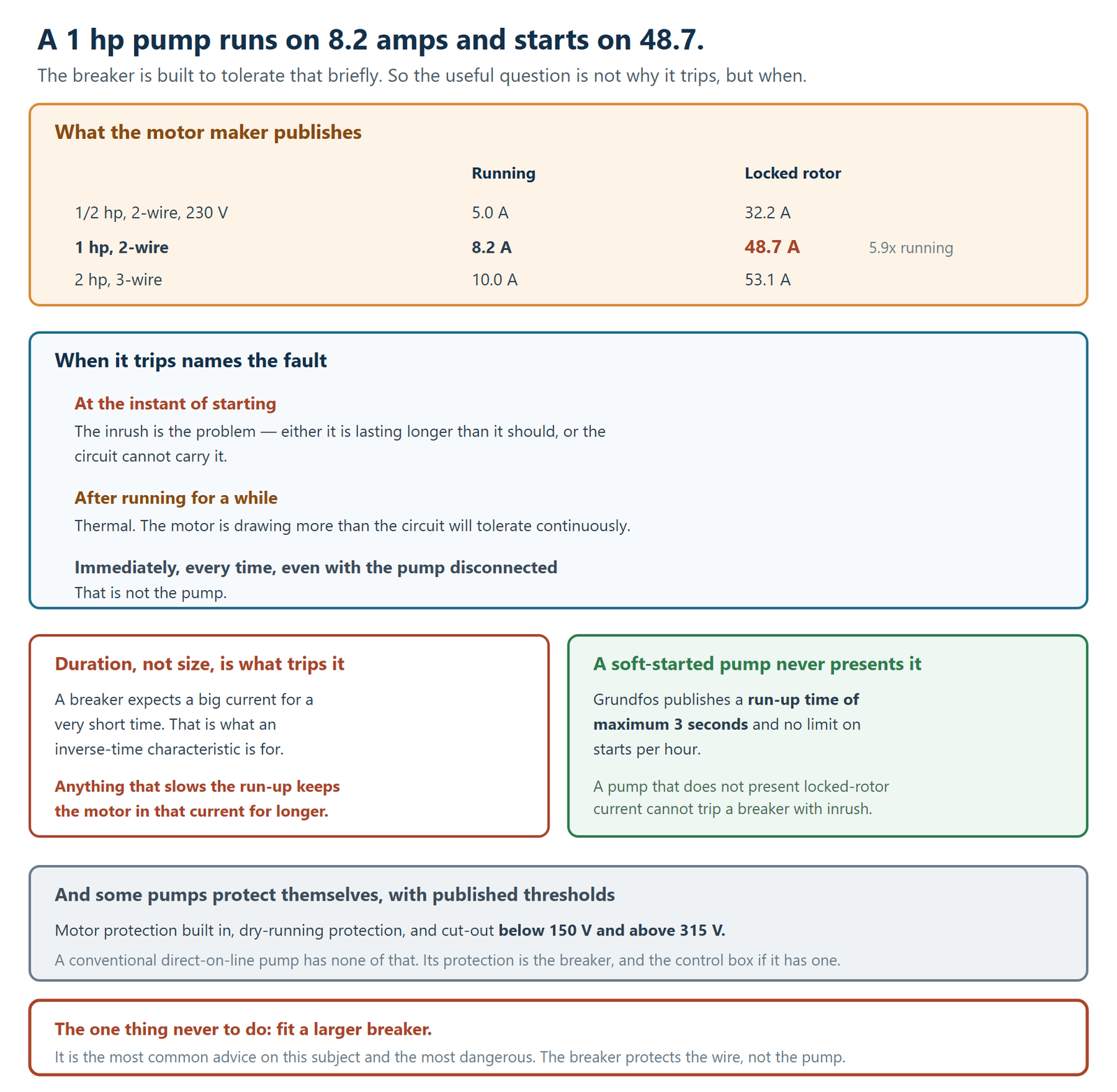
Franklin publishes these, and this site has already used them to size a generator:
| Motor | Running | Locked rotor |
|---|---|---|
| ½ hp, 2-wire, 230 V | 5.0 A | 32.2 A |
| 1 hp, 2-wire | 8.2 A | 48.7 A |
| 2 hp, 3-wire | 10.0 A | 53.1 A |
Locked rotor amps is what the motor demands at the instant it starts, before it is turning. For the 1 hp motor that is 5.9 times its running current.
The same figure is what sizes a generator — there, because the generator has to survive it. Here, because the breaker has to not mind it.
Why that does not trip the breaker on its own
Because breakers are designed for exactly this.
A thermal-magnetic breaker has an inverse-time characteristic: the larger the current, the faster it trips — but a very large current for a very short time is tolerated on purpose, because that is what every motor in a house does when it starts.
So the surge is not the fault. A 48.7-amp draw lasting a fraction of a second is normal behaviour.
What trips the breaker is that current lasting longer than it should.
Which is why the timing is the diagnosis
It trips at the instant of starting
The inrush is the problem, and there are two reasons it can be.
The run-up is taking too long. Anything that stops the motor reaching speed quickly keeps it drawing locked-rotor current — a supply that sags under load, a failing start capacitor or relay on a 3-wire motor, or a pump that is partly obstructed and fighting to turn.
Or the circuit was never right for it. A breaker of the wrong type or rating for a motor load will trip on a surge it should tolerate.
One-minute observation: does it trip on every start, or only sometimes? Intermittent points at the supply — sagging when something else is running. Every time points at the motor or the circuit.
It trips after running for a while
This is thermal, and it is a different problem entirely. The motor is drawing more than the circuit tolerates continuously, and the breaker is doing exactly what it exists for.
A motor working harder than it should — against a restriction, or beyond its curve — draws more current, and current is what heats both the motor and the wire.
One-minute observation: note how long it runs before tripping, and whether that time is getting shorter. A shortening interval is a worsening fault, not a borderline breaker.
It trips immediately, every time, even with the pump disconnected
Then it is not the pump. A breaker that will not stay in with the load removed is reporting something upstream of it, and that is an electrician’s call from the first minute.
The pump that cannot do this at all
Worth knowing, because it explains a category difference rather than a fault.
A soft-started variable-speed pump publishes a run-up time of at most three seconds and no limit on starts per hour. It never presents locked-rotor current to the circuit, so it cannot trip a breaker with inrush.
And some of those pumps protect themselves, with published thresholds — motor protection built in, dry-running protection, and cut-out below 150 volts and above 315 volts.
A conventional direct-on-line pump has none of that. Its protection is the breaker, plus the control box if it is a 3-wire motor — which is one of the three things people mean by “resetting the well pump”.
The one thing never to do
Do not fit a larger breaker.
It is the most common advice on this subject and the most dangerous. The breaker is not protecting the pump. It is protecting the wire in the wall, which is sized for a specific current and does not get bigger because the breaker did.
A breaker that trips is reporting something. Replacing it with one that does not trip removes the report and leaves the cause.
When this needs a pro
All of it, honestly, past noting when it trips.
Measuring anything. This is 230 volts, usually in a damp place, and every manufacturer on this site routes voltage and wiring checks to a licensed electrician.
Deciding the breaker’s size or type. That is a calculation from the motor nameplate and the circuit, and it is not a rule of thumb.
Anything inside a control box. It contains a start capacitor, which stores charge.
Anything down the well. Pulling a submersible is hundreds of feet of pipe, wire and water.
What you can do yourself: note whether it trips at start or after running, whether it happens every time or only sometimes, and whether the interval is shortening. Three observations, no tools — and they tell whoever you call which of three faults they are coming to.
FAQ
Why does my well pump trip the breaker?
Note when. At the instant of starting points at inrush — a run-up that is taking too long, or a circuit that cannot carry it. After running a while points at a thermal overload. Immediately and every time, even disconnected, is not the pump at all.
How many amps does a well pump draw on startup?
Far more than it runs on. Franklin publishes 48.7 locked-rotor amps for a 1 hp two-wire submersible that runs on 8.2 — nearly six times. A half-horsepower motor runs on 5.0 amps and starts on 32.2.
If the surge is normal, why does it trip the breaker?
Because breakers tolerate a large current only briefly. A trip means the motor stayed in that current longer than it should — from low supply voltage, a failing start component on a three-wire motor, or a pump that is fighting to turn.
Can I just fit a bigger breaker?
No. The breaker protects the wiring, not the pump, and the wire does not get bigger because the breaker did. A tripping breaker is a report, and replacing it with one that does not trip removes the report rather than the cause.
Do variable speed well pumps trip breakers?
Not with inrush. A soft-started pump publishes a run-up of at most three seconds and no limit on starts per hour, so it never presents locked-rotor current to the circuit in the first place.
My breaker trips after the pump has run for twenty minutes — is that different?
Yes, completely. That is thermal rather than inrush: the motor is drawing more than the circuit tolerates continuously. Note whether the interval before tripping is getting shorter, because that indicates a worsening fault.


