On this page
Last Updated on September 28, 2026 by Muhammad Toqeer
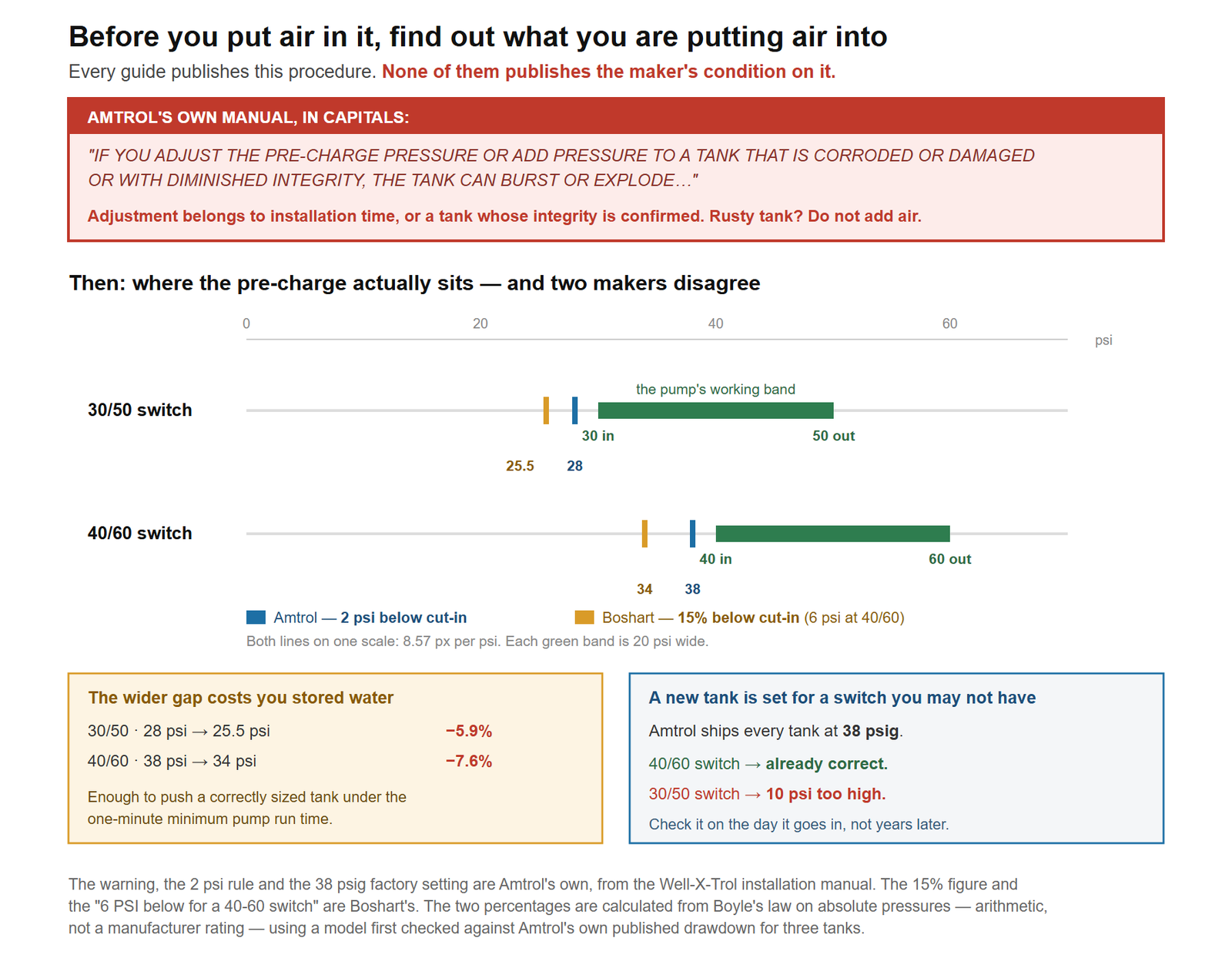
Set the pre-charge below your pressure switch’s cut-in — 28 psi for a 30/50 switch, 38 for a 40/60. That is Amtrol’s rule of 2 psi below cut-in.
But 2 psi is a floor rather than a target, and a second manufacturer says it is not enough once you are above a 20/40 switch. And before any of that, there is a question about the tank itself that no DIY guide on this subject asks.
First: is this tank safe to put air into?
This is not a formality, and it is the reason this article opens here rather than with a tyre gauge.
Amtrol’s own installation manual, in capitals:
“DANGER! EXPLOSION HAZARD. IF YOU ADJUST THE PRE-CHARGE PRESSURE OR ADD PRESSURE TO A TANK THAT IS CORRODED OR DAMAGED OR WITH DIMINISHED INTEGRITY, THE TANK CAN BURST OR EXPLODE, POSSIBLY CAUSING SERIOUS OR FATAL PERSONAL INJURY AND/OR PROPERTY DAMAGE.”
And the scope they put on the job:
“Do not adjust the pre-charge or re-pressurize this Product except for any adjustments required at the time of initial installation, especially if Product is corroded, damaged or has diminished integrity.”
Read that again, because it is the opposite of the usual advice. Amtrol treats pre-charge adjustment as something that belongs to installation day, or to a tank whose integrity has been confirmed — not as annual maintenance on a twelve-year-old tank in a damp basement.
So look at the tank before you look at the gauge. Rust streaks, flaking paint around the base, damp patches, a weeping seam, a bottom that has been standing in water — any of those and the answer is a new tank, not a bicycle pump. A pressure vessel that has been quietly corroding does not announce the moment it stops being able to hold what you are about to put in it.
If it is new, or sound and you can see that it is, carry on.
What you need
- A tyre pressure gauge. The one from the car is fine.
- A bicycle pump or a small compressor, only if the charge turns out to be low.
- A hose on the drain, if you would rather not empty the tank onto the floor.
- Nothing electrical. The pump gets switched off at the breaker and stays off.
The one temperature note nobody mentions. Amtrol: “Adjustments to pre-charge must be done at ambient temperature only.” Air pressure moves with temperature, so setting a charge on a freezing morning in an unheated outbuilding gives you a reading you will not keep.
The procedure
Amtrol’s own sequence is two steps. The detail is in getting step one genuinely complete.
- Switch the pump off at the breaker. Not the switch — the breaker.
- Drain the tank of all water. Open a tap or the tank’s drain and let it run until nothing more comes out. Amtrol: “Make adjustments only when the tank is empty of water and the system is off.”
- Read the Schrader valve at the top of the tank with the tyre gauge, exactly as you would a tyre.
- Add or release air to land on your target — “2 psig below the pressure switch pump cut-in setting.”
- Replace the valve cap, refill, and check the pump cycles normally.
Step two is the whole thing. A tank with water still in it reads system pressure rather than pre-charge, and you will “correct” a number that was never the number. The same trap sits behind most waterlogged-tank misdiagnoses.
And if air will not hold — you set it, it reads low again next week — the bladder has failed. That is not a charging problem and no amount of air fixes it.
A new tank is already set for a switch you may not have
Worth knowing on installation day, because half of buyers need to change nothing and half need to change 10 psi.
Amtrol ships every tank at 38 psig, and their own worked example is “38 psig precharge for a 40/60 pressure.”
| Your switch | Factory 38 psig is… |
|---|---|
| 40/60 | already correct |
| 30/50 | 10 psi too high — set it to 28 |
So the common residential setting is the one that needs adjusting out of the box — on the day it goes in, when the tank is new and the manufacturer says the adjustment belongs.
The 2 psi is a minimum, and it does not scale
Here is where the two manufacturers part company, and it matters more the higher your switch is set.
Boshart, on the same question:
“the 2 PSI is the minimum for a 20-40 switch, it is not enough for a 40-60 switch which should be 6 PSI below”
They give the general form as “10% – 20% below the pressure switch cut-in setting”, with “the mid-range of 15 % will be sufficient.” Those are the same rule — 15% of a 40 psi cut-in is exactly 6 psi.
And the objection is easy to see once it is pointed out. The same 2 psi is a very different margin depending on where you start:
| Cut-in | 2 psi is… | Boshart’s 15% |
|---|---|---|
| 20 psi | 10% | 3 psi |
| 30 psi | 6.7% | 4.5 psi |
| 40 psi | 5% | 6 psi |
The flat rule gets proportionally thinner exactly where the pressures are highest. The margin exists to stop the bladder being driven fully empty against the bottom of the tank on every cycle, and at 5% there is not much of it.
What the choice actually costs
It is not free to go wider, and this is the part neither manufacturer spells out.
A bigger gap between pre-charge and cut-in means less water stored. Running the standard tank arithmetic on absolute pressures:
| Switch | Amtrol (2 psi) | Boshart (15%) | Drawdown lost |
|---|---|---|---|
| 30/50 | 28 psi | 25.5 psi | 5.9% |
| 40/60 | 38 psi | 34 psi | 7.6% |
That is calculated rather than published — but the method was checked against Amtrol’s own drawdown figures for three different tanks first, and it lands within about 5% on all three.
And six per cent is not nothing. A tank’s drawdown has to be at least your pump’s flow in GPM, because the motor needs a one-minute run. A 44-gallon tank giving 13.6 gallons clears that for a 13 GPM pump at 63 seconds. Take 5.9% off and it is 12.8 gallons — 59 seconds, and under the floor.
So the honest answer is that both rules are defensible and they trade against each other. Amtrol’s minimum gets you every drop the tank can hold. Boshart’s margin protects the bladder at higher pressures and costs you a few per cent. If your switch is 30/50 the difference is small. At 40/60 and above, Boshart’s case is stronger — and if your tank is marginal for your pump, go with the smaller gap and size the tank properly instead.
Whatever you choose, change one thing at a time. Moving the switch settings moves the target with them, and a pre-charge set for the old cut-in is simply wrong for the new one.
When this needs a pro
Any tank with visible corrosion. This is the one that matters. Amtrol’s warning is not boilerplate, and a corroded pressure vessel is not a DIY judgement call.
A tank that will not hold its charge. The bladder has gone; it is a replacement, and choosing the replacement is its own decision.
Anything involving the pressure switch itself. Live 240 V under the cover — and the settings interact with the tank.
And the annual check. Amtrol asks for it and is explicit about who does it: “A licensed professional should check the complete system, including the Well-X-Trol, yearly and more frequently as the system ages.”
FAQ
What should my pressure tank be set at?
Below your switch’s cut-in. Amtrol specifies 2 psi below, so 28 psi for a 30/50 switch and 38 for a 40/60. Boshart considers 2 psi a minimum and recommends about 15% below cut-in, which is 6 psi at a 40/60.
How do I check my pressure tank’s air charge?
Switch the pump off at the breaker, drain the tank of all water, then read the Schrader valve on top with a tyre gauge. A reading taken with water still in the tank is system pressure, not pre-charge, and tells you nothing.
Why is my new pressure tank at 38 psi?
That is Amtrol’s factory pre-charge, and it is already correct for a 40/60 switch. If you run 30/50 it is 10 psi too high and should be set down to 28 on the day it is installed.
Can I add air to an old pressure tank?
Not without looking at it first. Amtrol warns that adding pressure to a tank that is corroded, damaged or of diminished integrity can make it burst or explode, and limits the adjustment to installation or to a tank whose condition is confirmed.
What happens if the pre-charge is wrong?
Too high and the tank stores less water and can empty early, giving short pump runs. Too low and the bladder is worked harder and the tank waterlogs sooner. Either way you lose drawdown, which is what keeps the pump running long enough per cycle.
My tank will not hold its air charge. What now?
The bladder has failed. Air escaping into the water side is not something a charge fixes, and the tank needs replacing rather than recharging.


