On this page
Last Updated on September 27, 2026 by Muhammad Toqeer
A click is a contact closing. Something is being told to start and is not starting.
And the click has already told you where to look, because your pump cannot be the thing making it. On a submersible system the motor is at the bottom of the well, under water, on the end of a pipe. You could not hear it click if it tried. Everything capable of making that noise is at the surface, within a few feet of where you are standing.
What you will find there depends entirely on which of three systems you own — and that is the part almost nobody sorts out first.
Before anything else: this is a 240-volt circuit in a damp place. Switch the breaker off before you take a cover off anything. The checks below that need power are called out specifically, and they are the ones worth handing to somebody else.
First, which system do you have?
Open the cover and count the wires going down the well. It takes ten seconds and it decides everything that follows.
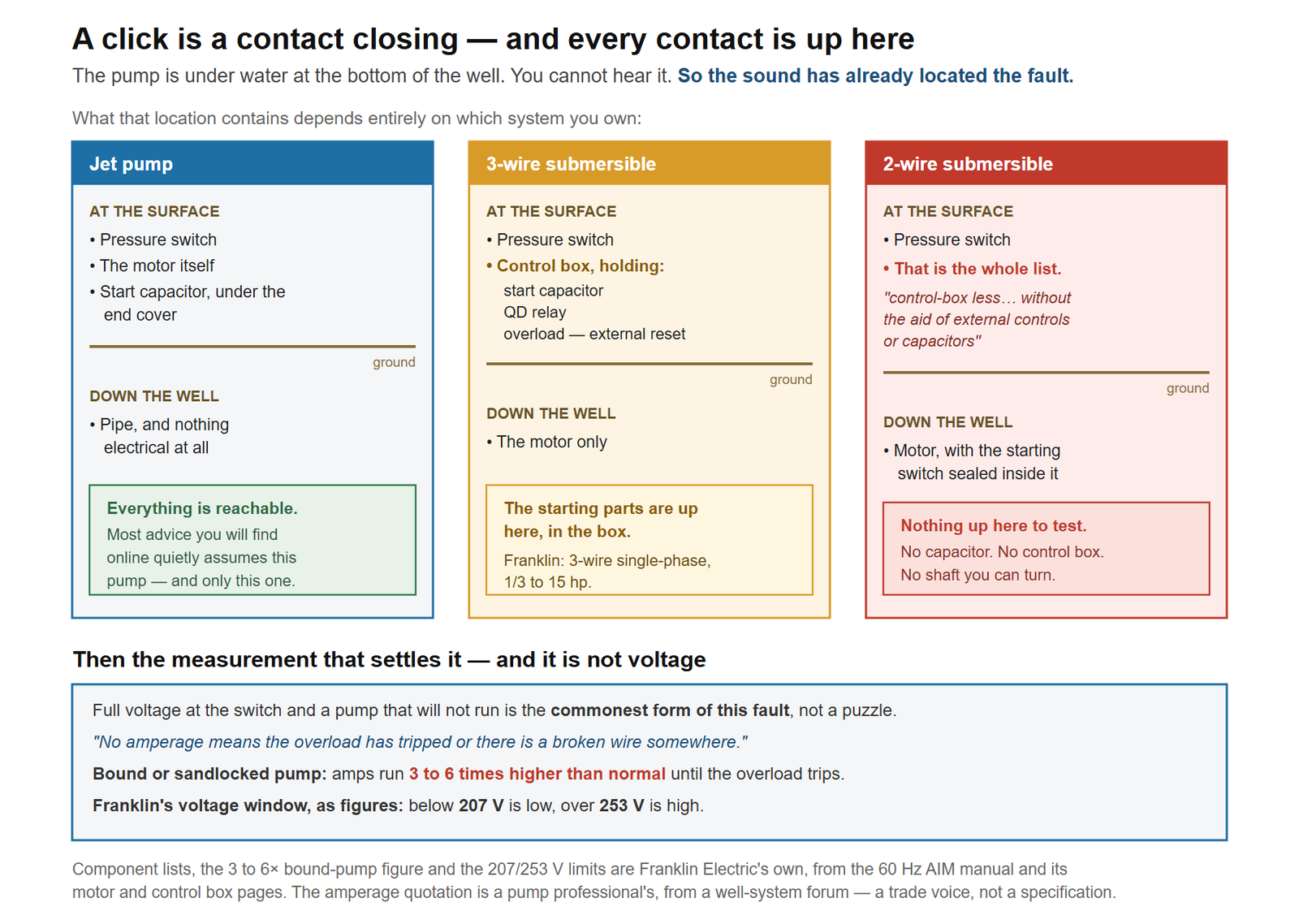
A jet pump sits at the surface, and so does its motor. If the pump is above ground, this is what you have. The start capacitor lives under a cover on the back of the motor. Everything is in front of you.
A 3-wire submersible has a grey or beige box on the wall near the tank — the control box. Franklin makes the common ones, and they are built “specifically for Franklin three-wire, single-phase motors rated 1/3 to 15 hp.” Inside are the start capacitor, the relay, and the overload, which Franklin gives “external access to” for resetting. The motor is down the well; its starting parts are not.
A 2-wire submersible has no control box at all, and this is the one that matters most. Franklin describes these motors as:
“a split phase, control-box less submersible motor for direct connection to a fused power supply”
with
“a long-life electronic switch that allows it to run without the aid of external controls or capacitors.”
The starting switch is sealed inside the motor, hundreds of feet down. So on a 2-wire system there is no capacitor to test, no control box to open, and no relay to replace. If you have been working through a list that told you to do those things, the list was written for a different pump.
So what is actually clicking?
Three candidates, and they sound different.
The pressure switch. A single sharp click as the contacts close, then silence. It is doing its job — it has decided the pressure is low and called for the pump. The fault is downstream of it.
The control box relay, on a 3-wire system. Also a click, from the box rather than the switch. Put a hand on each while somebody switches the breaker on and you can tell which one moved.
The overload protector, cycling — and this is the repeating click, the one that goes every thirty seconds or so and will not stop. Franklin describes the loop exactly, for a 2-wire motor that cannot get going:
“…the motor may not start; however, there will be current in the main winding until the overload protector interrupts the circuit. The time for the protector to reset is longer than the reset of the starting switch.”
Read that as a cycle. The motor tries. It fails. Current keeps flowing in the main winding, so the overload heats up and cuts out. It cools, resets, and lets it try again. A rhythmic click on a repeating interval is a motor being protected from itself — and it means something down the well is wrong, not up here.
Switch it off if it is doing that. Each cycle is a locked-rotor current event, and Franklin’s cycling damage list is the reason a cheap fault turns into an expensive one while you listen to it.
The measurement that settles it, and it is not voltage
Nearly every article on this subject tells you to check for 230 volts at the switch. That check is worth doing and it proves far less than people think.
Here is the case that shows why. A homeowner on Terry Love’s forum had a Franklin ½ hp control box, a Square D switch set 30/50, and a pump that would not run. He checked everything the guides say to check: the breaker had not tripped, the contacts were closed and not burnt, and “both the supply side and the motor side are reading 240 volts.” Textbook readings, dead pump.
Voltage is what the circuit is offering. Amperage is what the motor is taking. A pump professional in that thread put the consequence plainly:
“No amperage means the overload has tripped or there is a broken wire somewhere.”
A clamp meter around one of the wires to the pump answers this and a multimeter cannot. Voltage present and amps at zero is not a mystery — it is a specific finding that points at an open circuit between the switch and the motor windings.
One honest caveat about that thread: the homeowner shut the breaker off and never posted again, so nobody knows what it turned out to be. The reasoning is a professional’s and it is sound. The ending is not there.
The causes, and a test for each
Worked roughly in the order they actually turn out to be the problem.
The overload has tripped, and heat is why
On a 3-wire box the overload has an external reset. Before you press it, put your hand on the box.
“Direct sunlight or other heat source can raise control box temperature causing protectors to trip. The box must not be hot to touch. Shade box, provide ventilation.”
That is a genuine one-second test and almost nobody lists it. A control box in afternoon sun on a south wall, or boxed into an unventilated pump house, trips on ambient heat alone and will keep doing it every hot afternoon until it is shaded.
Cold is the other end of it, and worse, because it removes the protection rather than triggering it. Franklin: “Operating control boxes below +14 °F can cause reduced starting torque and loss of overload protection when overloads are located in control boxes.” An unheated pump house in a hard winter is a real cause of a no-start.
A reset that holds is a fix. A reset that trips again is a diagnosis — something is drawing too much current, and the next section is where to look.
The reset itself is a separate procedure, and which one you have depends on your system — the breaker, the control box overload and the pressure switch lever are three different things.
The pump is bound or sandlocked
This is the one with a published signature, and it is how you tell a seized pump from everything else without pulling anything:
“Bound pump — Check for misalignment between pump and motor or a sand bound pump. Amp readings will be 3 to 6 times higher than normal until the overload trips. Pull pump and correct problem.”
Three to six times normal. Nothing else on this list does that. If you have a clamp meter on it and the needle jumps to several times the nameplate figure for a second before the overload cuts out, the pump is locked and the answer is to pull it.
Franklin’s 2-wire motors are designed to fight this on their own: “When the motor is not free to turn, as with a sandlocked pump, the BIAC switch creates a reverse impact torque in the motor in either direction. When the sand is dislodged, the motor will start and operate in the correct direction.” Sometimes it frees itself. If it has not after a few cycles, it is not going to.
The voltage really is wrong
Franklin’s tolerance is ± 10% of rated voltage — “Contact power company if voltage is incorrect.” Their protection products put the same window in plain figures, which is easier to use:
| Reading | Verdict |
|---|---|
| Below 207 V | Low line voltage |
| 207–253 V | Within tolerance |
| Over 253 V | High line voltage |
A motor that clicks and hums but will not turn on a hot evening, when the whole street is running air conditioning, is a classic low-voltage no-start. Measure it while it is trying to start, not with everything idle — the same trap as taking a pressure reading with the house shut.
The contacts are burnt
Pitted, blackened or welded contacts pass some current and not enough. They click and the pump does nothing.
Worth knowing why they got that way: rapid cycling burns them out, so a switch that has failed like this is usually reporting a second fault rather than being the whole story. Replace the switch and fix the cycling, or you will do it again.
Loose or corroded connections
Unglamorous and common. Franklin’s own list puts “Defective wiring — check for loose or corroded connections” alongside the component failures, and a well cap or a switch in a damp basement is exactly where that happens. Power off, then look and wiggle.
The capacitor — on a jet pump or a 3-wire box only
A failed start capacitor gives you the textbook symptom: it clicks, it may hum, it does not turn. Often the case is visibly bulged or leaking.
This guide will not walk you through testing one. A capacitor stores a charge after the power is off and can hold it for a long time. This is the point where a homeowner job becomes a trade job, and it is a cheap call-out.
And on a 2-wire system, skip this entirely — there is no capacitor up here to be at fault.
Two things the internet will tell you to do that you cannot
“Turn the motor shaft by hand to see if it is seized.” Fine on a jet pump, where the motor is in front of you. Impossible on any submersible — the motor is on the end of a pipe at the bottom of a well. The amp reading above is how you answer that question instead.
“Open the control box and check the capacitor.” Only if you have a control box. 2-wire systems do not, and no amount of looking will produce one.
When this needs a pro
Anything that means pulling the pump. A bound pump, a failed motor, a broken wire down the well — all of them are a rig and two people.
Any measurement taken with the cover off and the power on. Reading amps on a live 240-volt circuit is routine for someone who does it daily and genuinely dangerous if it is not.
A capacitor, for the reason above.
An overload that trips again after a reset. Resetting it a third time is not troubleshooting; it is removing the only thing protecting the motor.
And if the motor runs but no water arrives, this is the wrong article — that is a different fault with a different list.
And where the motor turns out to be finished, size the replacement on flow at your own pressure rather than matching the horsepower of the one that failed.
FAQ
Why does my well pump click but not start?
Something is closing a contact and the motor is not responding. The click comes from the pressure switch, the control box relay, or an overload cycling — all at the surface. Common causes are a tripped overload, a bound pump, low voltage, burnt contacts or a failed start capacitor.
Where is the clicking sound coming from?
Not from the pump. On a submersible system the motor is under water at the bottom of the well and cannot be heard. The sound is the pressure switch or, on a 3-wire system, the relay in the control box.
My pump clicks every 30 seconds. What is that?
An overload protector cycling. The motor tries to start, fails, current keeps flowing, the overload heats and cuts out, then cools and lets it try again. Switch the breaker off — each attempt is drawing locked-rotor current.
I have 240 volts at the pressure switch. Why won’t the pump run?
Voltage only proves the circuit is offering power; it does not prove the motor is taking any. Measure amperage with a clamp meter. No amps means the overload has tripped or there is a break between the switch and the windings.
How do I know if I have a 2-wire or 3-wire pump?
Look for a control box near the pressure tank. A 3-wire system has one, holding the start capacitor and relay. A 2-wire system has none — Franklin builds those motors “control-box less”, with the starting switch sealed inside the motor down the well.
Can I fix a clicking well pump myself?
Some of it. Checking whether the control box is hot, looking for loose connections and resetting an overload once are reasonable. Testing capacitors, taking live amp readings and anything requiring the pump to be pulled are not.


