On this page
Last Updated on October 13, 2026 by umar bwn
A jet pump that’s grinding is almost always a worn motor bearing — the motor sits right next to you, sealed and permanently lubricated, and when that bearing goes you hear it directly. A submersible that seems to growl is a different animal: the motor is hundreds of feet down, and in most cases what’s reaching your ears isn’t the bearing at all. Which one you have decides everything that follows, so start there.
Jet pump or submersible — check this first
Look at where your pressure tank and controls sit. If there’s a pump body bolted to the wall or floor near the tank, with its own motor you can put a hand near, that’s a jet pump — the whole unit is above ground. If the tank and switch sit alone with no visible pump, and a wellhead or pitless adapter is the only thing poking out of the ground outside, you have a submersible, and the motor is down in the casing with the pump.
This matters because a jet pump motor is a standard surface-mounted unit with sealed ball bearings at each end of the shaft — not a lubrication fitting to grease, just a wear item that eventually fails. A submersible’s bearings sit on a shaft under hundreds of feet of water and pipe, and almost nothing about that construction can send a raw grinding sound up to where you’re standing. Two different parts, two different diagnostic paths.
If it’s a jet pump: the sound is the bearing
A jet pump motor’s ball bearings are sealed at the factory — Goulds and Xylem’s literature on their J-series motors describes them as permanently lubricated, with no serviceable grease point. That’s a maintenance decision the manufacturer already made for you: there is no re-lubrication step to try, whatever some lists imply. Once the bearing surface wears, metal runs against metal and the motor growls, then grinds, then seizes.
One-minute test: with the pump running, put your hand flat on the motor housing near each end bearing (not on anything spinning) and feel for a rough, buzzing vibration distinct from normal hum. Then kill power at the breaker and try turning the motor shaft by hand through the fan opening at the back — a healthy bearing turns smoothly with even resistance; a failing one catches, grinds, or has noticeable side-to-side play.
If you feel that play or roughness, the verdict is the motor end, not the pump end. On most residential jet pumps the motor is a sealed assembly bolted to the pump housing — replacing just the bearing isn’t a homeowner repair, and on most models it isn’t a repair at all. Compare a new motor-and-pump assembly against a rebuild before you commit to either; on an older unit the rebuild rarely comes out ahead.
If it’s a submersible: you’re probably not hearing the bearing
This is where most of what you’ll read gets it wrong, and it’s worth saying plainly why. Some repair-contractor sites tell you a submersible sits too deep to hear directly — true — and then, a few paragraphs later, list “grinding” and “bearing failure” as the top cause of a noisy submersible pump, with no mention that the two statements don’t fit together. Nobody explains how a raw mechanical sound is supposed to travel up through several hundred feet of water, steel pipe, and soil-coupled casing to reach your ears at the surface. It almost never does. So if a submersible system sounds like it’s grinding or growling, work through what can actually carry a sound that far before you assume the worst.
Cause 1: drop-pipe resonance
A submersible pump vibrates at its own frequency, and if the length of drop pipe above it happens to match that frequency, the whole column can resonate and hum or growl audibly through the house plumbing — sometimes described as a growl you can feel through the floor near the pressure tank. This isn’t a failing part; it’s two numbers lining up by coincidence.
One-minute test: run a tap and listen at the pressure tank, the well cap, and a faucet on the same level as the tank. If the sound is loudest and most uniform at the tank and fades the farther you get from the plumbing, you’re hearing the pipe, not the pump. The fix, when it’s needed at all, is usually shortening or lengthening the drop pipe by a foot or two to detune it — a well contractor’s job, not a parts swap.
Cause 2: surface-side hardware, not the pump at all
A loud well-system noise that sounds alarming at the pressure tank is often the check valve or pitless adapter fitting, not anything underground. A chattering or banging check valve under water-hammer stress can sound like something is grinding if you’re not used to isolating it by ear. (We cover the mechanism and fix in our write-up on well pump banging noise if what you’re hearing is closer to a bang or thud than a continuous growl.)
One-minute test: shut off the pump at the breaker, then open a faucet to bleed pressure slowly. If the noise occurs on the way down rather than only while the pump runs, it’s hardware reacting to pressure change, not the motor.
Cause 3: electrical hum, not mechanical wear
Franklin Electric’s own motor manual notes that a submersible system is “normally not a source of problem noise,” but says tolerances in the electrical system can occasionally create an audible hum, and that adding a run capacitor is one documented fix. This is a narrower, rarer cause than either of the above, and it sounds electrical — a steady hum, not a grinding or growling cadence that changes with load.
One-minute test: if the sound is a flat, continuous hum rather than something that grinds or growls unevenly, and it’s present even right at start-up before any water is moving, treat it as electrical and have whoever services your control box check the capacitor and connections — this is breaker-and-240V territory, not a DIY check.
When it actually is the motor
Here’s the honest gap in all of this: Franklin’s own detailed troubleshooting chart for submersible motors has no row at all for “running and making noise.” Its chart covers a motor that won’t start and one that trips its overload — not one that’s running and sounds wrong. That’s not an oversight so much as a fact worth knowing: the manufacturer most of this advice traces back to doesn’t document the symptom you’re trying to diagnose, which is exactly why so many sources guess at “bearing wear” with nothing to back it.
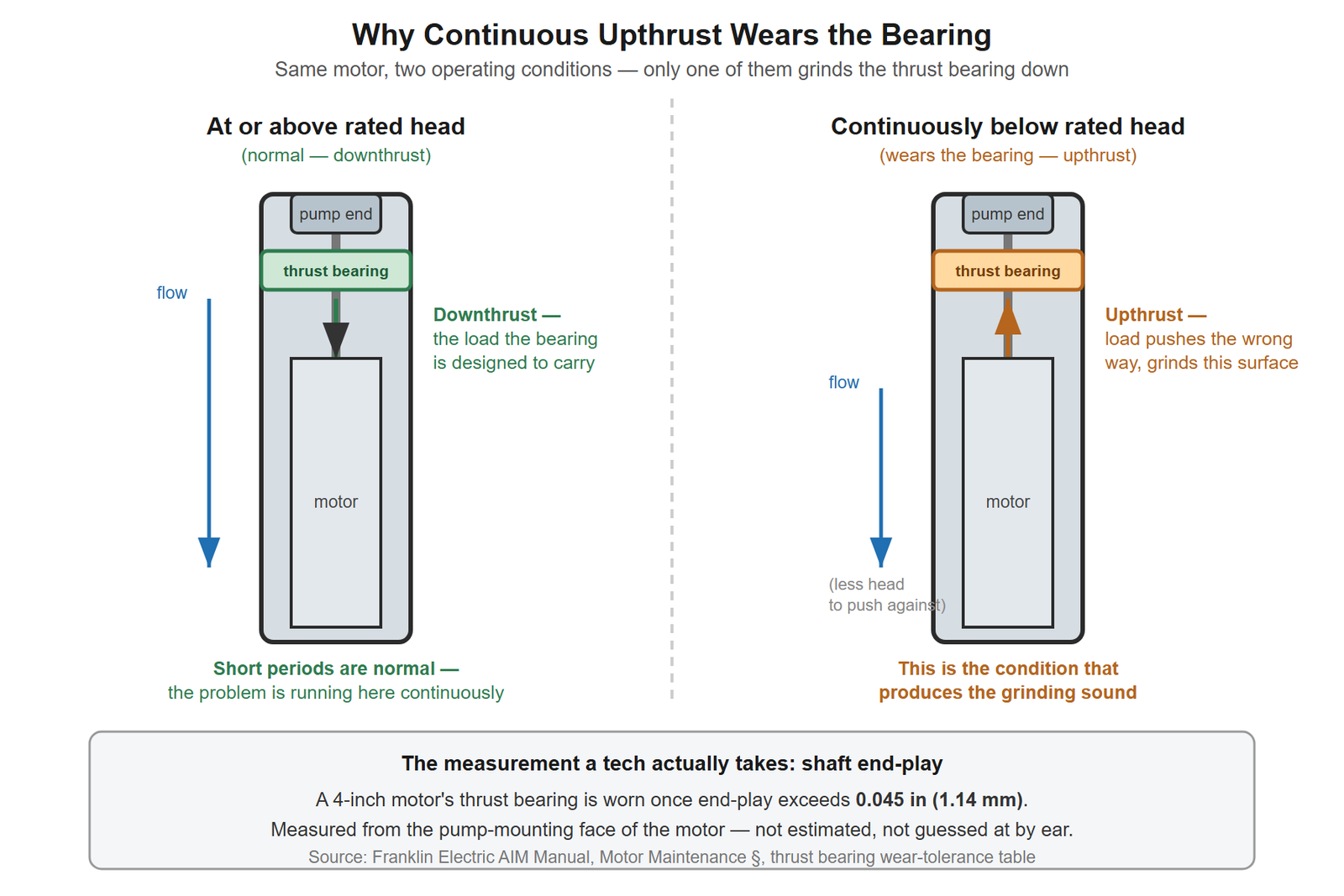
When a submersible bearing does fail, it’s usually for a specific, named reason, not just age. Franklin’s AIM manual describes thrust-bearing wear as driven by continuous upthrust — the pump running with the water level or demand below its rated operating head, which pushes the shaft load the wrong way against a bearing designed to carry load in the other direction. Franklin is explicit that occasional upthrust at each start is normal; it’s running there continuously that wears the bearing early. Horizontal or near-horizontal mounting makes it worse. (If your pump was set without regard for this, our guide to well pump setting depth and motor cooling covers the related clearance rule a lot of installs get wrong in the same direction.)
The actual confirmation isn’t something you can do from the surface: a technician pulls the motor and measures shaft end-play against a published tolerance — 0.045 in (1.14 mm) maximum on a common 4-inch motor. Exceed that and the thrust bearing gets replaced, which on most residential submersible units means replacing the motor, and often the whole pump end along with it given its age by that point.
So if you’ve ruled out resonance, surface hardware, and electrical hum, and the sound keeps getting worse, you’re not looking at a repair you can scope out yourself. Our best deep-well submersible pump guide is the right next stop — not because every growl ends there, but because once the first three causes are ruled out, a worsening sound from a submersible genuinely does mean it’s time to start pricing a replacement rather than waiting for it to fail on its own schedule.
When this needs a pro
Anything that involves pulling a submersible pump — disconnecting the drop pipe, lifting pipe and pump out of the casing, working at the wellhead — is a well contractor’s job, not a solo weekend project: the pump and pipe assembly is heavy, the wiring runs on a dedicated 240V circuit that needs to be locked out first, and a pitless adapter seal that gets damaged on the way back down means a second pull. A jet pump motor bearing replacement is smaller in scale but still means working inside a wired-in 240V motor housing; if you’re not comfortable killing power at the breaker and verifying it’s dead before you touch anything inside that housing, that’s also a call to make rather than a step to push through.
One more distinction worth keeping straight while you’re diagnosing: a grinding or growling sound while the pump runs is a different symptom from a pump that clicks and won’t start at all. That’s an electrical fault at the surface controls, not a mechanical one in the pump — covered separately in our well pump clicking but not starting guide — and it’s also worth knowing that rapid short-cycling can damage bearings through a different mechanism than the one here (cycling stress rather than continuous upthrust); our short-cycling article covers that failure path and how to tell if that’s what’s actually going on with your system.


