On this page
- What the checklist asks for
- The one that is genuinely counter-intuitive
- And the remedy is a component most owners have never heard of
- Read "clear water" literally
- Cooling needs movement, not just immersion
- This is the second constraint, not a replacement for the first
- What you would need to work this out
- When this needs a pro
- FAQ
Last Updated on October 6, 2026 by Muhammad Toqeer
The number is ten feet, and it is measured the way nobody expects:
“Verify there is a minimum of 10 feet of clear water between the bottom of the motor and the bottom of the well.”
Not submergence above the pump. Clearance below the motor.
**And it is in a section of the manufacturer’s checklist headed Motor Cooling — because a submersible motor is cooled by the water travelling past it on its way to the intake. Setting depth is a cooling decision as much as a hydraulic one**, and that half of it is missing from almost everything written on the subject.
What the checklist asks for
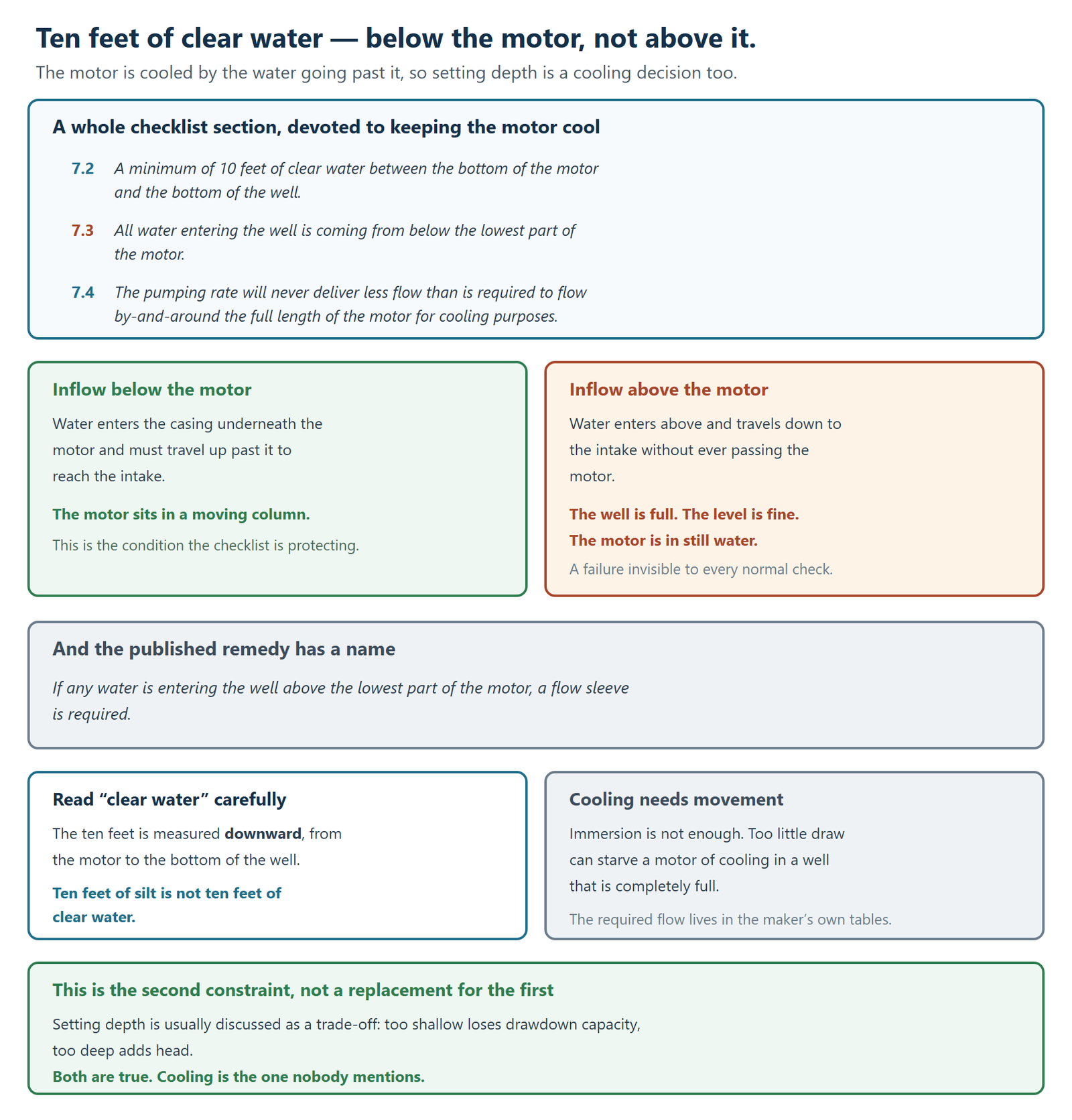
From Franklin Electric’s AIM Manual, section 7.0, Motor Cooling:
7.1 “Verify that the well water temperature does not exceed the maximum ambient temperature indicated on the nameplate of the motor.”
7.2 “Verify there is a minimum of 10 feet of clear water between the bottom of the motor and the bottom of the well.”
7.3 “Verify that all water entering the well is coming from below the lowest part of the motor.”
7.4 “Verify the system pumping rate will never deliver less flow than is required… to flow by-and-around the full length of the motor for cooling purposes.”
Four verification items, and all four are about the same thing: keeping water moving past the motor.
The one that is genuinely counter-intuitive
Item 7.3 is the finding worth the page.
“Verify that all water entering the well is coming from below the lowest part of the motor.”
Think about what happens when it is not.
Water entering the casing above the motor travels downward to the pump intake — without ever passing the motor. The pump draws it in, the house gets water, and the motor sits in a column that is not moving.
The well is full. The level is fine. The flow is fine. And the motor is cooking.
That is a failure mode invisible to every ordinary check, because every ordinary check looks at water level and delivery, and both of those are healthy.
One-minute observation, if you have the well log: look at where the producing zone or the screen sits relative to your pump setting. If water is coming in above the motor, this applies to you.
And the remedy is a component most owners have never heard of
The Notice that closes the section:
“If any water is entering the well above the lowest part of the motor, a flow sleeve is required.“
A flow sleeve is a shroud around the motor that forces incoming water to travel down and then up past the motor before it can reach the intake. It restores the cooling path that the inflow position destroyed.
“Required”, not “recommended” — and it is specified by a condition the owner has no way of observing from the surface.
This is worth asking about on any well where the pump has been replaced and the new one failed early. It is the kind of thing that gets omitted on a swap, because the swap is treated as like-for-like.
Read “clear water” literally
Back to the ten feet, and two details in that sentence.
It is measured downward. From the bottom of the motor to the bottom of the well — not from the pump up to the static water level, which is what people usually mean by submergence.
And “clear water” is doing real work. A well with ten feet of accumulated silt and sediment at the bottom does not have ten feet of clear water. The clearance is to usable water, not to the physical bottom of the hole.
Which is why this spec drifts over time in a well that is making sediment — the clearance you installed with is not the clearance you have in year fifteen.
Cooling needs movement, not just immersion
Item 7.4 is the one that surprises people who assume a submerged motor is a cooled motor.
“…will never deliver less flow than is required… to flow by-and-around the full length of the motor for cooling purposes.”
So a motor can be fully underwater and still be under-cooled, if the rate at which water moves past it is too low.
The manufacturer refers to its own tables for the required flow rather than giving a single figure, so there is no number to quote here — and this page will not invent one. What matters is knowing the requirement exists, because it turns “is it deep enough?” into “is enough water moving past it?”
And it connects to something this site has already published. A motor that is working harder than it should draws more current, and current is what heats both the motor and the wire — cooling and electrical load are the same problem seen from two ends.
This is the second constraint, not a replacement for the first
Setting depth is normally discussed as a trade-off, and that discussion is correct as far as it goes.
Too shallow and you lose capacity to drawdown; too deep and you add head — that is the hydraulic frame, and it is in the sizing article where it belongs.
Cooling is the constraint that sits underneath it, and it can rule out a setting the hydraulics would happily accept.
Both have to be satisfied. A setting that gives you beautiful drawdown and puts the motor above the inflow is not a good setting.
What you would need to work this out
And this is where it stops being a homeowner calculation.
The well log — total depth, casing, where the producing zone or screen sits.
Static and drawdown water levels, which change with season and with use.
The motor’s nameplate ambient temperature, item 7.1, against the actual well water temperature.
The pump’s own specification, because flow and horsepower both feed into the cooling requirement.
Three of those four are in a document you may not have, and the fourth is at the bottom of the well.
When this needs a pro
All of it, honestly, past reading your own well log.
Choosing a setting depth. It is four constraints at once — drawdown, head, cooling and sediment — and getting it wrong only becomes obvious once the pump is back down the hole.
Deciding whether a flow sleeve is needed. That depends on where water enters the casing, which is a well-construction question.
Anything that involves pulling or re-setting the pump. That is hundreds of feet of pipe, wire and water.
And a pump that has failed early for no obvious reason. If it ran and delivered nothing, that has its own diagnosis — but a motor that keeps failing in a well that seems fine is worth asking the cooling questions about.
What you can do yourself: find the well log, note the total depth and where the pump is set, and look at whether the producing zone is above or below that point. Three facts off a piece of paper — and they tell a contractor in one sentence whether the cooling constraints are satisfied.
FAQ
How deep should a submersible well pump be set?
There is no single answer, but there is a published minimum clearance: at least 10 feet of clear water between the bottom of the motor and the bottom of the well. That is measured downward, not as submergence above the pump, and it sits in the manufacturer’s motor cooling checklist.
Why does a well pump motor need water flowing past it?
Because that is how it is cooled. The manufacturer requires that the pumping rate never delivers less flow than is needed to flow by-and-around the full length of the motor, which means a fully submerged motor can still be under-cooled if too little water is moving.
Can a well pump overheat even when the well is full?
Yes, and it is the counter-intuitive case. If water enters the casing above the motor, it travels down to the intake without ever passing the motor. The level is fine, the delivery is fine, and the motor sits in still water.
What is a flow sleeve on a well pump?
A shroud that forces incoming water to pass the motor before reaching the intake. The manufacturer states that if any water is entering the well above the lowest part of the motor, a flow sleeve is required — so it is specified by well construction rather than chosen.
Does “10 feet of clear water” mean 10 feet of submergence?
No. It is the clearance between the bottom of the motor and the bottom of the well, measured downward. And “clear water” is literal — accumulated silt at the bottom of the well does not count toward it, which is why the figure drifts over the years in a sediment-producing well.
Isn’t setting depth just about drawdown and head?
Those are the usual considerations and they are real — too shallow loses drawdown capacity, too deep adds head. Cooling is a second set of constraints underneath them, and it can rule out a depth the hydraulics would accept.


