On this page
Last Updated on September 30, 2026 by Muhammad Toqeer
Yes, you can pump it out. That is not the thing to do first. The question a flooded well pit raises is whether that water got into the casing — and if it did, this is a drinking-water problem that a pump does not touch.
Start with the reason the pit is a problem at all. Every rule about the top of a well is written to keep it above water. A pit puts it in a hole.
Which is why new ones are not permitted anywhere.
The inversion, in the code’s own numbers
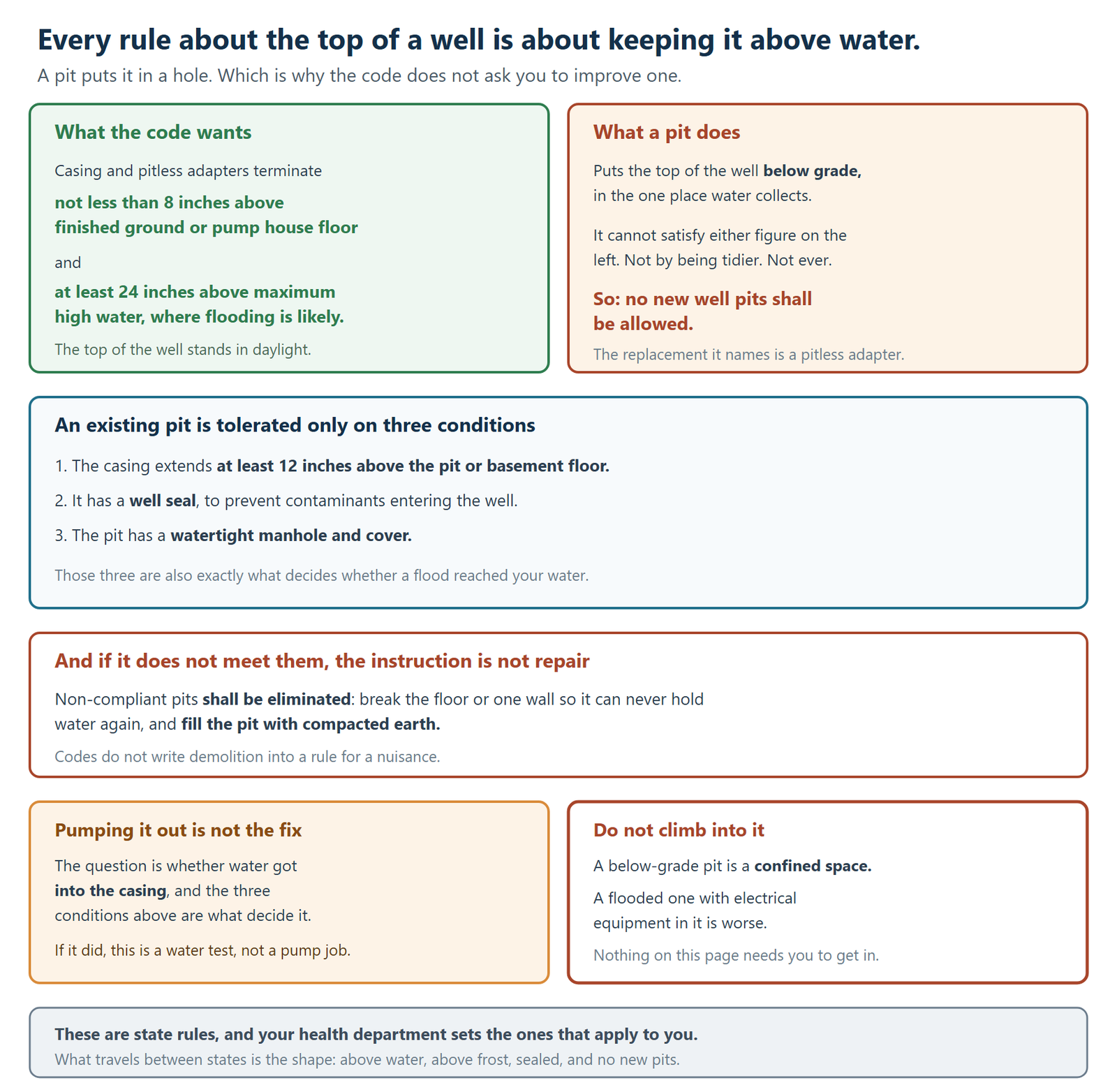
What the code asks for, in Illinois’ wording, which is explicit and typical:
“Well casing and pitless well adapters shall terminate not less than 8 inches above the finished ground surface or pump house floor and at least 24 inches above maximum high water level in areas where flooding is likely to occur.”
Eight inches above the ground. Twenty-four inches above high water. The top of the well is supposed to stand in daylight where you can see it and water cannot reach it.
A well pit is a chamber sunk below grade with the wellhead inside it. It cannot meet either figure. Not with better drainage, not with a sump in the bottom, not ever — the geometry is the problem.
So the rule is blunt:
“No new well pits shall be allowed.”
And the code names what replaced them. A pitless adapter lets the water line leave the casing below the frost line while the casing itself continues up into the open air:
“No well casing shall be cut off or cut into below ground surface except to install a pitless well adapter below the frost level.”
Above water and below frost at the same time — which is the thing a pit was invented to achieve and achieves by the wrong method.
Why yours is still there, and what it has to meet
Plenty of pits are perfectly legal, because they predate the prohibition. They are tolerated under conditions, and those conditions are the ones you now need to check.
“The casing shall extend at least 12 inches above the pit or basement floor and have a well seal to prevent contaminants from entering the well.”
“A watertight manhole and cover must be provided for the pit.”
Three things, then:
- Twelve inches of casing standing above the pit floor
- A well seal on top of that casing
- A watertight manhole and cover on the pit itself
Now read those again as a flood question, because that is what they are. If the water in your pit stayed below the top of the casing and the seal is sound, the well was defended. If the water went over the top, or the seal is not sound, it was not.
That is the whole diagnosis, and it takes one look.
The sentence that tells you how seriously the code takes this
For a pit that does not meet those conditions, the instruction is not to fix it.
“Existing pits which are not in compliance with subsection (b)(2) shall be eliminated and the floor or one wall of the pit shall be broken or removed and the pit shall be filled with compacted earth.”
Break the floor or a wall so it can never hold water again. Fill it in.
Codes do not write demolition into a rule for something that is merely inconvenient. If you take one thing from this page, take the fact that the regulation’s own remedy for a bad well pit is to destroy it.
So what do you actually do
Do not climb into it. A below-grade chamber is a confined space, and a flooded one containing electrical equipment is a worse one. Nothing on this page requires you to get in, and the things that do require it are somebody else’s job.
Look from the top. Is the casing standing well proud of the water? Is there a cap or seal on it, and does it look sound and in place?
If the water was over the casing top, or you cannot tell: treat the water as suspect and get it tested. That is a call to your county or state health department, and it is the actual response to this event.
If you are going to remove the water, do it knowing it changes nothing about the above. A submersible pump chosen for dirty standing water is the right tool — but this is housekeeping, not remediation.
And expect it to happen again, because a hole that filled once is a hole. The permanent answer is conversion to a pitless adapter and elimination of the pit, which is what the code has been steering everyone toward for decades.
What this is not
It is not the reason your pump is not delivering water. That has its own list of causes and they start at the wellhead for different reasons. A flooded pit and a pump that will not pump are two separate findings that happen to live in the same hole.
It is not something a cover alone settles. A watertight cover is one of three conditions, not a substitute for the other two.
And it is not a reason to panic about your water without testing it. Suspect is not the same as contaminated. The point of the three conditions is that they tell you which one you are in, and the test tells you for certain.
When this needs a pro
Everything structural. Converting to a pitless adapter means working on the casing below grade, and the code specifically restricts cutting a casing below ground to exactly that purpose.
Anything electrical in or near the pit. Wet, below grade, and usually 240 volts.
Entering the pit at all. Confined space, and licensed well contractors have procedures for it that a homeowner does not.
The water test and its interpretation. Your well system is its own trade, and your health department is the authority on what a result means.
What you can do yourself: look in from the top and note two things — how far the casing stands above the water line, and whether the seal is on and intact. Two observations, no entry, and they are exactly what whoever you call will ask first.
One jurisdiction note, and it matters. These figures are from one state’s code because its wording is explicit and typical. Washington prohibits pit completion too, and every state has its own version. Your state and county health department set the rule that applies to you. What travels is the shape: above water, above frost, sealed, and no new pits.
FAQ
Is water in a well pit normal?
It is common and it is not acceptable. Well pits collect water because they are below grade, which is the reason new ones are prohibited. Whether it matters depends on whether the water reached the top of the casing.
Can I just pump the water out of my well pit?
You can, and it does not answer the question the flooding raised. What matters is whether water got into the casing, which is decided by how far the casing stands above the pit floor and whether the well seal is sound.
Are well pits illegal?
New ones are prohibited in many states — Illinois’ code says plainly that no new well pits shall be allowed, and Washington prohibits pit completion. Existing pits are tolerated where they meet specific conditions, and must be eliminated where they do not.
What replaced the well pit?
A pitless adapter. It allows the water line to leave the casing below the frost line while the casing itself continues up above ground, which achieves frost protection without putting the top of the well in a hole.
How high should a well casing be?
Codes commonly require the casing and pitless adapter to terminate at least 8 inches above finished ground or the pump house floor, and at least 24 inches above maximum high water where flooding is likely. Inside an existing pit, at least 12 inches above the pit floor.
Should I test my well water after the pit floods?
If the water was above the top of the casing, or you cannot tell, yes — and the test is arranged through your county or state health department rather than guessed at. Suspect is not the same as contaminated, and only a test distinguishes them.


