On this page
Last Updated on September 28, 2026 by Muhammad Toqeer
Time one run. Franklin Electric, whose motors are in most American residential wells, puts the floor in writing: “Motors should run a minimum of one minute to dissipate heat build up from starting current.”
Under a minute and you are below the motor maker’s own limit. That is the test, and it needs nothing but a phone.
Is it actually short cycling?
Every article on this subject uses the phrase and none of them says what counts. There are two published numbers, and both come from the same manual.
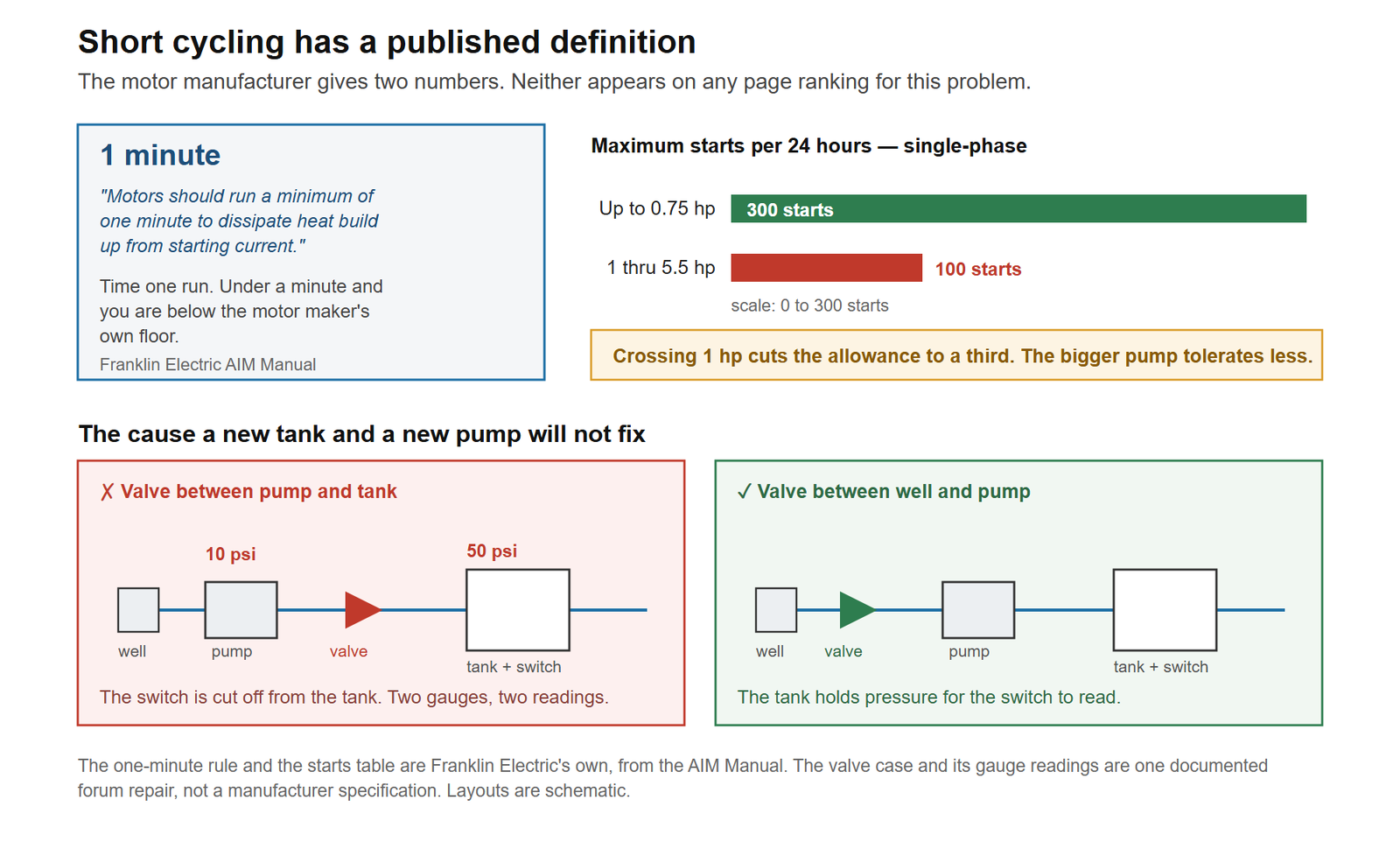
The run: at least one minute. Anything shorter and the motor has not had time to shed the heat that starting current puts into it.
The day: a starts budget that depends on horsepower, and this is where it gets counterintuitive. Franklin’s Table 3, for single-phase motors:
| Motor rating | Maximum starts per 24 hours |
|---|---|
| Up to 0.75 hp | 300 |
| 1 through 5.5 hp | 100 |
| 7.5 through 30 hp | 50 |
Cross one horsepower and your allowance drops to a third. The bigger pump is the less tolerant one, which is the opposite of what most people assume when they size up after a pressure complaint.
Treat that as a daily budget rather than a stopwatch interval — Franklin is explicit that it is an average “over a period of months or years”, and household water use comes in bursts. But 100 starts is not many. A pump kicking in every couple of minutes through an evening will spend a large part of a year’s allowance in a week.
What it is actually costing
Worth knowing before you decide it can wait, because the damage is not where people expect. Franklin’s own list:
“Excessive cycling affects the life of control components such as pressure switches, starters, relays, and capacitors. Rapid cycling can also cause motor spline damage, bearing damage, and motor overheating.”
The control gear goes first. The switch, the relay, the capacitor — the cheap parts wear out before the expensive one, which is why a system that short-cycles for a year often presents as a run of unrelated electrical faults. It is the same principle this site found in another silo entirely: a pump’s real unit of life is cycles rather than years.
Cause 1 — the tank has lost its air
This is the common one by a distance. A pressure tank works because a cushion of air is compressed as water enters. Lose the air and the tank holds almost nothing, so the pump refills a few litres and stops, over and over.
Air is lost two ways: a bladder that has split, or — in an intact tank — air slowly permeating out through the rubber over years.
One-minute test, and it is decisive. With the pump switched off, press the pin on the Schrader valve at the top of the tank, exactly like a tyre valve. Air means the bladder is intact. Water means it has failed, and the tank is finished.
Second test if you would rather not vent anything. Knuckle the tank from top to bottom. A healthy one sounds hollow in the upper part and solid lower down. A waterlogged tank sounds solid all the way up.
Franklin adds a detail nobody connects: a waterlogged tank “will cause fast cycling” and should be corrected “to prevent nuisance tripping of the overload protector.” So if your pump is also tripping out for no obvious reason, these are probably the same fault.
Does it mean replacement? A split bladder does. An intact tank that has simply lost charge can be re-inflated — which is cause 2. If it is the bladder, size the new tank from your pump rather than your house — the drawdown has to be at least your pump’s GPM.
Cause 2 — the air charge was never right
A tank can be perfectly healthy and still cycle the pump, because the charge has to match the switch.
The rule is the manufacturer’s: set the pre-charge 2 psi below the pump’s cut-in. And the trap, covered in full in the well system guide, is that Amtrol ships tanks at 38 psig — right for a 40/60 switch, ten pounds too high on a 30/50 system. A tank fitted out of the box and never adjusted is wrong before anyone runs a tap.
One-minute test: switch the pump off, drain the tank of all water, then read the Schrader valve. That order matters — gauge a tank with water still in it and you are reading system pressure, not air charge, which is why people check and wrongly conclude it is fine.
Fix: add or release air to land 2 psi under cut-in. No replacement needed. The full procedure, and why 2 psi is a minimum rather than a target — including the condition the tank maker puts on doing it at all.
Cause 3 — a check valve in the wrong place
This is the one worth knowing about, because people spend real money before they find it.
A homeowner on Terry Love’s forum fitted a new 30-gallon tank and a new 1 hp pump — and it still cycled every second. Both replacements were wasted, because the fault was a check valve installed between the pump and the tank.
With the valve there, the pressure switch is cut off from the tank. It sees only the short run of pipe between pump and valve, and that loses pressure the instant the pump stops. The advice from the thread was blunt:
“Remove the check valve. Place the check valve between the well and pump.”
“the pressure drops fast since there is nothing to hold pressure, therefore, the pump immediately cycles back on.”
The outcome, from the poster: “I took the check valve off the next day and the pump works perfectly…No leaks, quiet motor.”
One-minute test: if there is more than one gauge on the system, read them both. In that case one showed about 10 psi at the pump and 50 psi at the tank. Two pressures in one system means something between them is holding them apart.
Does it mean replacement? No — relocation. But it is plumbing work on a pressurised line.
Cause 4 — something in the house is leaking
If the pump starts when nobody is using water, the system is losing pressure somewhere. A running toilet flapper is the classic, and it will cycle a pump all night.
One-minute test: note the gauge reading, close the main valve to the house, and wait. If pressure holds, the leak is downstream of it. If it still falls, the loss is between the valve and the well — including the possibility of a foot valve or drop pipe leaking back down the well, which is a different and larger job.
Cause 5 — the tank is simply too small
Rarer, and usually seen after someone has replaced a pump with a bigger one. A tank that is healthy and correctly charged can still be undersized for the flow the pump delivers, so it fills too fast to give a decent run.
The test is the one at the top of this article: if the tank checks out and the pump still cannot manage a one-minute run, capacity is the remaining explanation.
When this needs a pro
Anything inside the pressure switch with power on. It is line voltage, often 240 V, in a damp place.
Pulling or re-plumbing a check valve on a live pressurised line. The diagnosis above is yours; the pipework is a judgement call about your own competence.
Anything down the well. If the pressure test says the loss is on the well side, that is a foot valve, a drop pipe or the pump itself, and none of them is a surface job.
And if the pump has been cycling hard for months, tell whoever services it. Franklin’s damage list is the reason: the switch, relay and capacitor may already have taken the wear even after you fix the cause.
And if the pump itself turns out to be worn rather than mis-set, compare replacements on flow at your own cut-out pressure — not on horsepower.
FAQ
How do I know if my well pump is short cycling?
Time a single run. Franklin Electric’s manual says a motor should run at least one minute to shed the heat from its starting current, so a run shorter than that is below the maker’s own floor.
How many times should a well pump start per day?
Franklin publishes a maximum of 300 starts per 24 hours for single-phase motors up to 0.75 hp, and only 100 for motors from 1 through 5.5 hp. Treat it as a daily budget averaged over time rather than a fixed interval.
Why does short cycling damage a pump?
Franklin names the components: pressure switches, starters, relays and capacitors first, then motor spline damage, bearing damage and overheating. The cheap control gear tends to fail before the motor does.
How do I test if my pressure tank is waterlogged?
With the pump off, press the pin on the tank’s Schrader valve. Air means the bladder is intact; water means it has failed. You can also tap the tank top to bottom — hollow above and solid below is healthy, solid throughout is waterlogged.
I replaced the tank and the pump and it still short cycles. What now?
Check where the check valve is. A valve between the pump and the tank isolates the pressure switch from the tank, and the pump restarts the moment it stops. The signature is two gauges reading very different pressures.


