On this page
Last Updated on October 13, 2026 by umar bwn
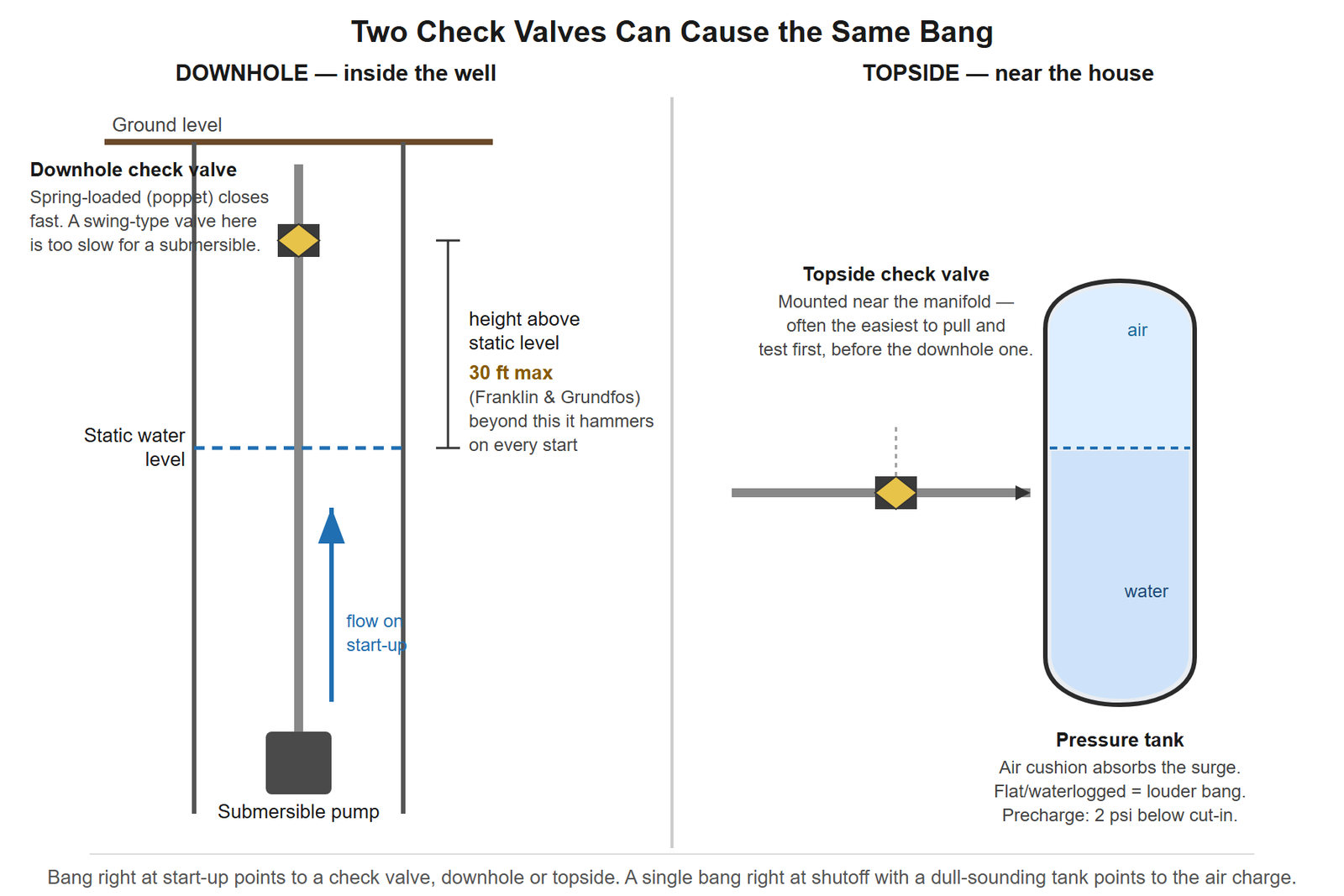
Two different faults sound almost identical here, and the giveaway is timing. A bang right when the pump kicks on is almost always a check valve — the water column slamming into a valve that wasn’t ready for it. A single, duller thud right at shutoff usually means the pressure tank has lost its air cushion.
Both get called “water hammer.” They’re not the same fix, and most of what’s written about this treats them as one thing with one answer — install an arrestor. That’s table stakes advice, and it skips the part that actually matters: which component is failing, and where it sits in your system.
Time it before you touch anything
Stand near the pressure tank or the well-house manifold the next time it happens, and notice two things: does the bang land the instant the motor sound starts, or a beat after? And what does the gauge read — right around the low cut-in number, or up near cut-out?
A sharp crack that follows the motor kicking on, especially right around cut-in pressure (40 psi on a 40/60 switch is the classic complaint), points to a check valve. The mechanism is almost always the same: when the pump shuts off, the water in the drop pipe and the pipe above it starts falling back down. By the time the pump restarts, that column is moving at real velocity, and it slams into the closed check valve and the still water sitting above it. The bang happens at start, but the problem began at the previous shutoff.
A single, lower-pitched thud that lands right as the pump shuts off, with no corresponding crack at the next start, points away from the check valve and toward the tank. That’s the next section.
The pressure tank has lost its cushion
The tank’s job during every pump cycle isn’t just to store water — its compressed air charge is what absorbs the shock when flow starts or stops suddenly. A correctly charged tank cushions that deceleration the way a shock absorber cushions a pothole. A flat or waterlogged tank has nothing left to absorb it, so an ordinary valve closure that would otherwise be silent turns into an audible knock.
One-minute test: find the Schrader valve on top of the tank (it looks like a tire valve) and press the pin with the system fully drained to zero water pressure. Air hissing out means the bladder is intact and the charge is just low or wrong. Water at the pin means the bladder itself has failed.
If it’s just a low charge, the fix is a bike pump or a small compressor, set to 2 psi below your pump’s cut-in pressure, measured with the tank empty of water — the full procedure, including why that number and not a round 5 or 10 psi, is in setting the pressure tank’s air charge. A tank running flat this way also tends to short-cycle the pump, so if the banging shows up alongside the pump starting and stopping every few seconds rather than settling into a normal run, read well pump short cycling as well — it’s usually the same root cause wearing two symptoms.
If water came out at the Schrader pin, recharging won’t help. A torn diaphragm can’t hold air no matter what you pump into it, and the tank needs replacing, not adjusting. Best well pressure tanks covers sizing and the models worth buying when that’s the actual fix.
The topside check valve is stuck or worn
Most published advice on this symptom only talks about the check valve down the well. There’s often a second one, mounted inline near the pressure tank or the manifold where the line comes up from the well — and it’s frequently the more worn, more accessible culprit, because unlike the downhole valve it doesn’t require pulling the pump to reach.
One-minute test: with the pump breaker off and the system pressure bled down, crack the union fitting nearest the topside valve (if there is one — not every setup has a union there) and watch what happens. Water that immediately drains backward toward the well means the valve isn’t holding, which is consistent with the chattering or slamming you’re hearing. Water that holds in place means this valve is sealing fine and the fault is downhole.
If this valve isn’t sealing, the practical fix most well techs give is blunt: pull the cartridge and replace it, or remove it outright if the downhole valve is doing its job on its own. A second check valve in the line doesn’t add protection if it’s the one failing — it just adds a second place for the same bang to start.
The downhole check valve is too high, or the wrong type
This is the one almost nothing online gets specific about. Two manufacturers — Franklin Electric, in its submersible systems troubleshooting manual, and Grundfos, in its own water-hammer FAQ — independently publish the same number: if the lowest check valve sits more than 30 feet (9 meters) above the standing water level, you will get hammer on every single start. It isn’t a maybe. The column of water between the valve and the water below it is long enough to build real velocity before it slams shut against the valve.
The practical problem is that you can’t see this without pulling the pump or checking the installation paperwork. One-minute test, the realistic version: call whoever drilled or last serviced the well and ask for the completion report or pump installation record. Most keep these on file, and the check valve depth relative to the water level is usually right there. If nobody has that record, it becomes one of the first things worth confirming when the pump does eventually come out for any other reason.
Valve type matters just as much as depth. A swing-type check valve — the kind with a hinged flapper — reacts too slowly for a submersible system. By the time it swings shut, the water has already built up speed and the slam has already happened. A spring-loaded (poppet) check valve closes fast enough to catch the flow before it gets moving, which is why manufacturer installation guidance specifically calls for a positive-sealing, spring-loaded valve on submersible systems and not a swing valve. If your system is old enough that nobody’s sure which type is down there, that’s worth asking about at the same time as the depth question above.
Upthrust and backspin aren’t the same noise
Franklin’s manual treats water hammer as one of three related but distinct start/stop faults, alongside “backspin” (the motor spinning backward briefly when it stops, driven by the falling water column) and “upthrust” (a mechanical shove on the shaft at the instant the motor starts under load). Neither of those is a bang — backspin sounds more like a brief reverse whir, and upthrust shows up as vibration or clunking right at start, not a sharp crack. On larger three-phase installations, manufacturers address upthrust and hammer together with a reduced-voltage starter that ramps the motor up to full speed over a few seconds instead of slamming it on instantly. That’s pro-grade equipment for bigger systems, not something to retrofit onto a typical single-phase residential setup, but it’s worth knowing the industry treats “hammer” as one piece of a cluster of related start/stop faults rather than a single universal phenomenon.
Don’t start with a water hammer arrestor
Most of what’s published on this topic leads with “install a water hammer arrestor,” the same device plumbers use to quiet a washing machine valve. It’s not wrong that arrestors absorb shock — it’s that they’re the wrong first move here. An arrestor installed near a fixture softens a shock that’s already traveling through the pipe; it does nothing about a check valve that’s letting a column of water build speed in the first place, or a tank that’s lost its cushion. Fix the actual source first. If there’s still a faint tick after the check valve and tank are both confirmed good, that’s the point where an arrestor earns a place in the system, not before.
If you’re on a constant-pressure (VFD) system
Homes with a variable-frequency drive controlling the pump — look for a control box with a digital display or an adjustable-speed drive rather than a simple relay — have one more thing to check. Franklin’s manual flags that a check valve not specifically rated “VFD compatible” will cause water hammer on these systems even when depth and valve type would otherwise be fine, because the flow profile ramps differently than on a standard on/off pump. If you’re on a constant-pressure system and the valve down there predates it, confirm with whoever installed the drive that the check valve was swapped to match.
When to call a pump contractor
Anything that involves pulling the pump — confirming check valve depth or swapping a swing valve for a spring-loaded one — means killing power at the breaker, not just the pump switch, and handling a wellhead seal that’s there to keep groundwater out of your water supply under your state’s well code. That’s a licensed well or pump contractor’s job. The tank-side checks above (the Schrader test, the topside union) are reasonable for a homeowner to do with the system depressurized and the breaker off; opening the wellhead itself generally isn’t.
One more thing worth asking a contractor about, if the tank and both check valves all check out and there’s still a faint residual knock: some well owners retrofit a cycle-stop valve to reduce cycling and smooth out pressure changes, and a few report it helps with hammer too. That’s a real product some contractors use, but it’s not something this article can verify as a fix for hammer specifically — treat it as a question to raise, not a result to expect. For the fuller picture of how the pump, check valves and tank work together as one system, the well pump system guide walks through all three.


