On this page
Last Updated on October 11, 2026 by umar bwn
If your jet pump still primes fine every morning, but lately needs re-priming more often, takes longer to build pressure, or fades mid-task — partway through a tub fill or a sprinkler run — that’s not the overnight foot-valve fault other guides cover. That’s wear: a fouled nozzle, a worn impeller, or a well that can’t keep up with the pump.
This is a different fault from “loses prime overnight”
If the pump is completely empty and has to be reprimed from scratch every morning, or after every power blip, that’s a foot valve letting the column drain back while the pump sits idle — covered in well pump runs but no water comes out, which has its own one-minute test for that exact pattern.
This article is about the opposite situation: the pump never goes fully empty. It’s still working, it’s just getting weaker — needing a boost more often, running longer per cycle, or losing suction mid-use when nothing about how or when you use it has changed. That’s a mechanical capacity problem, not a sealing problem, and it has its own three causes, in roughly the order a working tech sees them.
1. A fouled or worn nozzle — the most common cause
Every shallow-well jet pump makes its suction with two matched parts inside the housing: a nozzle, a narrow orifice that speeds the pump’s own discharge water into a high-velocity jet, and a venturi, the chamber right after it where that jet’s speed drop pulls suction water in from the well. Goulds’ own troubleshooting manual for its jet pumps (IM102, p.12) lists this exact fault — “impeller worn or plugged, no jet assembly installed, or jet plugged” — as a cause separate from “pump not primed, inadequate suction pipe submergence, air leak in suction pipe.” The manufacturer draws the same line this article does: wear and air leaks are two different faults, not two flavors of one.
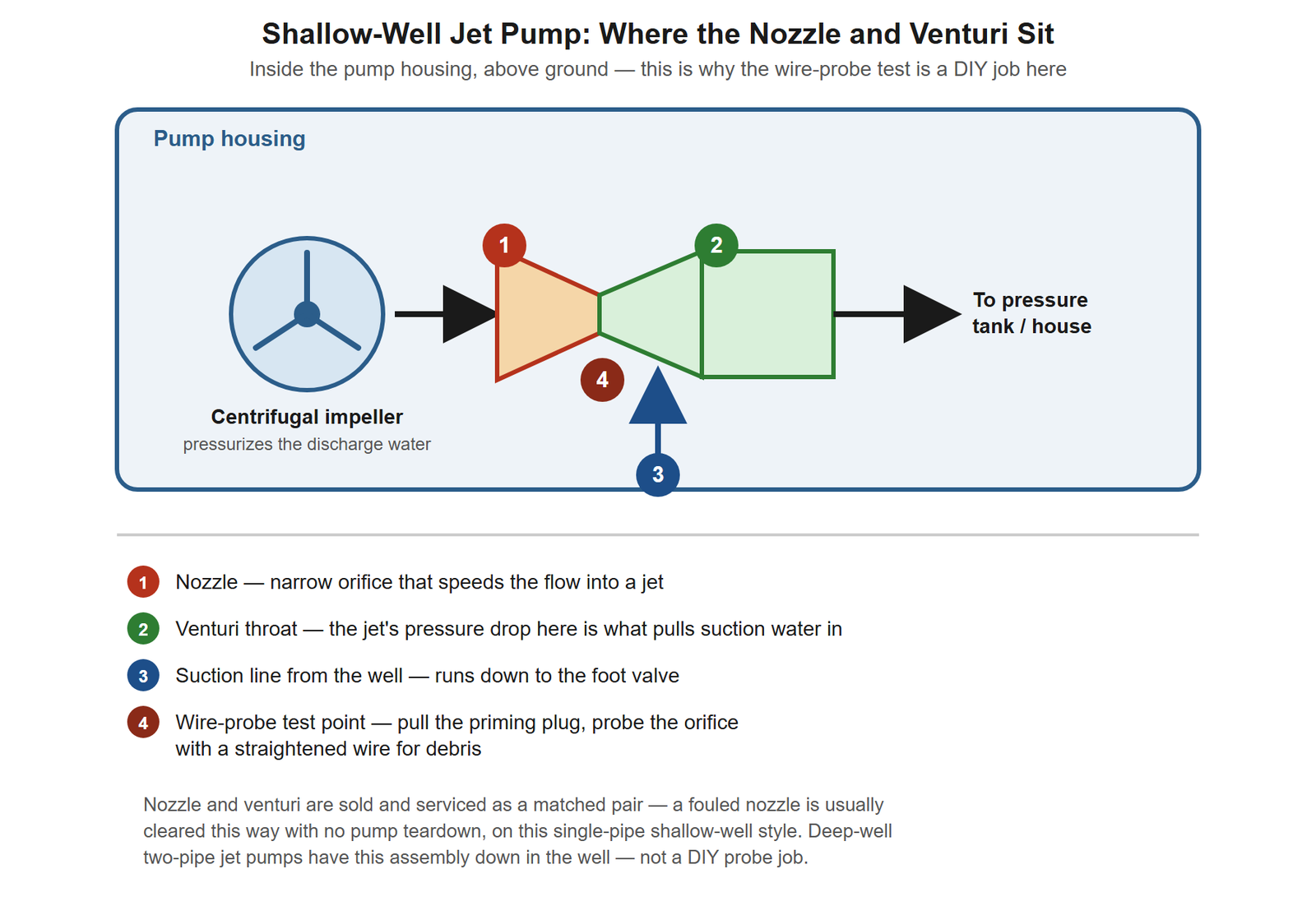
A partially fouled or eroded nozzle doesn’t stop the pump — it just can’t build the same pressure drop it used to, so the pump runs, moves some water, but struggles to reach cut-out. On a Terry Love Forums thread, a homeowner stuck around 35 psi with a fluttering gauge needle got this diagnosis from Valveman, a working pump tech, without anyone touching the pump: “I am guessing you have something clogging the venturi nozzle in the pump.” His field test needed no teardown: “A piece of a coat hanger or something similar will work. If the jet nozzle is plugged the pump can’t produce enough pressure to reach the shut off point.” The poster probed the nozzle, found it clogged, cleared it, and the pump was back to normal.
One-minute test. Watch the pressure gauge while the pump runs a full cycle. A healthy pump climbs steadily to cut-out. A fouled or worn nozzle produces a needle that hunts or flutters and plateaus below cut-out instead of reaching it — “weak and getting weaker” rather than a sudden stop.
The confirming test. Shut power at the breaker, not just the switch — this assembly is right next to the motor’s electrical connections. Pull the priming plug and probe the nozzle orifice with a straightened wire or coat hanger, the way Valveman described. Resistance or debris on the wire confirms it.
The fix. Goulds sells and services the nozzle and venturi as a matched pair, not separately — its standard shallow-well J5 jet uses nozzle AN017 with venturi AD3731, while the J7/JRD7 uses AN018 with AD3536. Clearing or replacing one without checking the other is a half-fix, since a worn venturi paired with a new nozzle (or the reverse) changes the pressure drop the whole assembly was designed around.
This test only applies to single-pipe, shallow-well jet pumps, where the jet assembly sits inside the pump housing above ground. Deep-well, two-pipe jet pumps have their nozzle and venturi down in the well itself — see the “needs a pro” note below.
2. A worn or pitted impeller
This usually shows up alongside nozzle wear rather than instead of it, because they share a cause: sand or grit moving through the pump erodes both over time. It also has a second trigger worth knowing about — Valveman’s warning in that same forum thread was “you may have nuked the impeller if you let it get that hot,” meaning a pump left running for a long stretch against a restricted, overheating nozzle can pit or damage the impeller even if the impeller itself started out fine.
One-minute test. Time how long the pump runs per cycle — cut-in to cut-out — and compare it to a few weeks ago. A steadily lengthening run time with normal motor sound and normal amp draw (not the 3–6× spike of a jammed or seized impeller, which is a different fault entirely) points to impeller wear rather than an electrical problem.
The fix. A worn impeller is a rebuild of the pump’s wet end, not a part you pull through the priming plug — it means opening the casing. If the pump is old enough that you’re now looking at a nozzle, a venturi, and an impeller in the same repair, or if the casing itself shows pitting, the honest math usually favors a new pump over a piecemeal rebuild. That’s the point where it’s worth comparing options in our guide to the best shallow well jet pumps rather than sinking another parts order into a pump that’s already nickel- and-diming you.
If the well itself is pushing sand or fine grit — check for grit in a sediment filter or at the bottom of the pressure tank — that’s worth dealing with on its own, since a new impeller in the same water will wear the same way.
3. The well can’t keep up with the pump during a long draw
This one isn’t wear at all, and it’s the cause every ranking article misses entirely: a deep well whose production rate falls behind the jet pump’s rated capacity during a sustained draw will “break suction and lose prime” exactly the way a worn part does — Goulds’ own manual uses that phrase for it. As the water level drops during a long draw (drawdown), the jet’s position relative to the water column changes, and past a certain point the pump can no longer maintain suction at all.
Goulds’ published capacity curve for its deep-well tailpipe setup shows how steep that drop-off is:
| Drawdown during the draw | % of rated pump capacity |
|---|---|
| 10 ft | 80% |
| 15 ft | 70% |
| 20 ft | 57% |
| 25 ft | 40% |
| 28 ft | 25% |
| 29 ft | 17% |
| 33.9 ft | 0% — suction fully broken |
The jet itself should be set 5 feet below the static (resting) water level, with a 34-foot tailpipe running from the jet assembly down to the foot valve. If the well’s drawdown during normal use is eating into that margin — because the water table has dropped seasonally, or the original installer set the jet shallower than the well can support — the pump will behave exactly like a worn nozzle: fine at first, weakening the longer you draw.
One-minute test. Pay attention to when the weakness shows up. Wear (causes 1 and 2) tends to be weak from the first use of the day and stays roughly that weak. A drawdown problem is usually strong for the first minute or two of a long draw — filling a tub, running a sprinkler zone — and then fades, recovering fully once the pump rests and the well level recovers. If a neighbor’s well report or your own driller’s log shows the static water level sitting close to where the jet is currently set, that’s confirmation.
The fix. This is resetting the jet’s depth and possibly extending the tailpipe to put it back within the well’s actual drawdown margin — not replacing a nozzle, an impeller, or the pump. See the pro note below; this one almost always involves pulling the drop pipe.
Low pressure everywhere, not just re-priming — check this first
If pressure is weak across the whole house all the time, rather than specifically tied to re-priming frequency or a fade mid-task, you may be looking at a different problem — see low water pressure on a well: 8 causes before assuming it’s nozzle or impeller wear.
And if what you’re actually hearing is air spitting from the faucets rather than a struggle to build pressure, a fouled nozzle can produce entrained air that looks similar at the tap, but it isn’t the same fault as the suction-side air leaks covered in air spitting from faucets on well water. Worth ruling that one out too before opening the pump.
When this needs a pro
Any test here that goes past probing the priming plug means killing power at the breaker first, not just the pump switch — the nozzle and venturi sit directly beside the motor’s wiring. And cause 3’s fix, resetting the jet depth or extending the tailpipe, means pulling the drop pipe out of a sealed, code-regulated well casing. That’s a two-person job with the right pipe clamps even on a shallow well, and on most residential wells it’s licensed well-driller or pump-installer territory, not a weekend DIY repair — get that one quoted rather than attempted solo.
FAQ
Can a fouled or worn nozzle actually damage the pump itself?
Yes, indirectly. A restricted nozzle doesn’t stop the motor — it keeps running against higher resistance with less water moving through to carry heat away, and a pump left running like that for a long stretch can pit or damage the impeller even if the impeller started out fine. That’s why nozzle wear and impeller wear so often show up together rather than as two separate repairs.
Do I need to replace the nozzle and the venturi together, or can I just swap the worn one?
Replace them together. Manufacturers like Goulds sell and service these as a matched pair — its standard shallow-well J5 jet pairs nozzle AN017 with venturi AD3731, for example — because the pressure drop the assembly creates depends on both parts being sized to each other. Swapping one against a worn or mismatched other part changes that pressure drop and can leave you re-diagnosing a “new” fault that’s really just a mismatched pair.
Why does my pressure gauge needle flutter instead of climbing smoothly to cut-out?
That hunting, fluttering needle that plateaus below your normal cut-out pressure is the classic sign of a partially restricted nozzle — the pump is still building some pressure, just not enough, and not steadily. It’s different from a needle that drops to zero and stays there, which points back to a lost-prime or air-leak fault instead.
How deep should the jet assembly actually be set below the water level?
For a deep-well, two-pipe setup, the jet should sit about 5 feet below the well’s static (resting) water level, with roughly a 34-foot tailpipe running down to the foot valve. If the well’s drawdown during a long draw eats past that margin, the pump loses suction the same way worn parts would, and the fix is repositioning the jet, not replacing a part.


