On this page
Last Updated on September 27, 2026 by Muhammad Toqeer
Pick the flow first, then buy horsepower to reach your depth. On every established brand the model number already fixes the gallons per minute — the motor size decides how far down it can deliver them, not how many you get.
Get that the wrong way round and you overpay for a bigger motor that produces exactly the same water. If your water sits within 25 feet of the surface you want a jet pump instead.
Before the reviews, do one line of arithmetic
A listing on the first page of results for this search advertises a 1 HP, 115 V pump delivering 37 GPM at 207 feet.
That is not a bargain. It is not possible.
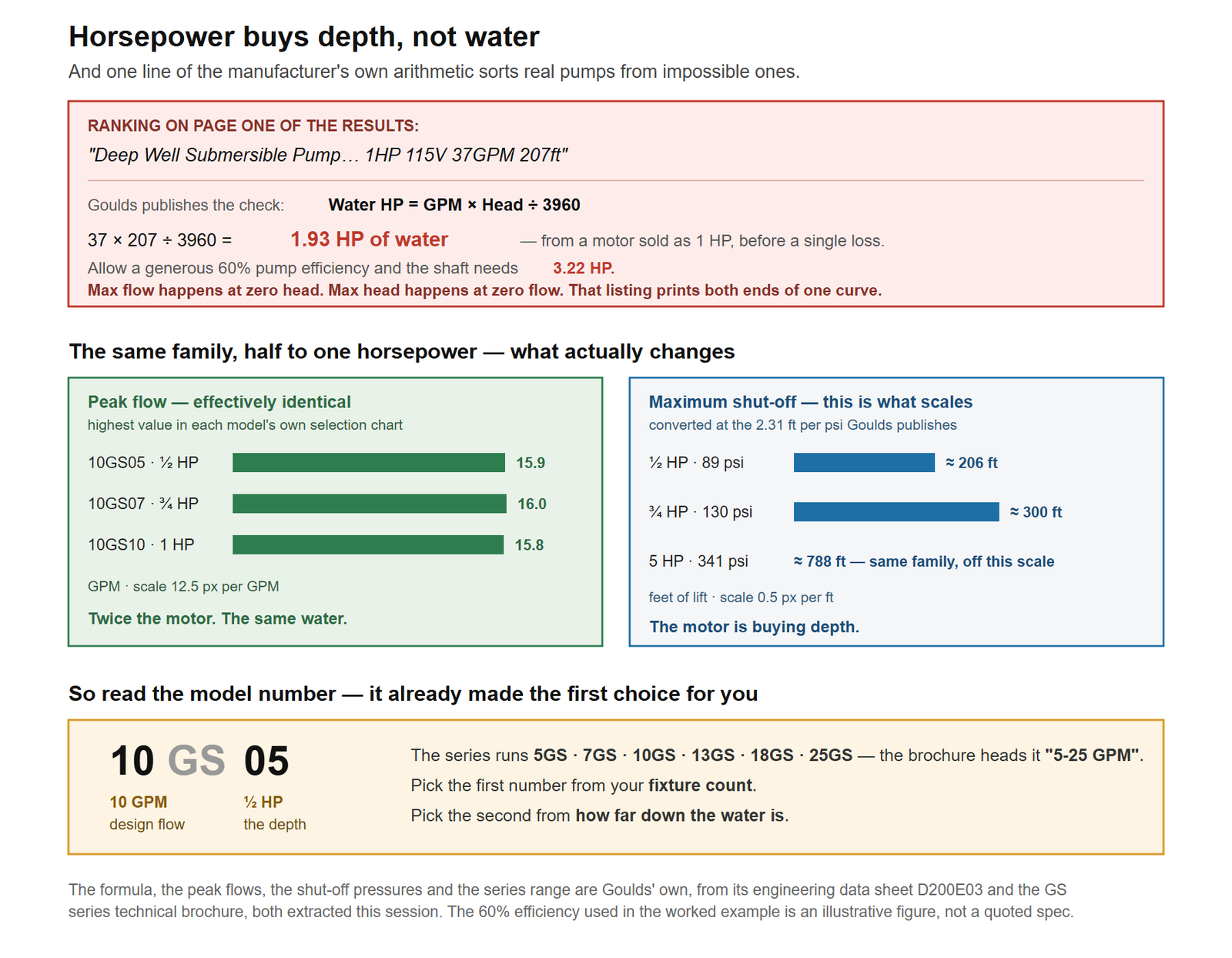
Goulds publishes the check in its own engineering data:
“WATER HORSEPOWER: = GPM x 8.33 x Head / 33000 = GPM x Head / 3960”
So 37 × 207 ÷ 3960 = 1.93 horsepower of water. That is the theoretical figure, at 100% efficiency, with no losses anywhere — already nearly double the motor being advertised. Goulds’ next line accounts for the real world:
“LABORATORY BHP = Head x GPM x Sp. Gr. / (3960 x Eff.)”
At a generous 60% pump efficiency the shaft would need about 3.22 HP.
What is actually happening is simpler than fraud. Maximum flow occurs at zero head. Maximum head occurs at zero flow. They are the two opposite ends of one curve, and the listing prints both as though you get them together. You never do.
Run that division on any pump you are considering. If the answer comfortably exceeds the motor on the label, the two numbers are curve endpoints rather than a duty point.
What horsepower actually buys
Here is the same point from the other direction, using one manufacturer’s published selection charts for a single family of pumps.
| Model | HP | Peak flow in its own chart | Max shut-off |
|---|---|---|---|
| Goulds 10GS05 | ½ | 15.9 GPM | 89 psi |
| Goulds 10GS07 | ¾ | 16.0 GPM | 130 psi |
| Goulds 10GS10 | 1 | 15.8 GPM | — |
Double the motor and the water does not move. What changes is the pressure the pump can still make — and pressure, on a well, is depth.
Convert those shut-off figures at the 2.31 feet per psi the same maker publishes elsewhere:
- ½ HP → 89 psi → about 206 feet
- ¾ HP → 130 psi → about 300 feet
- 5 HP → 341 psi → about 788 feet
That is the horsepower-to-depth relationship in feet, from the manufacturer’s own two documents rather than a rule of thumb.
The model number already made your first choice
On the established ranges the series number is the design flow. Goulds heads its brochure “5GS, 7GS, 10GS, 13GS, 18GS & 25GS — 5-25 GPM”, so a 5GS is a 5 GPM pump and a 25GS a 25 GPM pump. The trailing digits are horsepower: 10GS05 is ½ HP, 10GS07 is ¾ HP.
Grundfos does the same thing. A 10SQ05-160 reads as 10 GPM, ½ HP, 160 feet.
So the decision is two questions in order:
- How much water? From your fixture count. Most houses land around 10 GPM, which is why the 10-series exists.
- From how deep? That picks the horsepower.
A worked caution on the naming, using Grundfos’ own honesty: the 10SQ05-160 is named for 10 GPM and 160 feet, and is rated at 8.81 GPM with a maximum head of 177.2 feet. The name is nominal; the specification is the duty point. Grundfos prints both, which is exactly what the impossible listing does not.
The five, side by side
Every figure is the manufacturer’s, with its measuring condition attached where one was published.
| Pump | HP | Body | Flow, as published | Max shut-off | Wiring | Warranty |
|---|---|---|---|---|---|---|
| Goulds 10GS05 | ½ | 4″ stainless | 15.9 GPM peak | 89 psi (≈206 ft) | 2 or 3-wire | — |
| Goulds 10GS07 | ¾ | 4″ stainless | 16.0 GPM peak | 130 psi (≈300 ft) | 2 or 3-wire | — |
| Goulds 10GS10 | 1 | 4″ stainless | 15.8 GPM peak | — | 2 or 3-wire | — |
| Grundfos 10SQ05-160 | ½ | 3″ stainless | 8.81 GPM rated, 177.2 ft max head | — | 2-wire | 5 yr |
| Red Lion RL12G05-2W2V | ½ | 4″ stainless | 12 GPM at 40 ft, 30 psi | 212 ft | 2-wire | 3 yr |
Read the flow column carefully — it is three different kinds of number. A peak is the top of a chart. A rated figure is a duty point. Red Lion’s is the only one that arrives with both a depth and a pressure attached.
The picks
Goulds 10GS05 — ½ HP, the default for an average house
Who it is for: a 10 GPM household with the pump set within roughly 200 feet.
The 4″ GS series uses a “face clearance, floating impeller stack design” with impellers, diffusers and bearing spiders in “glass filled engineered composites that are corrosion resistant and non-toxic” — the floating stack is what makes it tolerant of sand, which is the thing that actually kills submersibles.
The honest drawback: its shut-off tops out at 89 psi. Past about 200 feet of lift you are at the end of the chart, and the chart is where honesty lives.
Goulds 10GS07 — ¾ HP, the same water from deeper
Who it is for: the same house, with the water further down — or a 40/60 switch, which costs head before the well is even involved.
Peak flow 16.0 GPM, effectively identical to the ½ HP, with shut-off rising to 130 psi — about 300 feet. Its selection chart spans half again as many depth columns as the ½ HP’s.
The honest drawback: you are buying 50% more motor for 0.1 GPM. Only worth it for the depth, which is precisely the article’s point.
Goulds 10GS10 — 1 HP, for the deepest residential settings
Who it is for: deep settings, or a high cut-out pressure at moderate depth.
Peak flow 15.8 GPM — again unchanged.
The honest drawback: the same one, more so. If your water is 120 feet down, this is a larger electricity bill and no extra water.
Grundfos 10SQ05-160 — ½ HP, and the one for a narrow casing
Who it is for: 3-inch casings, and anyone who wants the gentlest possible start.
A 3″ body with a minimum borehole of 2.99 inches — it fits where the 4″ pumps simply cannot go. Stainless, 3 stages, 2-wire, available in 115 V or 230 V, rated 8.81 GPM at up to 177.2 feet of head. It uses a permanent-magnet motor with soft start, which Grundfos describes as giving “low current with a smooth and steady acceleration… prevents overload of the mains power, reduces water hammer in the pipe and reduces pump wear.”
And it carries a 5-year limited warranty — the longest here.
The honest drawback: less flow and less head than the 4″ pumps, which is what the slim body costs you in performance.
Red Lion RL12G05-2W2V — ½ HP, 12 GPM, no control box
Who it is for: a 4″ well wanting a little more flow than the 10-series, with the simplest possible wiring.
Stainless casing with thermoplastic discharge and motor bracket, a built-in suction screen and check valve, 2-wire so it needs no control box, and a 3-year warranty. Its headline figure is properly conditioned, which on this SERP is worth saying out loud: 12 GPM at 40 feet and 30 psi. Maximum shut-off 212 feet.
The honest drawback: its depth rating is described three different ways across retailers — “depths to 120′” on one, wells “to depth of 250′” on another, against that 212-foot maximum shut-off. Three numbers, one pump. Take the 212 as the ceiling and the 120 as the working figure.
2-wire or 3-wire?
Not a performance question. It is a question about where the starting gear lives, and it changes what you can fix yourself.
2-wire pumps have their starting components sealed inside the motor and need no control box — the Grundfos and the Red Lion above are both 2-wire. 3-wire pumps put the start capacitor, relay and overload in a box at the surface.
The trade-off is repairability against simplicity. A 3-wire system’s most failure-prone parts are at the surface where you can reach them. A 2-wire system has nothing on the wall to go wrong — and nothing on the wall to test if it stops. That distinction is worked through properly here, including what each one can and cannot be diagnosed with.
What decides it for your well
Three numbers, none of which come from a catalogue:
- Depth to water, and your intended pump setting. From the well log. Setting depth, not well depth.
- Your cut-out pressure. It is head, and it eats into the depth the pump can manage.
- What the well actually yields. A pump cannot deliver more than the well makes — and on a low-yield well the answer is a smaller pump plus storage, not a bigger motor.
And unlike a jet pump, this one is going down a hole. How the whole system fits together is here, and it is worth reading before you commit to a setting depth.
Getting it wrong means pulling it back out, which is why the specification matters more here than the brand does.
FAQ
How many GPM do I need from a deep well pump?
Around 10 GPM suits most houses, which is why the 10-series exists across several brands. Count your fixtures rather than your bedrooms — a shower is roughly 2 GPM.
Does a bigger horsepower pump give more water?
No. Across Goulds’ 10GS family the peak flow is 15.9 GPM at ½ HP, 16.0 at ¾ and 15.8 at 1 HP. The horsepower raises the pressure the pump can make, which is what lets it deliver that flow from further down.
How deep can a ½ HP submersible pump go?
Goulds’ ½ HP 10GS05 has a maximum shut-off of 89 psi, which converts at 2.31 feet per psi to roughly 206 feet — and that is at zero flow, so the working depth is less. The ¾ HP reaches about 300 feet on the same basis.
Can a 1 HP pump really deliver 37 GPM at 207 feet?
No. Using the manufacturer’s own formula, GPM times head divided by 3960, that duty needs 1.93 horsepower of water before any losses, and over 3 at the shaft once efficiency is allowed for. Those two numbers are opposite ends of a curve.
What is the difference between a 2-wire and 3-wire submersible pump?
A 2-wire pump has its starting components sealed inside the motor and needs no control box. A 3-wire pump puts the capacitor, relay and overload in a surface box — more parts, but the parts most likely to fail are within reach.
Should I buy a submersible or a jet pump?
Depth decides it, not preference. Jet pumps are limited to about 25 feet of suction lift; below that a submersible pushes from underneath instead, and loses no prime.


