On this page
Last Updated on September 27, 2026 by Muhammad Toqeer
Everyone gives the same advice: open every tap, highest first, and run the air out. That is half a procedure. Purging clears air that is already in the pipes. It does nothing about air that is still arriving, and the sputtering is back by the evening.
Run it, then wait. What happens next is the actual diagnosis.
The test the purge advice is missing
Open every tap in the house, starting with the highest and working down, and let them run until the spitting stops.
Then leave it alone for a day.
It stays clear. The air was trapped from a past event — the system was drained, a pipe was opened, the pump ran dry once. Nothing is wrong now.
It comes back. Air is still getting in, and no amount of purging will hold. Which brings you to the question nobody asks first.
What kind of pressure tank do you have?
This decides everything, because one type physically cannot put air into your water and the other is built to.
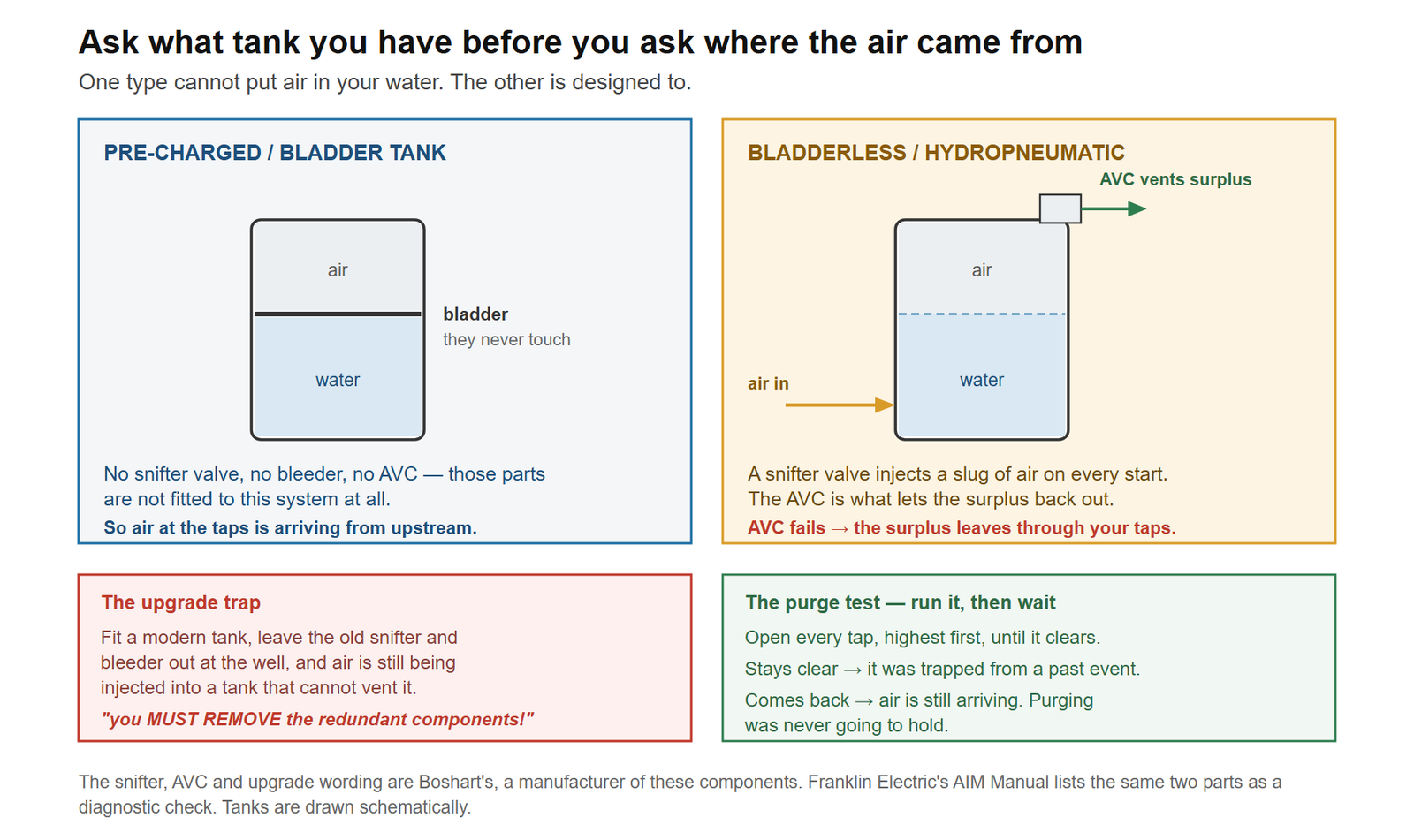
A modern pre-charged tank has a bladder or diaphragm inside it. Air on one side, water on the other, and they never meet. There is nothing in that tank that can add air to your water.
An older bladderless tank — galvanised, often tall and plain, sometimes called hydropneumatic — holds air in direct contact with the water. And the air did not get there by accident.
If you are not sure which you are looking at, the system guide sets out what the tank is doing.
On a bladder tank, the air is coming from upstream
Nothing in the tank can be responsible, so the air is entering somewhere between the water and the tank.
The water level has dropped to the pump intake. The pump is drawing a mixture of water and air. This tends to come and go with heavy use and recover after a rest.
A suction leak, if it is a jet pump. The suction side is under vacuum, so a bad joint pulls air in rather than leaking water out — and it leaves nothing to see. That fault and its test are covered here.
A cracked drop pipe on a submersible. Water escapes on the way up and air enters as the column falls back between cycles.
A check valve that no longer holds. The column drains back when the pump stops and the space fills with air.
One-minute test for all four: note whether the air is worse after the pump has been off for a while, and better after it has been running. Air that is worst on the first draw of the morning points at something draining back overnight. Air that gets worse the longer you run water points at the well itself.
On a bladderless tank, the air may be the tank’s own
Here is the part no one writes down. On these systems, air is injected into the tank on purpose.
A snifter valve out at the well lets air into the pipe as the column drains back when the pump stops. Boshart, which makes these components, describes the result plainly:
“Each time the pump starts the air that is trapped in the top section of pipe is forced into the tank.”
That air is what keeps the cushion in a tank with no bladder. But the system deliberately over-supplies it, so a second component — the air volume control, or AVC — sits on the tank and lets the surplus out:
“The AVC will purge excess air from the water tank to the atmosphere through a port on the AVC as necessary.”
When the AVC stops working, the surplus has one route left. The manufacturer names the symptom:
“If the air release stops working, you will have too much air in the tank resulting in blowing of air at the faucets!”
That is this problem, exactly, and it has nothing to do with your well, your pump or your water level. Franklin Electric’s own troubleshooting lists the same pair of parts as a thing to check: “Check the air volume control or snifter valve for proper operation.”
One-minute test: find the tank and look for a small device on its side or top with a vent port — that is the AVC. If it is wet, crusted, or obviously weeping, it is not sealing and not venting properly.
The upgrade trap
This one catches people who did the right thing.
Those air components belong to one kind of system only. Boshart is explicit:
“Air volume controls, snifter valves, and bleeders are ONLY used on pumping systems with hydro pneumatic or atmospheric tanks.”
So when an old galvanised tank is replaced with a modern pre-charged one, the snifter valve and bleeder out at the well have to come out too. If they do not, the system carries on injecting air on every single start, into a tank that has no way to vent it. Straight through to the taps, forever, and the new tank gets blamed.
Boshart puts it in capitals:
“If you decide to replace an old hydro pneumatic tank with a pre-charged tank you MUST REMOVE the redundant components!”
If your sputtering started after a tank replacement, start here rather than anywhere else.
When this needs a pro
Removing or plugging a snifter and bleeder means work out at the well, on the drop pipe. That is not a surface job.
A dropping water level is a well question, not a pump question. Whether it is seasonal or permanent decides whether you wait or spend, and a driller answers it.
Air arriving with a vacuum on the suction side is also a contamination path — whatever can pull air in can pull other things in. If you are on a jet pump and finding air, have the water tested as well as the plumbing fixed.
And if the pump is also short cycling, deal with that at the same time — a tank that has lost its charge and a tank that is over-charged are different faults with overlapping symptoms.
Where the fix turns out to be a new pump rather than a new tank, compare candidates at matched pressure and lift rather than on the headline figure.
FAQ
Why is air coming out of my faucets on well water?
Either air was trapped in the pipes from a past event, or it is still arriving. Run every tap from the highest down and wait a day — if it stays clear, it was trapped. If it returns, the next question is what kind of pressure tank you have.
Can a pressure tank put air in my water?
A bladder or pre-charged tank cannot; air and water never touch inside it. An older bladderless tank can, because air sits directly on the water and is injected on purpose by a snifter valve.
What is an air volume control?
A device on a bladderless pressure tank that vents surplus air to atmosphere. Its manufacturer says that if the air release stops working you get “too much air in the tank resulting in blowing of air at the faucets”.
My faucets started spitting air after a new pressure tank was fitted. Why?
Very likely the old air-injection parts were left in place. A snifter valve and bleeder belong only to bladderless systems, and Boshart’s instruction on switching to a pre-charged tank is that you must remove the redundant components.
Is air in well water dangerous?
The air itself is not the hazard. What matters is how it is getting in — a suction-side leak that pulls air can pull other things in too, so if you are on a jet pump it is worth testing the water as well as fixing the leak.


