On this page
- Eight features, five protections, and two that do not stop the pump
- The one that changes the pump's behaviour without stopping it
- And reduced speed is a reportable state, not housekeeping
- The protection that leaves no trace at all
- What the maker says you therefore do not need
- If you have a conventional pump, none of this applies
- When this needs a pro
- FAQ
Last Updated on October 8, 2026 by Muhammad Toqeer
First, the scope, because this page is wrong for about half the people who will land on it.
This is about electronically controlled, variable-speed submersibles — the constant-pressure kind. If you have a conventional pump on a pressure switch and a tank, the diagnosis is a different one entirely, and none of what follows applies to it.
Still here? Then here is the finding, from the motor maker:
“If the pump is exposed to heavy load… the motor will automatically compensate for this by reducing the speed.”
It does not stop. It delivers less, deliberately — and it only gives up entirely below a published figure.
Eight features, five protections, and two that do not stop the pump
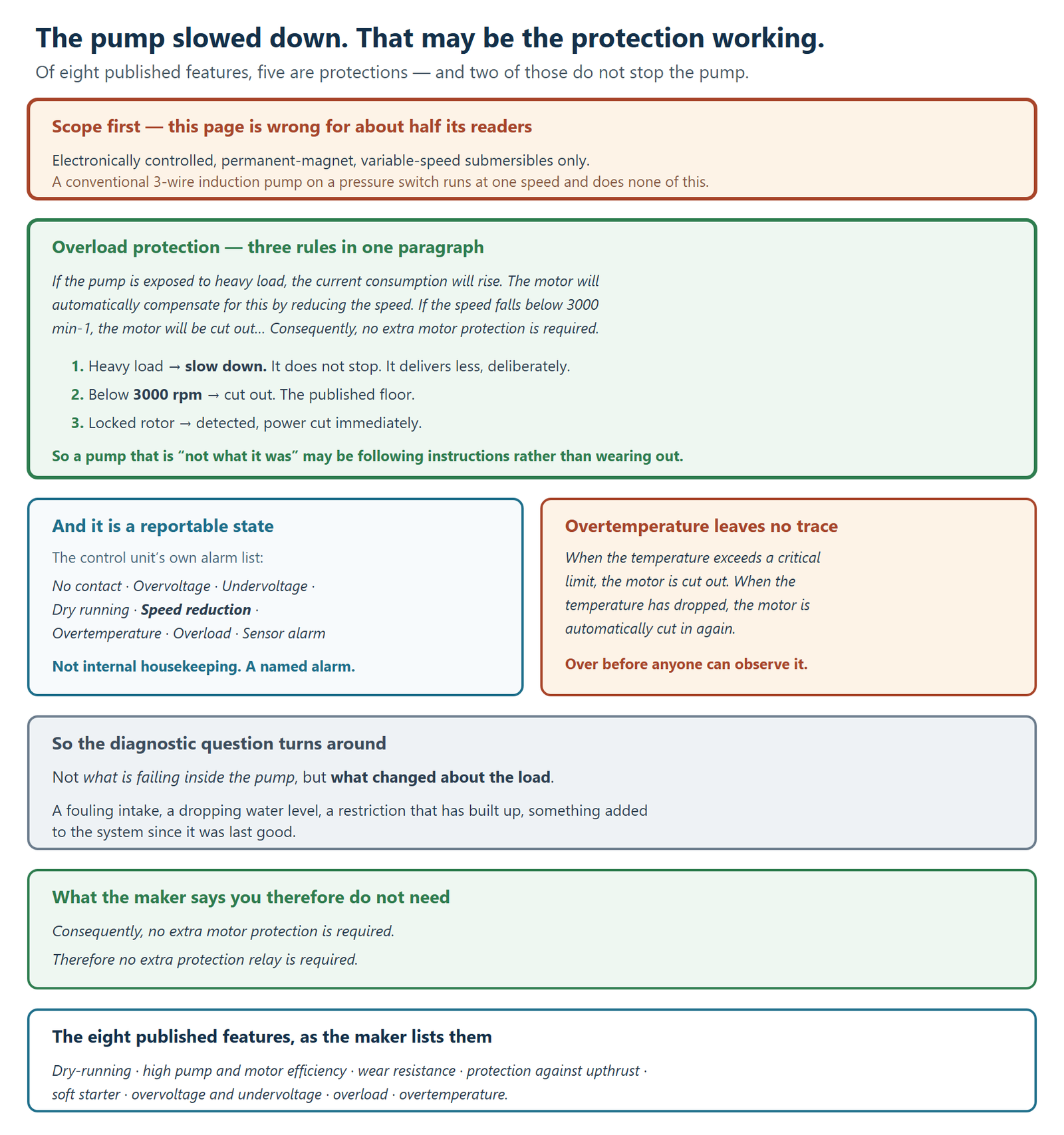
Grundfos publishes the feature list for this class of pump, and it is longer than most owners expect:
“dry-running protection, high pump and motor efficiency, wear resistance, protection against upthrust, soft starter, overvoltage and undervoltage protection, overload protection, overtemperature protection.”
Five of those eight are protections — dry running, upthrust, voltage, overload and overtemperature. The other three are efficiency, wear resistance and the soft starter.
And most protections stop the pump when something is wrong. That is what people expect the word to mean.
Two of them do something else, and those two are why a pump can seem to be failing while behaving exactly as designed.
The one that changes the pump’s behaviour without stopping it
The overload paragraph, in full and verbatim:
“If the pump is exposed to heavy load, the current consumption will rise. The motor will automatically compensate for this by reducing the speed. If the speed falls below 3000 min-1, the motor will be cut out. If the rotor is being prevented from rotating, this will automatically be detected and the power supply will be cut out. Consequently, no extra motor protection is required.”
Read it as three separate rules, because that is what it is.
Rule one: heavy load, so slow down. The motor sees its current rising and backs off rather than pushing through. You get less water, and nothing has broken.
Rule two: below 3000 rpm, stop. That is the published floor. The pump will trade speed for survival right down to that figure, and only then quit.
Rule three: locked rotor, cut the power. Immediate, and separate from the other two.
The consequence for an owner is the thing worth taking away. A constant-pressure system that is “not what it was” is not necessarily wearing out. It may be being asked to do more than it was, and quietly doing less in response.
Which turns the diagnostic question around. Instead of what is failing inside the pump, the first question becomes what changed about the load — a partially blocked intake, a dropping water level, a restriction that has built up, something added to the system.
And reduced speed is a reportable state, not housekeeping
You might assume a pump trimming its own speed is an internal detail nobody is meant to see. The manufacturer does not treat it that way.
Its control unit publishes an alarm list, and this is on it:
“No contact / Overvoltage / Undervoltage / Dry running / Speed reduction / Overtemperature / Overload / Sensor alarm”
“Speed reduction” sits in the same list as dry running and overvoltage — conditions nobody would call routine.
So the manufacturer considers a pump running slower than it should need to as something worth telling you about. If your system has a control unit, that information may already be on its front panel.
The protection that leaves no trace at all
Overtemperature works differently again:
“As an extra protection, the electronic unit has a built-in temperature sensor. When the temperature exceeds a critical limit, the motor is cut out. When the temperature has dropped, the motor is automatically cut in again.“
Cut out, then automatically back in.
Which means the event is over before anyone can observe it. The pump stopped at some point, nobody was there, and by the time you go and look it is running normally.
If your complaint is intermittent — water fine most of the time, occasionally not — this is a mechanism that produces exactly that pattern, and it is designed behaviour rather than a fault.
And it means “I reset it and it was fine” proves very little, because several of these protections need no resetting at all. They will have reset themselves whether you intervened or not.
What the maker says you therefore do not need
Twice in the same section, Grundfos makes the same point about external protection:
“Consequently, no extra motor protection is required.”
“The integrated protection of all motors prevents damage to the motor in case the voltage moves outside the permissible voltage range. Therefore no extra protection relay is required.”
That is worth knowing before anyone sells you a protection device for this class of pump, because the manufacturer’s position is that the protections are already inside the motor.
Dry running is in there too:
“The pumps are protected against dry running. A value of pcut-out ensures cut-out of the pump in case of water shortage in the borehole, thus preventing a burnout of the motor. Pcut-out is factory-set.”
Factory-set, and the manual does not publish the figure — so there is no number to quote here, and this page will not invent one.
A pump that runs and delivers nothing has its own diagnosis, and on a well that is running dry, the protection above is what should be preventing the worst outcome.
If you have a conventional pump, none of this applies
Worth repeating at the point where it matters.
A conventional 3-wire induction submersible on a pressure switch runs at one speed. It cannot reduce its own speed, because there is nothing in it that could decide to.
So if your system has a pressure switch, a gauge and a tank, and the water has gone weak, the diagnosis runs through the gauge rather than through any of this — and a weak shower on a system reading normal pressure is usually a restriction rather than a pump fault.
The difference between the two machines is a buying decision as much as a diagnostic one, and it is worth knowing which one is down your well before troubleshooting either.
When this needs a pro
Reading anything off a control unit and acting on it. An alarm state tells you a condition exists, not what caused it.
Establishing what changed about the load. A falling water table, a fouling intake and a restriction downstream all look identical from the tap, and separating them is well-contractor work.
Anything that involves pulling the pump. It is the heaviest job on a domestic well and nothing on this page is a reason to start it.
And a pump that is cutting out repeatedly rather than just slowing. Repeated protective cut-outs mean a condition that has not been found.
What you can do yourself: work out which kind of pump you have, look at the control unit if there is one, and think honestly about what has changed since the system was good — a new appliance, a dry season, a filter nobody has touched. Two observations and one memory, and between them they tell a contractor whether to look at the pump or at everything around it.
FAQ
Can a well pump run slower instead of stopping?
On an electronically controlled variable-speed submersible, yes. The manufacturer states that under heavy load the motor automatically compensates by reducing the speed, and only cuts out if the speed falls below 3000 rpm. A conventional pump on a pressure switch cannot do this.
What does “speed reduction” mean on a well pump controller?
It is a named alarm state on the manufacturer’s control unit, listed alongside dry running, overvoltage and overtemperature. It means the pump is deliberately running slower than it should need to, which points at load rather than at the pump itself.
Why does my constant-pressure system work most of the time but not always?
One published mechanism produces exactly that pattern: the overtemperature protection cuts the motor out at a critical temperature and automatically cuts it back in once it has cooled, so the event is over before anyone looks.
Does a modern submersible need extra motor protection?
The manufacturer says not, twice — that no extra motor protection is required because overload is handled internally, and that no extra protection relay is required because voltage protection is integrated.
At what speed does the pump give up?
Below 3000 min⁻¹, per the published overload description. Above that figure it trades speed for survival; below it, the motor is cut out.
Does any of this apply to an ordinary well pump?
No. A conventional 3-wire induction submersible runs at a single speed and has none of these behaviours. If your system has a pressure switch, a gauge and a tank, the weak-water diagnosis is a different one.


