On this page
- Do you actually need one?
- How it actually works
- How much water it’s actually moving
- The number on the box isn’t the number you get
- Sizing one correctly
- Furnace condensate is acidic — and that matters for what it touches
- The code rule almost nobody quotes
- Condensate pump or sump pump — not the same thing
- When it goes wrong
- When this needs a licensed pro
- FAQ
Last Updated on October 12, 2026 by Muhammad Toqeer
A condensate pump is a small electric pump, mounted beside a furnace, air handler, mini-split or dehumidifier, that moves the water those appliances produce to a drain when gravity can’t. It switches on automatically when a float in its reservoir rises, and it exists for one reason: your equipment isn’t sitting above a place that water can drain to on its own.
Do you actually need one?
Not every furnace or AC needs a pump — and on the heating side the answer starts further back than most people expect, because a standard 80% furnace produces no condensate at all. You need one when the condensate has nowhere downhill to go — the unit is in a basement below the level of any floor drain, in an attic or second-floor closet, or on an interior wall with no clear path to an exterior wall. If your furnace already drains by a gravity-pitched line straight to a floor drain or to daylight outside, you don’t need a pump and adding one is just another point of failure.
The reverse mistake happens too: installers sometimes add a pump where a gravity run would have worked, because gravity lines that run outside can freeze and back up in winter. A pump in that same cold space is more exposed than the pipe, not less — it holds water by design and cannot drain itself. When a line does block, which of the two is blocked decides the tool — the wet-vac method everyone describes is for the gravity drain, not the pump’s vinyl discharge. And if the pump has no overflow switch of its own, adding one is a part rather than a new pump — though where you put it decides what it can actually protect. That’s a legitimate reason, but it’s a design choice, not a code requirement — worth asking about if a quote includes a pump and your equipment sits above an accessible drain.
Ductless mini-splits are their own case: the indoor head hangs seven or eight feet up a wall and normally drains by gravity, so most mini-splits don’t need a pump either, and the ones that do take a different class of pump entirely.
How it actually works
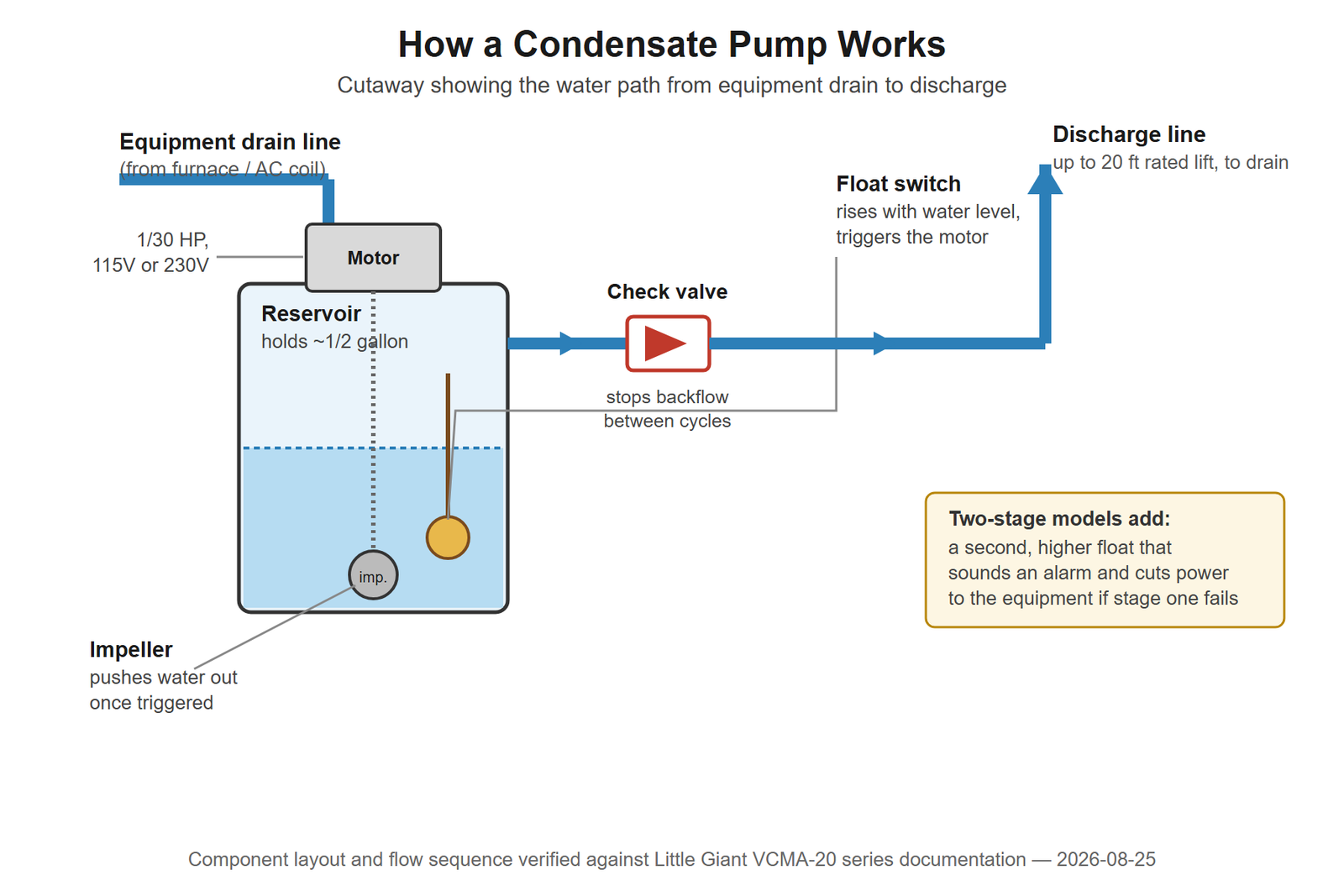
Four parts, always in this order: a small reservoir catches the water, a float switch (mechanical or, on newer units, an infrared or electronic sensor) detects when it’s full, a motor spins an impeller to push water out, and a check valve stops the discharge line from draining back into the reservoir between cycles. Most residential units use a fractional-horsepower motor — a common example, Little Giant’s VCMA-20, runs on 1/30 HP — and hold about half a gallon before triggering.
Two-stage pumps add a second, higher float as a backup: if the first switch fails to trigger the pump, the second one both sounds an alarm and cuts power to the furnace or AC before the reservoir overflows onto the floor. That second stage is what a lot of “safety switch” kits retrofit onto single-stage pumps. Whether yours has one, and whether anybody actually wired it, is the difference between a dry floor and a wet one — why the safety switch so often fails to stop an overflow covers how to check in a minute.
How much water it’s actually moving
Air conditioning condensate runs roughly 5 to 20 gallons a day, depending on humidity, run time, and system size. Furnace condensate is a smaller, steadier trickle by comparison, but it’s chemically different — more on that below. Either way, a pump isn’t fighting a flood; it’s handling a slow drip that adds up, which is why a half-gallon reservoir cycling every so often is normal, not a sign of trouble. It also sets the clock on a failure: half a gallon is about thirty minutes of a running furnace before the reservoir is full.
The number on the box isn’t the number you get
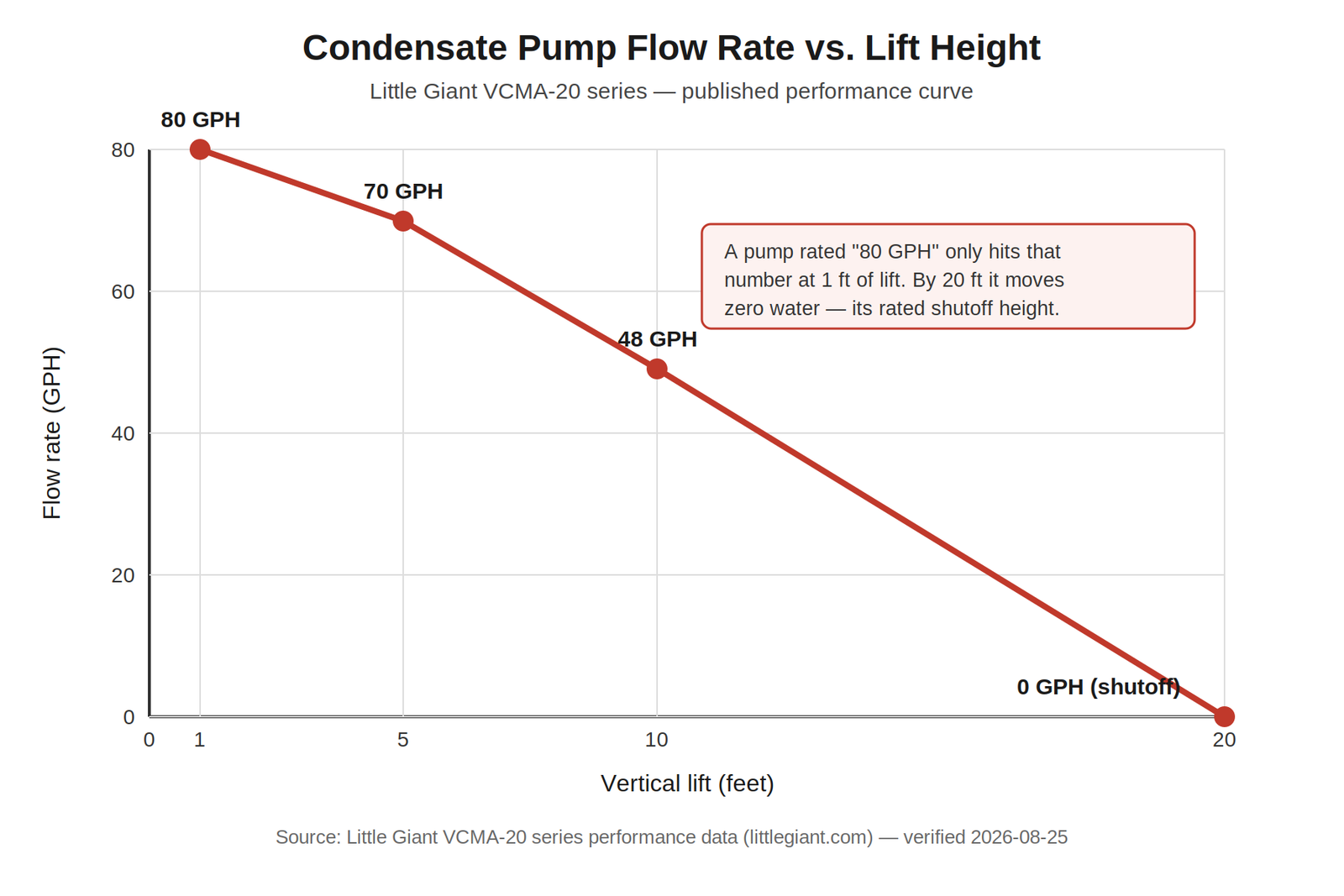
Every condensate pump is sold on its GPH (gallons per hour) rating, and almost every guide to buying one stops there. That number is measured at 1 foot of vertical lift, and it drops fast as the lift increases — because the pump is doing more work against gravity, not because anything is wrong with it.
Little Giant publishes the actual curve for its VCMA-20 series: 80 GPH at 1 foot of lift, 70 GPH at 5 feet, 48 GPH at 10 feet, and 0 GPH — its rated shutoff height — at 20 feet. A pump advertised as “80 GPH” moving water up a wall to a drain 12 feet above it is not an 80 GPH pump anymore. This is also one of the most common reasons a pump runs and hums without moving water: it’s being asked to lift higher than its curve allows, not because it’s broken.
Sizing one correctly
The rule installers actually use: size the pump’s rated output to at least double your expected input rate, then check that rating against your real lift, not the headline number. A furnace producing roughly 2 gallons a day of condensate is a trivial load for almost any pump at low lift — the sizing question only gets interesting when the discharge run climbs. If your run is under 5 feet of vertical lift, most 1/30 HP pumps have flow to spare. Past about 10–12 feet, check the manufacturer’s curve before buying, not after it hums for a week and does nothing. Which condensate pump you need works through that properly, and if your drain is a long way up, how far a condensate pump can actually push water covers where the whole product category runs out. Where it goes turns on the trap rather than the furnace, which is why sitting it above the furnace is the wrong frame. The tube itself is a smaller decision than it looks, and 3/8 versus 1/2 is usually the same tube measured twice. And once the height works, the surface it sits on is what decides how loud it is — wall versus floor is really a vibration question, because the decibel figure on the box is measured on a pump suspended in mid-air. The gravity line feeding the pump has a number attached to it that the pump’s own manual never gives you — 1/8 inch of fall per foot, and only on the lines that drain by gravity. And the far end is not a free choice either: the code names the receptors it will accept and closes the list, so where the discharge is allowed to terminate rules out two of the places people most often pick. Get that connection wrong and it announces itself through your nose — a musty smell is biofilm, but a rotten-egg smell is sewer gas, and only one of those is a cleaning job. What the water is doing to the drain is a separate question from what it smells like, and on a condensing appliance it is a pH question — the neutralized target is a window with a ceiling rather than a floor to clear, and the device that gets you there is sized in BTU off the furnace nameplate rather than in gallons. The safety switch has a trap of its own: the manual puts equipment shutdown on the COM and NO terminals and reserves NC for an alarm, so a furnace that will not start after a pump swap is usually two leads on the wrong pair. The pump’s own 120 V supply is a separate matter again, and one where the common advice is out of date: a GFCI that keeps tripping is measuring real leakage, and the exception that once let you skip it left the code in 2008. Once you have a number to shop against, the buying guide covers the six specs that actually separate these pumps — starting with the fact that maximum liquid temperature varies between series of the same brand, and that the model most guides still name has been discontinued. For a ductless head rather than a furnace, the mini-split guide is the equivalent — there the deciding spec turns out to be duty cycle.
Furnace condensate is acidic — and that matters for what it touches
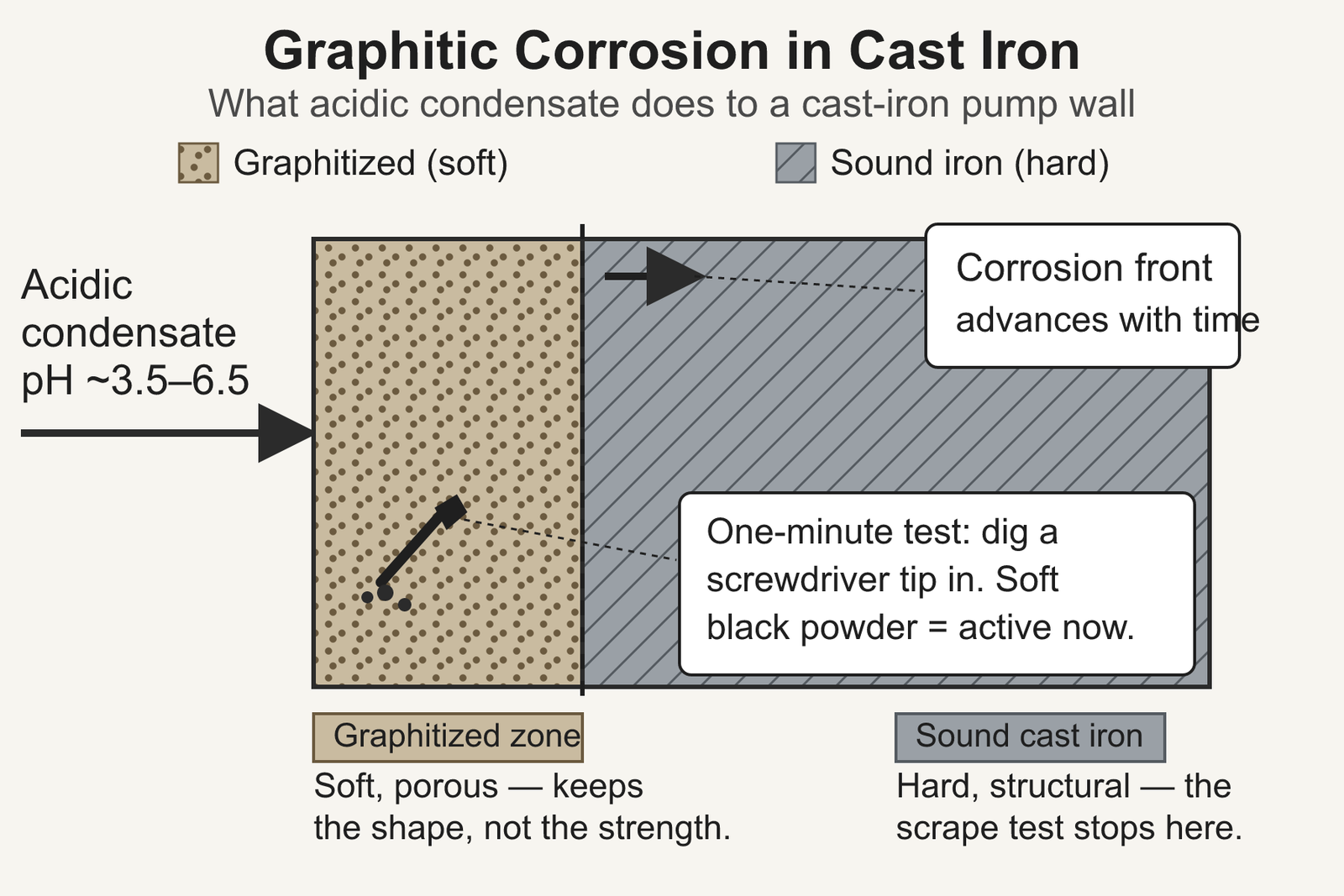
Air conditioning condensate is close to pH-neutral. Condensate from a high-efficiency (condensing) furnace is not: it typically runs around pH 5.0, and can range from 3.5 to 6.5, because it absorbs combustion byproducts on its way out of the heat exchanger. Anything below pH 6.5 is corrosive to most metals, and the acidity scale is logarithmic — pH 5 water is roughly 10 times more acidic than pH 6.
That matters for what the water passes through on its way to the drain. Cast iron is roughly 10 times more vulnerable to this kind of corrosion than copper, and both are slower to fail than the acid moving through PVC, which is unaffected. If a discharge line ties into an older cast-iron drain stack, or the pump’s own internal parts are metal rather than the glass-filled polypropylene used in most modern units, that’s a real degradation path over years, not a theoretical one. The standard fix where it’s a concern is an inline condensate neutralizer — a small cartridge of crushed limestone the water passes through before it reaches metal. And if the metal it reaches is a cast-iron pump housing, the damage has a name and a one-minute field test — graphitic corrosion leaves the shape intact while taking the strength out of the wall.
The code rule almost nobody quotes
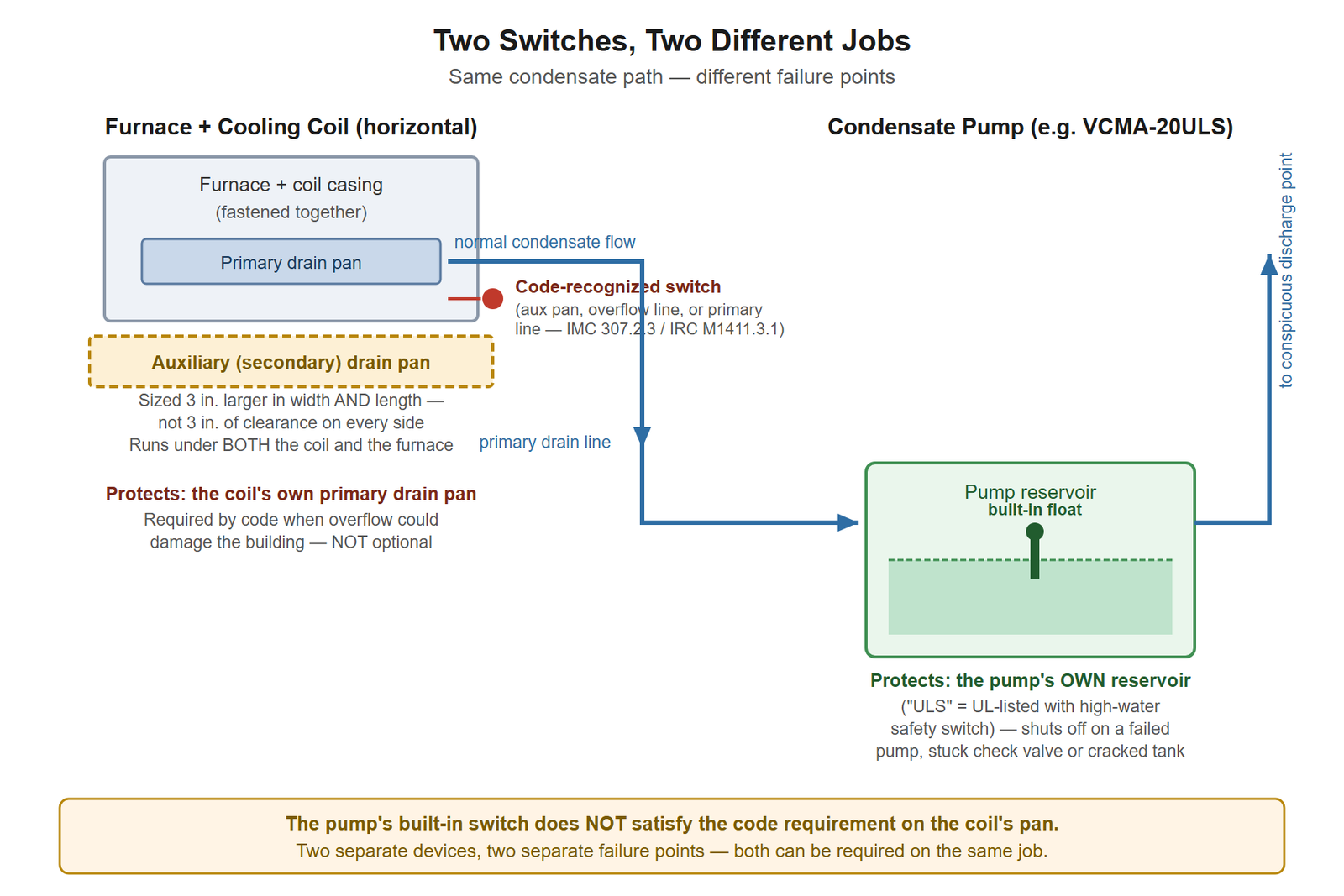
The 2024 International Residential Code, section M1411.3, requires backup overflow protection whenever cooling or heating equipment is installed somewhere a clogged primary drain could damage the structure — an attic, a closet, or above a finished ceiling. The installer has to provide one of three things:
- A secondary drain pan, at least 1.5 inches deep, with its own separate drain line, or
- A secondary drain line tapped off the primary pan at a point higher than the primary drain, routed to a conspicuous spot where a drip will actually get noticed, or
- A float switch in the primary pan that shuts down the whole system — not just the compressor — the moment water starts backing up.
Having one is the easy half. The manufacturer asks for it to be inspected and tested every thirty days, and specifies two tests rather than the one everybody publishes — the second proves it will act before the pan overflows, which the first cannot.
That last detail trips up DIY installs: a float switch wired to cut only the compressor still lets the air handler blower keep pulling humid air across a wet, overflowing coil. Code requires the whole unit to shut down. Primary drain lines themselves have their own minimums — at least 3/4 inch in diameter, pitched a minimum of 1/8 inch per foot toward the drain.
Condensate pump or sump pump — not the same thing
They look like a similar idea — a reservoir, a float switch, a pump — and homeowners sometimes ask if one can stand in for the other. It can’t, in either direction. A condensate pump’s reservoir holds well under a gallon and its motor is sized for a slow trickle; a sump pump moves groundwater by the hundreds of gallons and would short-cycle uselessly on condensate’s drip-feed. Just as important, a sump pump’s internals aren’t built to sit in acidic furnace condensate day after day, and a condensate pump has nowhere near the capacity to handle actual groundwater intrusion. If you’re trying to route a condensate line into a sump pit rather than buying a second pump, that’s usually fine for the water itself — check that your sump pit isn’t sealed for radon mitigation first, since venting it changes the math.
One thing that is never on that list: priming. A condensate pump sits under the water it moves, so it has no prime to lose — the component that does get primed is the furnace trap, and that one is a combustion-safety step rather than a drainage one.
And the fault that keeps coming back rather than staying fixed is nearly always the same one. Growth needs moisture, a surface and food; the pump is built so the first two cannot be taken away, which leaves only the food, and that arrives on the air rather than in the water.
When it goes wrong
Five things go wrong often enough to have their own answers, and they are told apart by what you actually observe rather than by what is broken:
- It hums but no water leaves — a blocked line, a check valve, or too much lift. Start at running but not pumping.
- Nothing happens at all — most often an outlet that isn’t live all the time, covered in not turning on.
- It starts, then cuts out partway through — that is the thermal protector, and something is making it work too hard.
- The float won’t move — the most common single failure on a tank pump, and usually freeable without replacing anything.
- The AC stopped and the floor is dry — that is the protection working, not the system failing. See AC shuts off when the pump fills.
Four of those five are downstream of the same thing — a tank and a line that have not been cleaned. The makers disagree about how often that should happen and even about what to clean it with, and their own words are worth reading before you reach for the bleach.
One last thing the spec sheets will not tell you: how long it should last. No manufacturer publishes a service life — what they publish is a one-to-three-year warranty — and owner reports run from three years to twenty-five. The spread is duty rather than quality, which means the answer depends on your furnace more than on your pump.
When this needs a licensed pro
Anything involving the pump’s electrical connection — wiring a safety switch to cut power to the whole furnace, sharing or not sharing a circuit with the equipment it protects, or running a new dedicated line — is mains-power work, and a miswired shutoff is exactly the kind of mistake that either fails silently or trips a breaker at 2 a.m. If your furnace is a condensing (high-efficiency) model and you’re not certain the condensate is being neutralized before it reaches an older metal drain line, that’s also worth a five-minute question to your HVAC tech rather than a guess.
FAQ
Does a condensate pump need its own dedicated outlet?
Not necessarily — many are plugged into a nearby outlet that also serves other equipment — but it should be on a circuit that isn’t shared with something that gets switched off independently, or the pump loses power without anyone noticing. If the pump feeds a safety switch that’s meant to cut the furnace, that wiring is a job for whoever installed the furnace, not a plug-and-play add-on.
Can I drain a condensate pump into a sump pit?
Usually yes, and it’s a common setup where a floor drain isn’t nearby. The one thing to check first is whether the sump pit is sealed as part of a radon mitigation system — running a condensate line into a sealed, actively-vented pit is a different situation than an open sump.
Why does my pump run and hum but not actually move water?
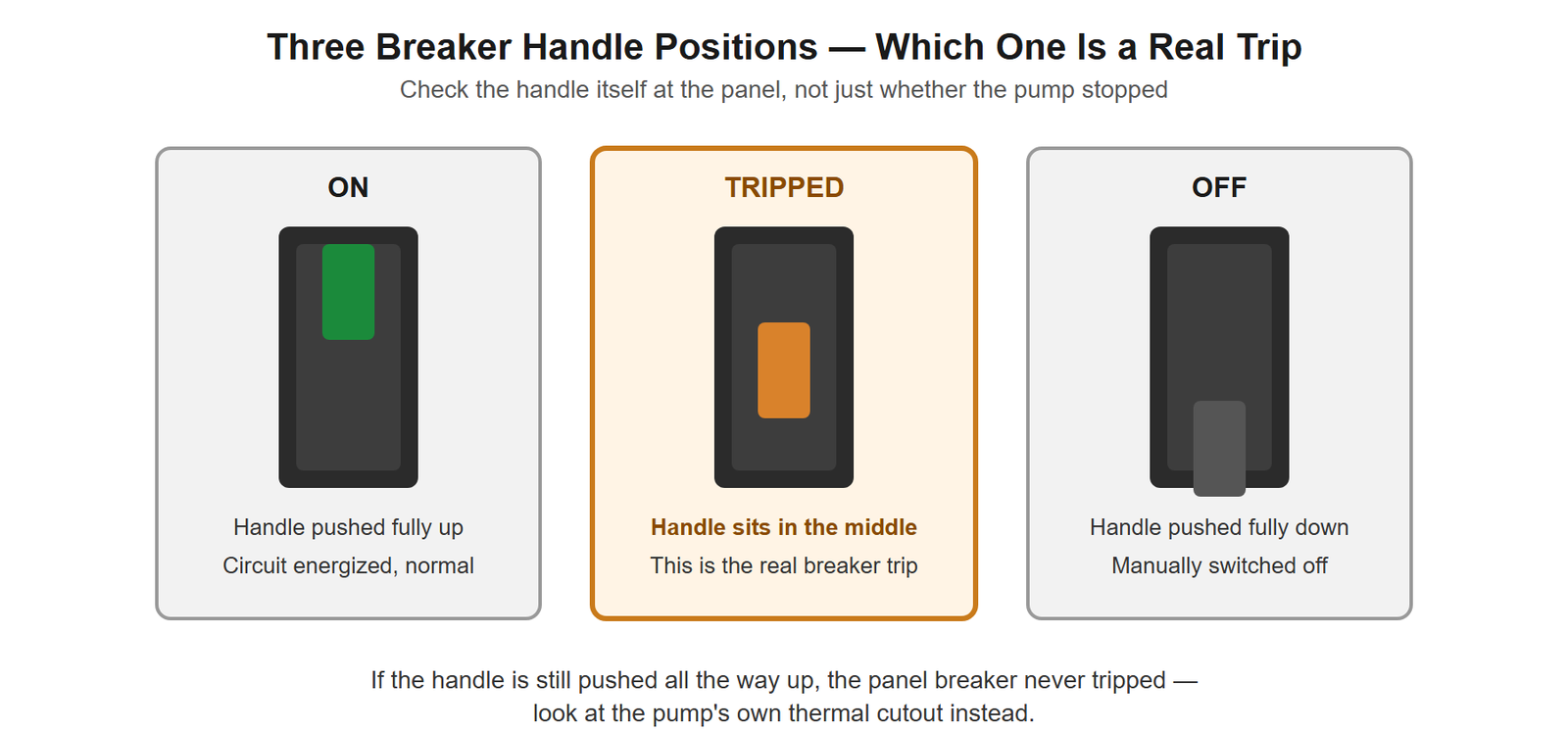
The most common cause is being asked to lift higher than its rated curve allows — see the lift-vs-flow numbers above. A stuck check valve or a clogged intake screen produce the same symptom and are worth checking first since they’re a five-minute fix. And if the breaker itself keeps going, look at the handle before you look at the pump — a tripped breaker sits mid-travel, and a handle still pushed fully up means the panel never tripped at all.
Is a two-stage pump worth the extra cost over a single-stage one?
If the pump is anywhere a slow overflow would land on finished flooring, drywall, or anything below it, the second float and shutoff is cheap insurance against exactly that failure mode.