On this page
Last Updated on September 21, 2026 by Muhammad Toqeer
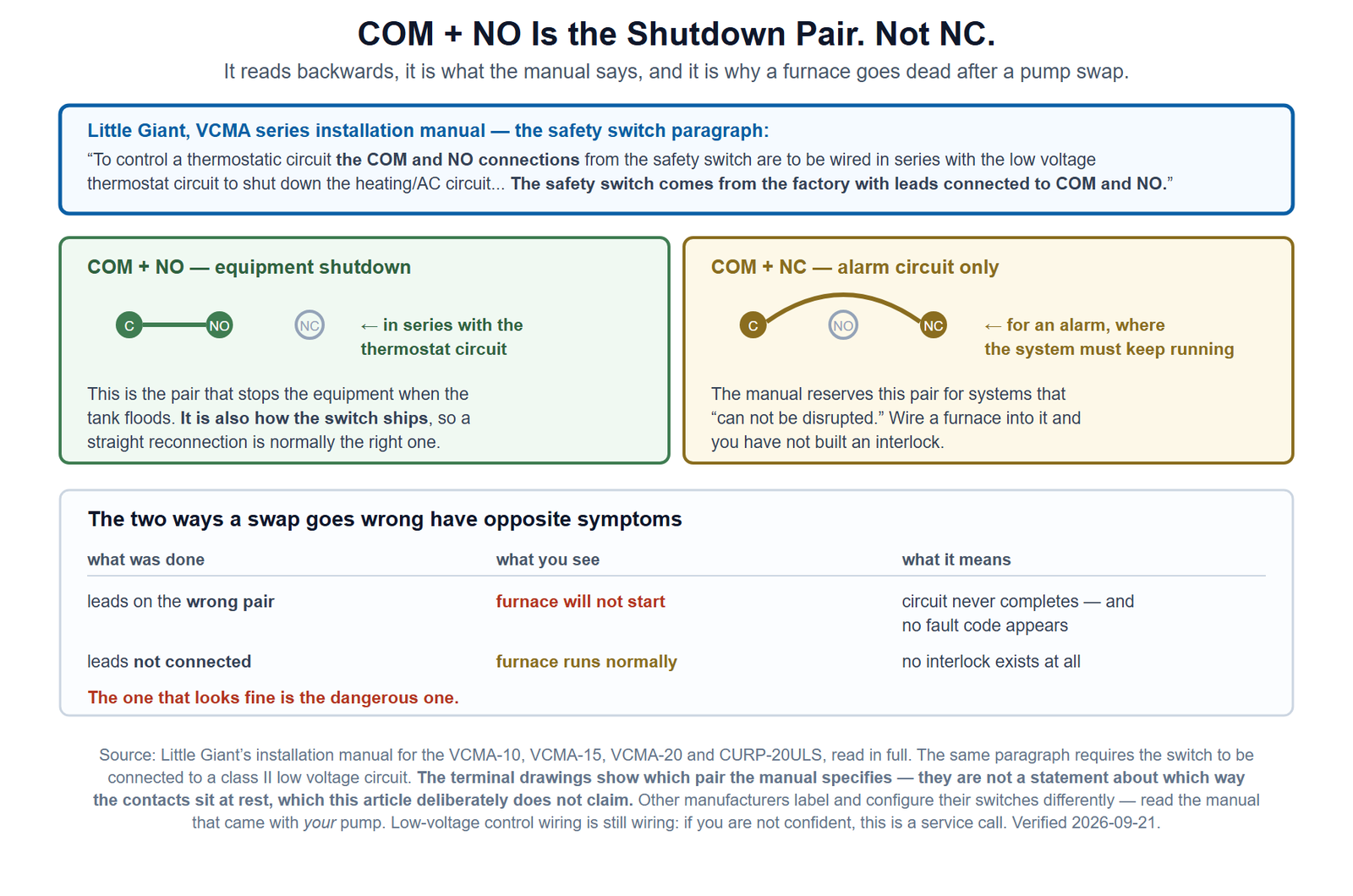
Check which two terminals the safety switch leads are on. Little Giant’s manual is explicit: COM and NO go in series with the thermostat circuit to shut the equipment down. COM and NC are for an alarm. That reads backwards to most people, which is exactly why a furnace goes dead after a pump swap.
And the switch ships on COM and NO — so if you simply reconnected what was there, you are probably fine and the fault is elsewhere. The trouble starts when somebody moves a lead.
What the manual actually says
Nobody on the first page of results quotes this, so here it is in full:
“Safety switch: The safety overflow switch should be connected to a class II low voltage circuit. To control a thermostatic circuit the COM and NO connections from the safety switch are to be wired in series with the low voltage thermostat circuit to shut down the heating/AC circuit. The COM and NC switch contacts may be used to actuate a low voltage alarm circuit (connected in series) if the heating/cooling system can not be disrupted. The safety switch comes from the factory with leads connected to the COM and NO switch terminals.“ — Little Giant, VCMA-10 / VCMA-15 / VCMA-20 / CURP-20ULS installation manual
Two things in that paragraph matter more than anything else you will read about this.
The shutdown pair is COM and NO. If you have ever wired a safety interlock before, your instinct says a safety contact should be normally closed — open the circuit, stop the appliance. On this switch, the pair the manufacturer names for equipment shutdown is the one labelled NO, and the NC pair is reserved for something else entirely.
COM and NC is an alarm circuit, and the manual says when to use it: “if the heating/cooling system can not be disrupted.” That is the opposite requirement. Wire a furnace into that pair and you have not built an interlock — you have built a circuit that was meant to ring a bell somewhere while the equipment kept running.
One-minute test: with the power off, follow the two switch leads back to the pump cover and note which terminals they sit on. COM and NO is the shutdown pair. If one lead has been moved to NC, you have found it.
This article deliberately does not tell you which way the contacts sit at rest. The labelling on float switches is ambiguous enough that reasoning it out would be guesswork, and the manual removes the need: it names the pair. Use the pair it names, in the manual that came with your pump.
Two ways to get it wrong, with opposite symptoms
This is the part worth slowing down for, because one of the two failures is invisible.
Leads on the wrong pair — the furnace will not start. The control circuit never completes, so the equipment simply never sees a call for heat. It does not see a fault either, which is why there is usually no code, no blinking light and nothing on the thermostat to point at. A live breaker and a working thermostat prove nothing here; the same silence is covered in why there is no warning when the switch shuts your AC down.
Leads not connected at all — the furnace runs perfectly. And it will keep running perfectly for years, right up until the pump blocks and there is nothing to stop the equipment making water it cannot get rid of. Nothing looks wrong, because from the furnace’s point of view nothing is.
The one that looks fine is the dangerous one. If your furnace started right up after the swap and you never touched the two small switch leads, that is worth going back for rather than a relief.
One-minute test: look at the pump’s cover. If two thin low-voltage leads run from it toward the furnace, an interlock exists. If they are coiled up, taped off, or still in the bag, it does not.
Before you blame the wiring
Two other things change during a swap and both are quicker to check.
Is the pump on constant power? The manual is specific — the cord “must be connected to a constant source of power (not a fan or other device that runs intermittently).” A pump moved to a switched receptacle during a swap creates a different fault, and the pump doing nothing at all is where that leads.
Did the model change? The suffix decides whether a safety switch exists. A UL model has none; a ULS does. Swapping a ULS for a UL removes the protection silently and leaves you with two spare leads and nothing to connect them to — the buying guide covers the suffix and why the S is worth paying for.
Proving it is the safety circuit
There is a standard field check: disconnect the two switch leads and bridge them, and see whether the furnace fires. It is a class II low-voltage circuit, which is why techs do this without ceremony.
Treat it as a test and nothing else. If the furnace starts with the leads bridged, you have proved the safety circuit is what is holding it off — and you now have a furnace with no condensate protection at all. Take the jumper out. Leaving it in is the same as never connecting the switch, with the added problem that you will forget it is there.
If you are not comfortable doing that, skip it. It is a diagnosis, not a repair, and the repair is the same either way: get the leads onto the pair the manual names.
When this needs a pro
If the leads were never connected and you want them connected properly, that is control wiring on the equipment side. It has to interrupt the right circuit, and getting it wrong in the other direction — into a pair that keeps the system running — puts you back where you started with a false sense of safety.
If the furnace still will not start with the safety circuit proved clear, the pump is a bystander. Something else opened, and it is time for someone with a meter.
If you want to confirm the switch itself still works, the manufacturer gives a test that needs no tools — raise the safety float by hand and the switch should act before water reaches the rim. It is set out in freeing a stuck float without wrecking it, which covers the same two floats.
And never leave a jumper in as a fix. A pump without a working interlock is the arrangement that turns a blocked discharge into a ceiling repair; for what that failure actually looks like, the condensate pumps guide sets out the whole arrangement.
One honest caveat on all of the above: the quoted wiring is Little Giant’s, for the VCMA family. Other manufacturers label and configure their switches differently. The principle transfers — there is a pair for shutdown and a pair for alarms, and they are not interchangeable — but the terminals are the manual’s to name, not this article’s.
FAQ
Why won’t my furnace start after replacing the condensate pump?
Most often the safety switch leads are on the wrong terminals. Little Giant’s manual specifies COM and NO in series with the low-voltage thermostat circuit for equipment shutdown, and reserves COM and NC for an alarm circuit. On the wrong pair the control circuit never completes, so the furnace behaves as though nothing is calling for heat.
Which terminals does a condensate pump safety switch use?
COM and NO for shutting the equipment down, per the manual, and that is also how the switch ships from the factory. COM and NC is specified for a low-voltage alarm where the system cannot be interrupted. Check the manual for your own pump — other makers differ.
Can I just jumper the condensate safety switch to get heat back?
Only as a momentary test, and then take it out. Bridging the leads proves the safety circuit is what is stopping the furnace, but leaving it bridged removes the only thing that stops a blocked pump flooding something.
My furnace started fine after the swap — is the wiring right?
Not necessarily. If the two switch leads were never reconnected, the furnace runs exactly as normal and the interlock simply does not exist. Look for two thin low-voltage leads running from the pump toward the equipment; if they are taped off or still bagged, there is no protection.
Why is there no error code on the furnace?
Because an open control circuit is not a fault the equipment recognises — it reads as no call for heat. That is why a working thermostat and an untripped breaker rule out much less than people expect.


