On this page
Last Updated on September 5, 2026 by Muhammad Toqeer
Three different things happen, and which one you get is decided by a single wire. Either the equipment shuts itself down and your floor stays dry, or the tank overflows — in well under an hour — or, on a high-efficiency furnace, the furnace locks itself out and nothing looks wet anywhere.
Most pages answering this question list the reasons pumps fail. That is a different question. This one is about what follows, and how much time you have.
How long before it overflows
Short enough to be worth knowing, and it is arithmetic rather than a guess.
The two most common residential pumps, Little Giant’s VCMA-15 and VCMA-20, hold half a gallon. A condensing furnace or boiler running flat out produces, in HTP’s words, “one gallon per hour for every 100,000 BTUs of input”. Divide one into the other and a 100,000 BTU furnace fills that entire tank in thirty minutes.
Air conditioning is slower but not by much. Published rates run about 0.1 gallons per ton-hour in dry conditions, 0.2 in average ones and 0.3 to 0.4 in humid ones, so a three-ton system makes somewhere around 0.3 to 0.9 gallons an hour — half a gallon in roughly 33 to 100 minutes depending on the weather.
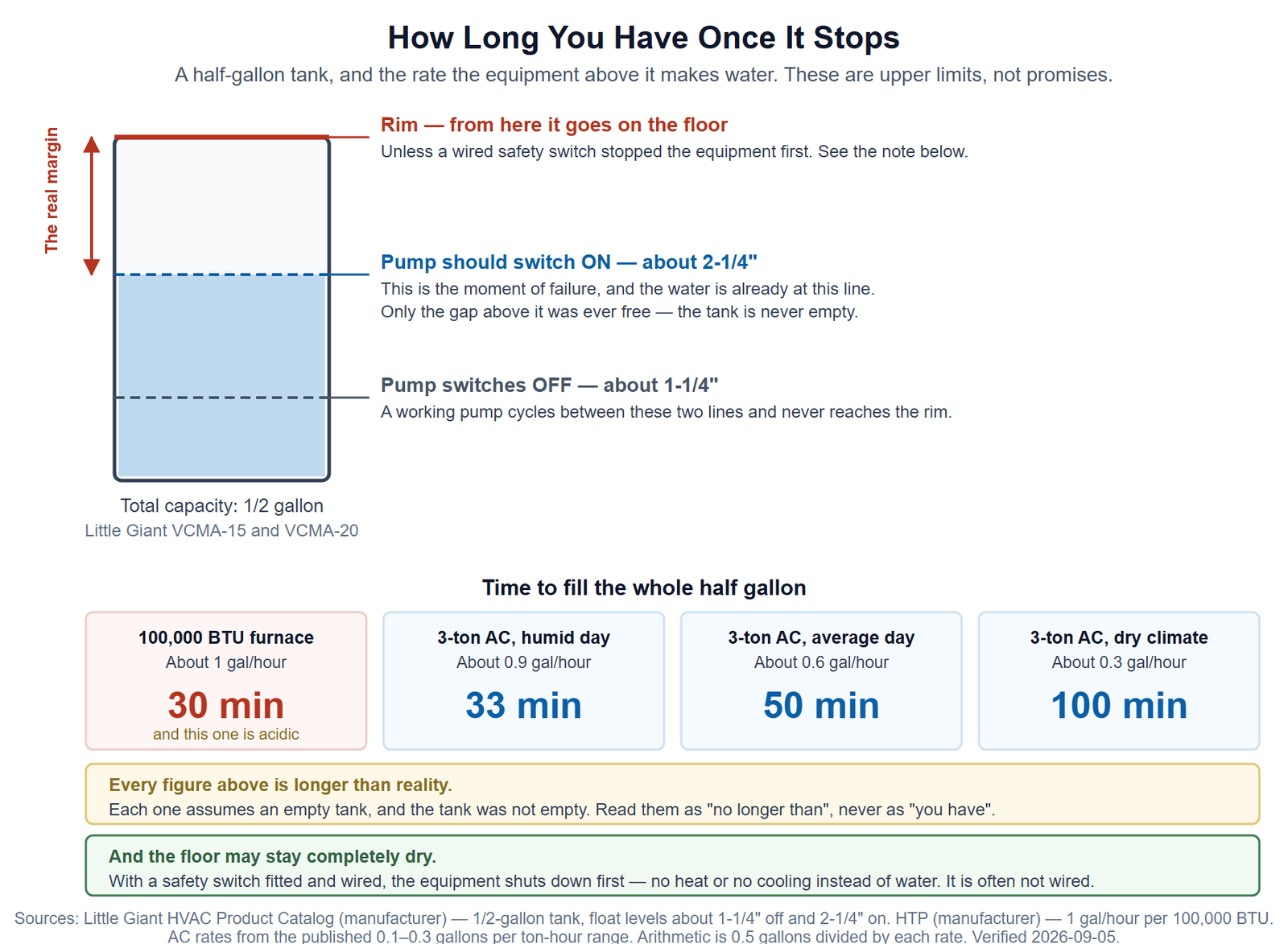
Treat all of those as ceilings rather than allowances. They assume an empty tank, and the tank is never empty when a pump quits — it sits at the level where the pump shuts off, around an inch and a quarter, and should restart at around two and a quarter. Only the space above that restart line was ever free. The real window is a good deal shorter than the numbers above.
Outcome 1: the equipment shuts down and nothing gets wet
This is the outcome nobody leads with, and it is the reason a lot of people arrive at this question with no water to look at.
If the pump has a high-water safety switch fitted, and that switch is actually wired into the equipment’s control circuit, the switch trips before the tank reaches its rim and stops the furnace or air handler. No more condensate gets made. The complaint becomes “my AC stopped working” on the hottest day of the year, and the floor stays perfectly dry.
Whether you get this outcome depends on two things, neither of which most homeowners know about their own pump: whether the switch is there at all, and whether anyone connected it. Little Giant fits one only to models whose number ends in S, and describes it as optional — the manufacturer’s own wording is that it “does not need to be hooked up for the pump to operate correctly”. That is exactly why it so often is not. There is a one-minute way to check yours in why the safety switch so often fails to stop an overflow.
Outcome 2: the tank overflows
No switch, or a switch nobody wired, and the water goes over the rim on the timetable above.
What that costs you has less to do with the pump than with where it sits. A pump on a basement slab next to a floor drain makes a mess. The same pump in an attic or a closet above a finished ceiling is putting water into a ceiling for as long as the system keeps running — which, with nothing to shut it down, is until somebody notices a stain.
That difference is why the residential code provision on condensate disposal asks for one of three things wherever a clogged drain could damage the structure: a secondary drain pan with its own drain, a secondary drain line run somewhere conspicuous, or a float switch that shuts the whole system down.
And what spills is not always just water
Nobody separates these two cases, and they are chemically different.
In cooling season, condensate is water condensed out of indoor air. It is just water.
In heating season on a high-efficiency furnace, it is not. Condensate from a condensing appliance is acidic — HTP puts the figure for a condensing boiler at “a pH level of 3.2 to 4.5, which is acidic enough to leave stains, kill shrubs, and eat away cast iron drainage systems.” A furnace produces it by the same flue-gas mechanism. Half a gallon of that on a finished floor is a different problem from half a gallon of AC condensate, and it is worth photographing what it landed on before you clean it up.
Outcome 3: the furnace locks itself out
This one appears in none of the pages ranking for this question, and it is the reason some people never suspect the pump at all.
On a 90%-plus condensing furnace, condensate that cannot leave does not simply sit in the pump. It backs up toward the furnace’s own trap and secondary heat exchanger. HVAC School describes what that does:
“If this trap is partially clogged, water can back up in the secondary heat exchanger. This can prevent the necessary air movement required to produce enough draft to close the pressure switch.”
The pressure switch is what proves the inducer fan is pulling draft. If it will not close, the control board will not light the burners, and the board “locks out into fault if the switch opens enough times while the flame is lit.”
So the symptom is a furnace throwing a pressure-switch code. No water anywhere, nothing obviously wrong with the pump, and a homeowner calling about a furnace fault.
One-minute test: the giveaway is the pattern. Reset it and it runs fine for a while, then faults again. HVAC School explains why — “it may have drained when the furnace was locked out and not running. So when you get there and reset it, everything runs fine until the condensate starts to back up again.” A fault that clears on a reset and returns an hour later is pointing at drainage, not at the pressure switch itself.
What does not happen
Worth saying, because the fear people arrive with is usually bigger than the reality.
A failed condensate pump does not wreck the furnace. On a condensing furnace, the lockout in outcome three is the protection working — the equipment refuses to run rather than damage itself. And where a safety switch is wired, outcome one is the same thing: designed-in refusal.
The genuinely unprotected case is narrower than the panic suggests, and worth knowing whether you are in it: an air conditioner, with a pump that has no safety switch or an unwired one, installed where a spill reaches finished space. That combination has nothing standing between a failure and a ceiling. Everything else has at least one thing.
None of this tells you why the pump stopped. If it is humming and moving nothing, or not starting at all, that has its own diagnosis — start with runs but no water leaves, and see the condensate pumps guide for how the parts fit together.
When this needs a pro
Two of the three outcomes end in low-voltage control wiring, and that is the line.
Connecting a safety switch puts you in the same 24-volt circuit as the thermostat. A switch wired wrong is worse than no switch, because it looks like protection and is not.
A furnace locking out on a pressure-switch fault needs a tech as well, and it is worth telling them on the phone that the fault clears on a reset and comes back — that points them at the drain rather than at the switch, and it is the detail that stops a pressure switch being replaced for nothing.
Call sooner, not later, if water has reached a ceiling, insulation or anything electrical. And if you are in the unprotected case above, the fix is not only a new pump — it is a pump with a switch, wired, and choosing that is covered in which condensate pump do I need.
FAQ
How long can a condensate pump sit not working before it overflows?
Less than an hour in most houses. A half-gallon tank under a 100,000 BTU condensing furnace fills in about thirty minutes at full output, and under a three-ton air conditioner in roughly 33 to 100 minutes depending on humidity. Both figures assume an empty tank, so the real margin is shorter.
Can a bad condensate pump stop my furnace from running?
Yes, in two separate ways. If the pump’s safety switch is wired, it shuts the furnace down on purpose. And on a high-efficiency furnace, condensate backing up can stop the pressure switch closing, which locks the furnace out on a fault code.
My AC turned off and there is no water anywhere. Could it still be the pump?
It is one of the more likely explanations. A wired high-water switch stops the equipment before anything overflows, so a dry floor is what a working safety switch looks like. Check whether the pump’s tank is full.
Is the water from a condensate pump harmful?
It depends on the season. Air conditioning condensate is water out of the air. Condensate from a high-efficiency furnace or boiler is acidic — the published figure for a condensing boiler is pH 3.2 to 4.5 — so a heating-season spill can stain what it sits on.
Will a failed condensate pump damage my furnace?
Generally no. A condensing furnace protects itself by refusing to fire when condensate cannot drain. The damage risk is to the building rather than the equipment, and it is highest with an air conditioner whose pump has no working safety switch, installed above finished space.


