On this page
Last Updated on September 16, 2026 by Muhammad Toqeer
Stop comparing these on maximum head. Four of the five pumps below publish exactly 33 feet — the spec every guide leads with is a dead heat. What actually separates them is duty cycle: how much of the time the manufacturer allows the pump to run. It ranges from 40% to continuous, it decides whether the pump keeps up on a humid August afternoon, and it appears on almost no comparison page.
First, though: make sure you need one at all. A wall-mounted head that can drain by gravity should, and whether a mini-split needs a pump works through that and produces the specification this page shops against.
Max head is a dead heat. Duty cycle is not.
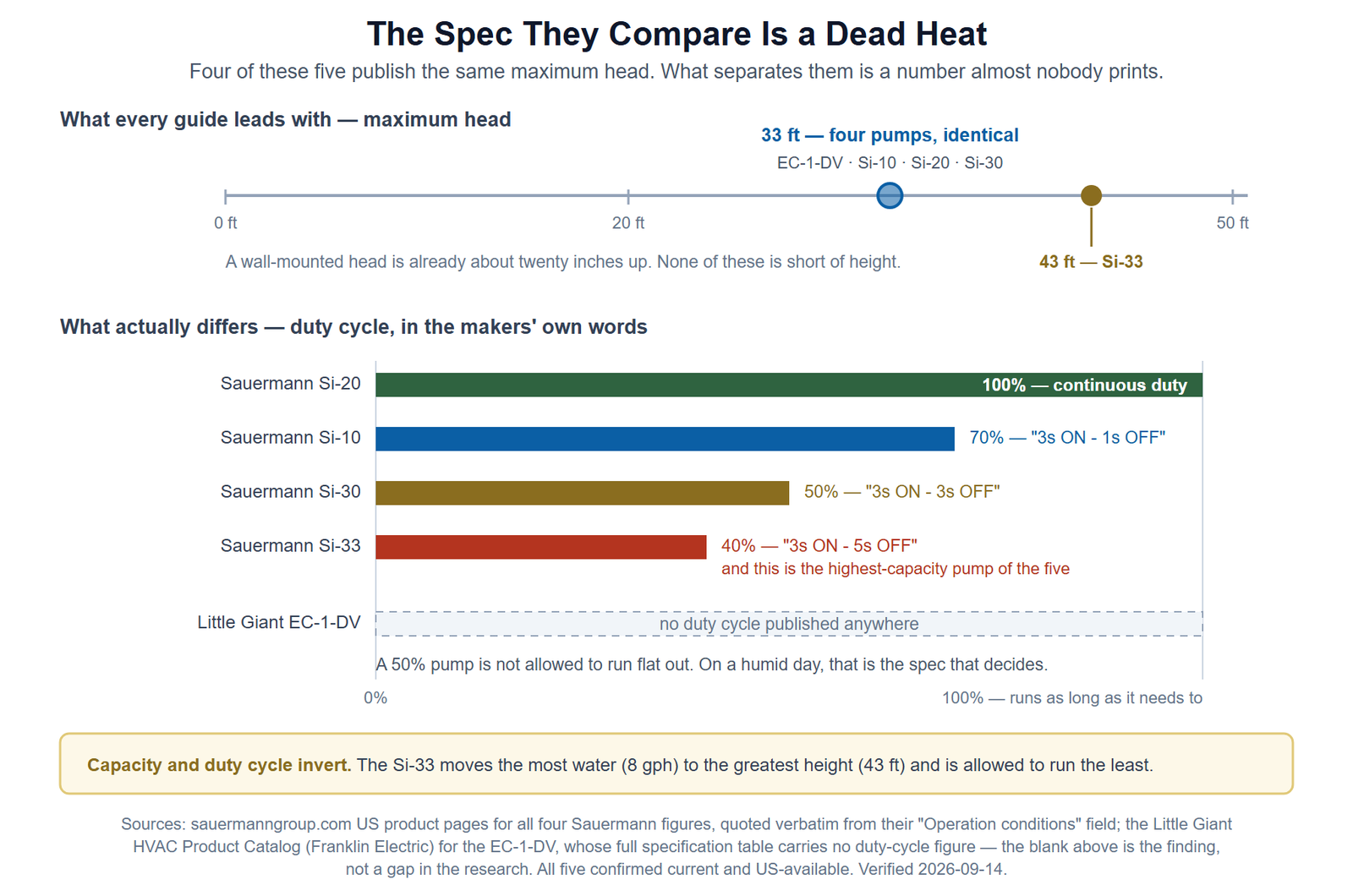
Duty cycle is the manufacturer telling you the pump is not designed to run without pausing. Sauermann prints it as a percentage and a rhythm — the Si-30 is “50%: 3s ON – 3s OFF”, the Si-33 is “40%: 3s ON – 5s OFF”. The Si-20 is the exception: “100 % – Continuous duty.”
Why it matters is simple. A mini-split head produces condensate steadily while it is cooling, and on a humid day it produces a lot of it. A pump that is only allowed to run half the time has to clear that in half the time it appears. If it cannot, the reservoir fills and the safety switch stops the air conditioner, which is exactly why an AC shuts off when the condensate pump fills. That is not a failure — it is the pump doing what its rating says it will.
And the trade-off inverts. The Si-33 is the biggest pump here — 8 gph, 43 feet — and has the lowest duty cycle of the five at 40%. Bigger is not simply better.
Little Giant publishes no duty figure for the EC-1-DV at all. Its catalog specification table is otherwise detailed, so the blank is worth noticing rather than assuming it means continuous.
Flow is not the deciding spec either
Worth dealing with quickly, because it is the other number people compare.
These pumps are rated 2.7 to 8 gallons per hour. A mini-split head at 34,000 Btu produces something in the region of a gallon an hour at the wettest. Even the smallest pump here has multiples of headroom, which is the same conclusion the sizing article reaches from the other direction.
So: not head, not flow. Duty cycle, physical fit, the switch, and voltage.
The five pumps
All confirmed current and US-available on their manufacturers’ own sites.
Little Giant EC-1-DV — the safe default in the US
Item 553507. 110–240 V, 50/60 Hz, 0.18 A, 18 W. 2.7 / 2.5 / 1.8 / 1.5 / 1.2 GPH at 0 / 1 / 5 / 10 / 20 feet, shut-off 33 ft, suction lift 3 ft. 21 dB(A). 1/4″ I.D. discharge. Rated for mini-splits up to 34,000 Btu. Two-piece: a clear reservoir with Hall-effect level sensors and a high-water sensor, plus a pump-controller, joined by a 3.3 ft communications cable. Two-year warranty.
Two things make it the default here. The DV suffix means one part number runs on anything from 110 to 240 V — you do not have to know your head’s supply voltage before ordering. And its alarm relay is rated 8 A resistive at 250 V, against 3 A across Sauermann’s whole mini range, which gives you more margin when wiring the shutdown into an unfamiliar control board.
The honest drawback: no published duty cycle, the lowest flow of the five, and a suction lift of only 3 feet — the reservoir and pump have to live close together, and the reservoir must sit flat.
Sauermann Si-20 — the one that can run all day
Ref SI20UL02UN12 / UN23. Max flow 5 gph, head 33 ft, max suction head 10 ft. “100 % – Continuous duty.” 120 V 13 W or 208–230 V 15 W. Protection IPX2. Safety switch NC 3 A – 250 V. Rated for units up to 20 kW / 60,000 BTU.
And it is extraordinarily slim: 7-3/32 × 1-1/16 × 1-1/16 inches. Sauermann say it “sets a new record for its slim casing design, allowing it to easily fit inside any type of air conditioning unit or lineset cover” — which solves the problem that actually defeats most installations, which is not lift but where the thing goes.
If your head is large, your summers are humid, or you simply do not want to think about duty cycle, this is the pump.
The honest drawback: at 22 dB(A) it is audibly above the Si-30’s 20, which matters in a bedroom and not much anywhere else. Separate part numbers for 120 V and 230 V, so you need to know your supply.
Sauermann Si-30 — the quietest of the five
Ref SI30UL01UN. Max flow 5 gph, head 33 ft, suction head 10 ft. 20.0 dBA at 1 metre, measured to EN ISO 3744. “50%: 3s ON – 3s OFF.” IP20. Piston technology, mounts remotely above the unit, locking power cord, integrated drain-safe device. 2-5/8 × 1-3/4 × 2-3/8 inches.
Twenty decibels is below the Little Giant’s 21 and the Si-10’s 23. In a bedroom, that is the argument, and Sauermann call this their best-selling mini pump.
The honest drawback: the 50% duty cycle. For a bedroom head in a dry climate it will never matter; for a living-room head in Houston it might.
Sauermann Si-33 — the most capable, and the most restricted
Ref SI33UL01UN12 / UN23. Max flow 8 gph, max discharge head 43 ft, max suction head 13 ft. “40%: 3s ON – 5s OFF.” IP20, safety switch NC 3 A – 250 V.
The only pump here that goes above 33 feet, and the only one above 5 gph. If the discharge has to climb two storeys, this is the one that does it — in a utility space rather than a bedroom, for the reason below.
The honest drawback: two, and the second is large. It has the lowest duty cycle of the group, which is a strange pairing with the highest capacity — you are buying reach, not endurance. And it is 34 dB(A), against 20 for the Si-30. Sauermann’s own comparison puts 30 dB at “extremely quiet room” and 38 at a refrigerator, so this one is genuinely audible. Buy it for the 43 feet, and not for a bedroom.
Sauermann Si-10 — for genuinely tight spaces
Ref SI10UL02UN23. Max flow 5 gph, head 33 ft. 23.0 dBA. “70%: 3s ON – 1s OFF.” Compact monobloc with an integrated detection unit — the sensor is inside the pump body rather than in a separate reservoir — plus an anti-vibration mounting bracket. 2-5/8 × 1-3/4 × 3 inches.
The integrated detection is the point: one object to place instead of two, which matters when there is nowhere to put a reservoir.
The honest drawback: the US reference is listed at 230 V, so check your supply before ordering. It is also the loudest of the three pumps here that publish a figure.
Side by side
| Pump | Max flow | Max head | Duty cycle | Noise | Switch rating |
|---|---|---|---|---|---|
| Little Giant EC-1-DV | 2.7 GPH | 33 ft | not published | 21 dB(A) | 8 A @ 250 V |
| Sauermann Si-20 | 5 gph | 33 ft | 100% continuous | 22 dB(A) | 3 A @ 250 V |
| Sauermann Si-30 | 5 gph | 33 ft | 50% | 20.0 dBA | 3 A @ 250 V |
| Sauermann Si-33 | 8 gph | 43 ft | 40% | 34 dB(A) | 3 A @ 250 V |
| Sauermann Si-10 | 5 gph | 33 ft | 70% | 23.0 dBA | 3 A @ 250 V |
The one blank is blank on purpose: Little Giant publishes no duty-cycle figure for the EC-1-DV anywhere, and none is invented here.
Why there is no Aspen on this list
Worth saying plainly, because if you have searched this topic you will have seen the Aspen Mini Orange recommended everywhere.
The strongest comparison content for mini-split pumps is British, and the Mini Orange is described by UK trade sources as the most widely installed condensate pump in that market. That is a claim about the UK. Aspen’s US product page returned an empty response when checked for this article, and no US-specific specification could be verified.
So it is absent for a reason that has nothing to do with the product being bad. It is absent because this site does not publish specifications it has not verified for the reader it is written for, and a US homeowner needs a US part number and a US voltage.
Kits, if you would rather not assemble one
Both manufacturers sell the same pumps as ready-to-fit packages, which is often the easier purchase: Little Giant’s EC-1K-DV line-set kit and EC-1U-DV undermount version, and Sauermann’s Omega Pack 2 (built around the Si-20) and Delta Pack (built around the Si-10). The pump inside is the one reviewed above, so pick the pump first and the packaging second.
Three shortcuts
Bedroom head, quiet matters most: Sauermann Si-30, at 20 dBA.
Humid climate or a big head: Sauermann Si-20 — the only one rated continuous duty, and rated to 60,000 BTU.
You do not know your voltage, or you want the longest warranty: Little Giant EC-1-DV. One part number covers 110–240 V and it carries two years.
When this needs a pro
The safety switch is the part that must be wired, and it is the part people skip. Every pump here ships a normally-closed contact whose entire job is to stop the air conditioner before the reservoir overflows. Left unconnected it does nothing at all, which is how a pump overflows onto the floor with the air conditioner still happily running. Note the ratings differ — 8 A resistive at 250 V on the Little Giant, 3 A on the Sauermanns — and that the contact has to be landed on the right terminals of your specific indoor unit. If you are not certain which, that is a service call.
Refrigerant lines are not a DIY surface. These pumps often mount inside the line-set cover, and anything that involves opening or disturbing refrigerant piping is EPA-certified work in the US.
And if the head is dripping rather than draining, a pump may not be the answer at all — a blocked drain pan or a line that slopes the wrong way produces the same symptom, and fitting a pump to it hides a problem instead of fixing one. The condensate pumps guide covers what these systems are doing, and a pump that runs but moves no water covers the failure that looks identical.
FAQ
What is the best mini-split condensate pump?
For most US installations the Little Giant EC-1-DV, because one part number runs on 110–240 V, it is quiet at 21 dB(A), and it carries a two-year warranty. If your climate is humid or the head is large, the Sauermann Si-20 is the better choice — it is the only pump here rated for continuous duty.
How high can a mini-split condensate pump lift condensate?
Almost all of them publish 33 feet, including the Little Giant EC-1-DV and the Sauermann Si-10, Si-20 and Si-30. The Sauermann Si-33 goes to 43 feet. Height is rarely the constraint on a mini-split, because a wall-mounted head already starts about twenty inches up.
What is duty cycle on a condensate pump and why does it matter?
It is the proportion of time the manufacturer allows the pump to run. Sauermann prints it as a rhythm — the Si-30 is “50%: 3s ON – 3s OFF”. A pump limited to half the time has to clear condensate in half the time it arrives, and on a humid day with the head running flat out that can be the difference between keeping up and tripping the safety switch.
Is the Sauermann or the Little Giant quieter?
On published figures the Sauermann Si-30 is quietest at 20 dB(A), then the Little Giant EC-1-DV at 21, the Sauermann Si-20 at 22 and the Si-10 at 23. The Si-33 is the outlier at 34 dB(A) — Sauermann’s own scale puts that between an extremely quiet room and a refrigerator.
Do I need a separate reservoir, or is the pump one piece?
It depends on the model. The Little Giant EC-1-DV and most Sauermann models are two-piece — a detection reservoir plus a pump — joined by a cable, and the reservoir has to sit flat. The Sauermann Si-10 has its detection unit built into the pump body, which is the reason to choose it when there is nowhere to put a second component.


