On this page
Last Updated on August 30, 2026 by Muhammad Toqeer
Two different faults look identical from the top of the tank: the motor hums, the water sits there, nothing comes out of the line. Which one you have depends on what the reservoir does over the next thirty seconds. If it stays full, something downstream is blocked. If it drains and then refills within seconds, the water is coming back down the tube at you — and that is a completely different repair.
Do that first. Everything below is sorted by which of the two you saw.
The thirty-second split
Pull the lid or look down into the tank while the pump is running. You want to know whether the water level moves at all.
It stays put, pump keeps running. The impeller is either not turning, not gripping water, or pushing against something it can’t get past. Go to the blocked-line group below.
It drops, the pump stops, then it’s full again a few seconds later and the pump restarts. The pump is working. The water is coming back. Go to the second group.
The reason this split is worth thirty seconds is that the two groups share almost no repairs. People replace pumps for the second problem all the time, and the new pump does exactly the same thing, because the fault was never in the pump.
There’s a measurement that helps here too. On Little Giant’s VCMA series the float turns the motor on at about 2-1/4 inches of water in the tank and shuts it off at about 1-1/4. If your pump is running and the water is above that on-level, the switch has done its job correctly and you can stop suspecting it.
Group one — the reservoir stays full
The discharge line is blocked
This is the most common cause and the first thing to rule out. Algae, biofilm and mineral scale build inside the tubing over a season, and the run doesn’t have to be fully plugged to stop a small pump — these motors are around 1/30 HP, and a partial restriction is enough.
One-minute test: pull the tubing off the pump outlet and hold it over a bucket. Blow through it. If it’s hard work, or it gurgles and pushes back, that’s your answer. If it’s clear, the fault is inside the pump and you’ve just saved yourself an hour.
Flush the line with a cup of white vinegar and leave it half an hour before rinsing. If the run is long or goes outside, check the far end too — the terminal inch is where deposits collect and where a winter freeze starts.
The check valve is stuck shut
The check valve is the small black barbed fitting the clear tube pushes onto. Its job is to stop the standing water in the vertical run from falling back every time the pump shuts off. When its internals gum up closed, the motor runs into a wall.
One-minute test: pull it off and blow through it. It should pass air one way and block the other. If it blocks both ways it’s finished, and if it passes both ways it isn’t doing anything — which puts you in group two instead.
Note which way round it was before you pull it. The arrow points toward the discharge.
The impeller is jammed
Sludge gets past into the pump body and binds the impeller. The motor energises, can’t turn the wheel properly, and you get the hum with no flow. Iron bacteria are the worst version of this — they leave a reddish-brown oily deposit that can seize an impeller solid rather than just slowing it.
One-minute test: with the pump unplugged, is there a gritty or slimy film on everything you can reach inside the tank? A pump whose reservoir is dirty has a dirty impeller. Clean the tank and the inlet screen with a soft brush rather than just rinsing — biofilm survives rinsing, which is why the problem comes back six weeks later on pumps that were “cleaned”.
Little Giant asks for routine flushing with fresh water for a second reason: as condensate concentrates, the tank pH can fall below an average of about 3.4, and the manual warns that a localised pocket of acid then “acts like a battery”, pitting the housing.
The line is going higher than the pump can lift
Every one of these pumps has a ceiling, and at the ceiling it will hum and move nothing at all. A VCMA-20 does 80 GPH at one foot of lift, 48 GPH at ten feet, and exactly nothing at twenty — that last figure is the shut-off head, not a suggestion. Measure from the pump to the highest point the tube reaches, not to where it ends up. There is more on how that curve behaves in the condensate pump guide.
Group two — it pumps, then the water comes straight back
This group is where the SERP falls apart, because almost every guide treats it as a check valve problem and stops there. Often it isn’t. Three of the causes below come from the manufacturer’s own installation manual, and none of them involve a faulty part.
The tell for all of them is the same: a gurgling or rushing sound down the line right after the motor stops, the level in the tank rising as you watch, and the pump kicking back in a few seconds later. That short-cycling is not the pump failing. It’s the pump doing the same lift over and over.
The discharge tubing is too fat
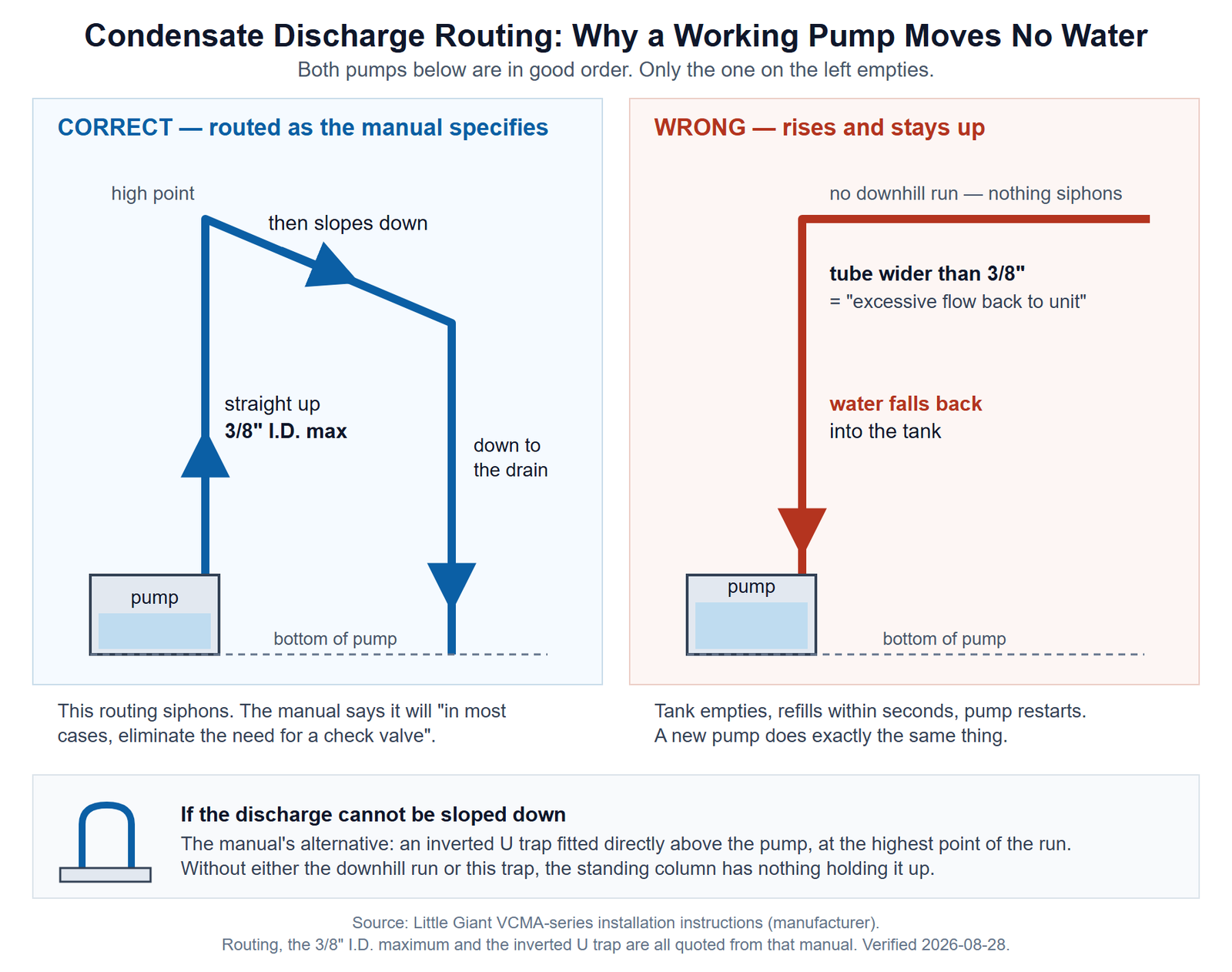
Little Giant specifies 3/8″ I.D. tubing as a maximum, and gives the reason in the manual: anything wider allows “excessive flow back to unit.”
This one catches people who did everything else right. Fatter tube feels like an upgrade — more bore, better drainage. It isn’t. A narrow bore lets the column of water hold itself in place between cycles; widen it and the slug the pump just lifted falls back down past itself the moment the motor stops.
One-minute test: measure the inside of the tube. If it’s 1/2″ or larger, that’s the fault, and no check valve or new pump will fix it.
The line never runs downhill, so it siphons backwards
The routing in the manual is specific, and it is not what most installs look like. Discharge goes straight up to its high point, then slopes down to a point above the drain, then turns down and ends below or roughly level with the bottom of the pump.
Run that way, the line siphons — and the manual says this “will, in most cases, eliminate the need for a check valve” at all. Which is worth sitting with for a second: the part every guide tells you to check first is the part the manufacturer designed the routing to make unnecessary.
A line that goes up and then stays up has no siphon to help it and a standing column to fight. If you can’t give it a downhill run, the manual’s answer is an inverted U trap directly above the pump at the highest point.
The check valve is doing nothing
If it passed air both ways in the test above, it’s failed open, and the water column has nothing holding it. Replace it — they’re a couple of dollars — and fit it with the arrow pointing toward the discharge. Then fix the routing anyway, because a check valve propping up a badly routed line is a part waiting to fail again.
The one that gets misdiagnosed as a bad float
Worth separating out, because it presents oddly: the pump runs at the wrong times, or won’t stop, and everyone blames the float switch.
The manual asks for the inlet tubing to extend into the tank 1 to 3 inches — explicitly so that it “will not interfere with proper float operation.” Pushed in further, the tube sits against the float and holds it where it shouldn’t be. The float is fine. The switch is fine. The tube is leaning on it.
One-minute test: look at how far the inlet tube pokes into the tank. More than about three inches, shorten it.
While you’re there: the inlet has to slope downward the whole way, because nothing pushes condensate into the pump. It arrives by gravity or it doesn’t arrive.
When it really is the motor
If the tank is clean, the line is clear, the valve passes air one way, the tubing is 3/8″, and lifting the float by hand still produces a hum and nothing else — the pump is done. These are sealed assemblies; below the impeller there is nothing a homeowner replaces.
Before you buy, check what the old one was rated at and how high your line actually goes, so the replacement isn’t chosen on price alone.
When this needs a pro
Two situations, both specific.
If the pump has a safety overflow switch wired into the equipment, that circuit runs in series with the low-voltage thermostat wiring and shuts the heating or cooling down when the tank fills. Anything past unplugging the pump is low-voltage control work — get an HVAC tech rather than disconnecting the switch to stop a nuisance shutdown, because that switch is what stops water reaching your ceiling.
And if the pump serves a high-efficiency furnace, the condensate is mildly acidic by design. Water that has been overflowing onto a slab, into a floor drain with metal components, or through anything cast iron is a corrosion question as well as a plumbing one, and worth having looked at properly.
FAQ
How long should a condensate pump run for?
Seconds at a time. It fills to about 2-1/4 inches, empties down to about 1-1/4, and stops. A pump that runs for a minute straight, or restarts every few seconds, is telling you the water is not leaving — not that it is busy.
Do I actually need a check valve on a condensate pump?
Not necessarily. Little Giant’s installation manual says a discharge line routed up, then down, terminating level with or below the bottom of the pump creates a siphon that “in most cases” removes the need for one. Most installs are not routed that way, which is why most of them have one.
Can I use bigger tubing to help it drain faster?
No — it makes it worse. 3/8″ inner diameter is the manufacturer’s maximum, and the reason given is that wider tube lets water flow back into the tank.
Why does my pump hum but not move any water?
Either something is stopping the impeller turning — sludge is the usual culprit — or it is turning freely and the line beyond it is blocked. Pulling the discharge tube off and blowing through it separates the two in under a minute.
The pump empties the tank but it fills again straight away. Is the pump bad?
Almost certainly not. That is water coming back down the discharge line, and the causes are a check valve that has failed open, tubing that is too wide, or a line with no downhill run to siphon. Replacing the pump changes nothing.


