On this page
Last Updated on September 22, 2026 by Muhammad Toqeer
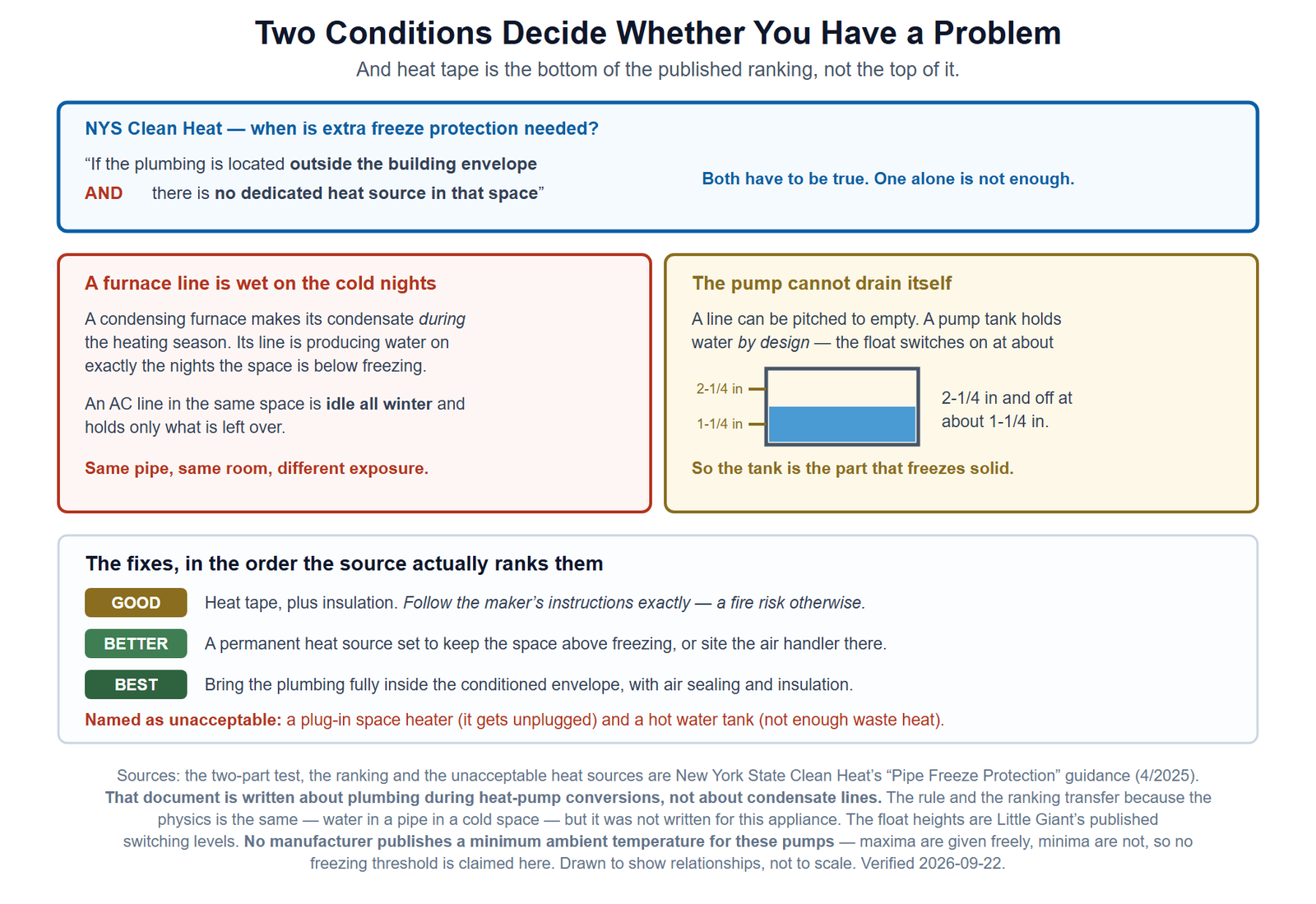
Two conditions have to be true together. New York State’s Clean Heat guidance puts it as a single test: protection is needed where the plumbing is “outside the building envelope” and “there is no dedicated heat source in that space.” One without the other is usually fine.
If both are true, the thing most at risk is not the line. It is the pump, because a pump holds water by design and cannot be pitched to drain itself.
Which appliance is feeding it changes everything
This is the part that decides how urgent your situation is, and almost nobody separates the two cases.
A condensing furnace makes its condensate during the heating season. That is what it is for — flue gases cool below their dew point and the water runs out. So a furnace condensate line passing through an unheated garage or crawl space is actively producing water on exactly the nights that space drops below freezing.
An air conditioning line in the same space is idle all winter. It made its condensate in July. In January it holds whatever residue is left and nothing is adding to it.
Same pipe, same room, completely different exposure. If your pump is serving a 90%-plus furnace in an unheated space, treat this as a live problem. If it is serving a cooling coil only, the risk is real but far smaller.
Why the pump is more exposed than the pipe
A drain line can be pitched so that it empties itself between cycles. That is the whole point of getting the fall right on a gravity line.
A condensate pump cannot do that. It works by holding water: the float switches the motor on at around 2-1/4 inches in the tank and off again at around 1-1/4. There is always water in there — that is not a fault, it is how the switch knows what to do.
So in a space that goes below freezing, the tank is the part that freezes solid. And a tank that freezes is a tank that can split, which is the cracked-housing failure that leaves water on the floor with the level sitting normally.
One-minute test: on a cold morning, tip the pump gently. If the water inside does not move, it is frozen — do not switch it on to find out. A motor driving an impeller locked in ice is a motor about to fail.
The trap that catches people mid-project
Here is the finding worth the whole article if you are changing anything about your heating:
“Waste heat from a furnace or boiler can keep basement pipes from freezing. Remove that heat source, and it could expose a home to high risk of pipe burst!”
The appliance you are worried about may be the only reason that space has stayed above freezing for twenty years. Replace an old boiler with something efficient, move the furnace, or switch to a heat pump, and the room gets colder — and everything else in it, including the condensate pump, is suddenly in a situation it has never been in.
That is a risk created by an upgrade, not by neglect, and it is the reason a pump that never froze once can freeze the winter after a new system goes in.
The fixes, in the order the source ranks them
Most articles offer heat tape as the answer. In the published hierarchy it is the bottom tier.
| Tier | Measure |
|---|---|
| Good | “Add heat tape (and insulation if applicable) to the plumbing in the unconditioned space.” |
| Better | “Add a permanent heat source that can be set to keep the space from freezing” — or put the air handler in that space and use its waste heat |
| Best | “Bring plumbing fully inside the conditioned space with air sealing and insulation” — and/or add heat pump distribution to the room |
Two things are named as not acceptable, and both are what people actually reach for:
- A plug-in space heater. “Space heaters can be accidentally unplugged or shut off by the occupants. They should not be left running unattended.”
- A hot water tank. “A domestic water heater will not produce enough waste heat to reliably keep an unconditioned space above freezing.”
And on heat tape, the caution is worth repeating exactly: “Be sure to follow the manufacturers installation instructions exactly to avoid creating a fire hazard.” Constant-wattage tape misapplied is a genuine fire risk, not a warranty formality.
One-minute test: stand in the space on a cold day and ask what is heating it. If the answer is “the furnace being in here” or “the water heater”, you do not have a dedicated heat source — you have a by-product, and the guidance above says neither counts.
Where this sits relative to the rest of the install: freezing is a reason to bring the line inside, not a reason to terminate it somewhere convenient. Where a discharge is allowed to end does not relax because it is cold.
What a freeze actually does to you
The failure chain is worth knowing because the first symptom is rarely “ice”.
The line or the tank freezes. Water stops leaving. The tank fills. If the safety switch is wired, it shuts the equipment down — which in a furnace, in winter, means no heat on the coldest night of the year, and no fault code to explain it. That sequence is covered in what happens when the switch stops the system.
If the switch is not wired, the furnace keeps making condensate into a system that cannot move it, and the water goes somewhere else.
When this needs a pro
If the pump is frozen, do not run it. Let it thaw, then look for a split before you trust it. Ice expands, and the tank is thin plastic.
If the space needs a heat source, that is an electrician or an HVAC contractor, and the guidance above is explicit that the answer is a permanent one rather than something on a plug.
If you are replacing or relocating heating equipment, raise the freezing question before the work rather than after. The waste-heat point above is the single most preventable version of this problem.
And if the tank has already cracked, that is a replacement — the buying guide covers what to look for. For how the whole arrangement is meant to fit together, the condensate pumps guide is the place to start.
One honest note on sourcing: the test, the ranking and the unacceptable heat sources come from a state programme document written about plumbing during heat-pump conversions, not about condensate lines. The physics is identical — water in a pipe in a cold room — but it was not written for this appliance, and you should read it as a strong principle rather than as a condensate pump specification. No manufacturer publishes a minimum ambient temperature for these pumps, which is why no freezing threshold is quoted anywhere on this page.
FAQ
Will a condensate pump freeze in an unheated garage?
It can, and it is more exposed than the pipe it feeds. The pump holds water permanently — the float cycles between roughly 1-1/4 and 2-1/4 inches — so unlike a sloped drain line it cannot empty itself between cycles. Whether it actually freezes depends on two things: whether the space is outside the building envelope, and whether anything heats it.
Is a furnace condensate line more at risk than an AC one?
Considerably. A condensing furnace produces condensate during the heating season, so its line is wet on the nights the space is coldest. An AC line in the same space is idle all winter and holds only residue.
Is heat tape enough to stop a condensate line freezing?
It is the lowest tier of the published ranking, not the top. Better is a permanent heat source for the space; best is bringing the plumbing inside the conditioned envelope. If you do use heat tape, follow the manufacturer’s instructions exactly — misapplied tape is a fire risk.
Can I put a space heater in the room to stop it freezing?
That is specifically named as unacceptable, because a plug-in heater can be unplugged or switched off without anyone noticing. A hot water tank is also ruled out — it does not give off enough waste heat to keep a space reliably above freezing.
My pump never froze before and now it does. What changed?
Often the heating system. Waste heat from an old furnace or boiler is frequently the only thing keeping an unconditioned space above freezing, so replacing, relocating or downgrading that appliance can expose everything else in the room. It is a risk created by the upgrade rather than by anything failing.


