On this page
Last Updated on September 21, 2026 by Muhammad Toqeer
Take it seriously. A GFCI does not trip on a hunch — it trips because it measured between 4 and 6 milliamps of current leaving the circuit somewhere other than the neutral. On a pump that sits in water for a living, that is the device doing precisely the job it was installed for.
And before you go looking: the fix you will find recommended — move the pump to a dedicated non-GFCI outlet — was deleted from the National Electrical Code in 2008.
What the device is actually measuring
A Class A GFCI, the type used in homes, is built to UL 943. Three numbers define it:
- It must trip at 6 mA of ground-fault current.
- It must not trip below 4 mA.
- It must interrupt the circuit within 25 milliseconds.
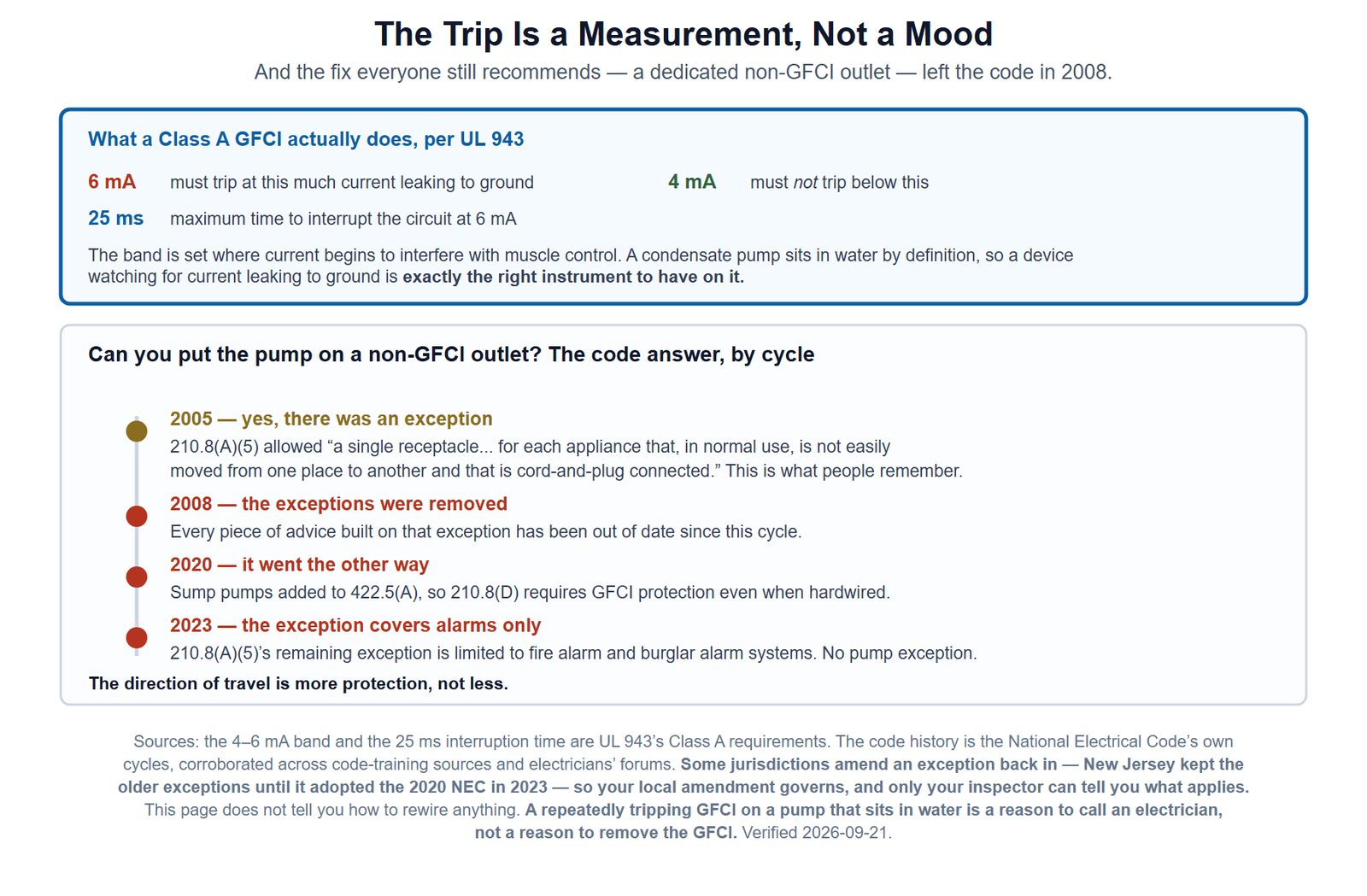
That band is not arbitrary. It sits where current begins to interfere with muscle control — the level at which a person holding something live may not be able to let go. The device is a personnel protector first and a fault detector second.
Which is why the word “nuisance trip” deserves suspicion. Sometimes the device really is failing. Far more often it is measuring something real, and the fault is small enough that nothing else in the house has noticed yet.
When it trips tells you what it is
The timing is the most useful diagnostic you have, and it costs nothing to observe.
It trips on the first start after a long idle spell, then behaves all day. This is the classic signature of condensation inside a motor that cooled down while it was off. On start-up, the damp lets current track to ground for a moment; once the motor warms, the moisture evaporates and the leakage goes with it. Seasonal equipment does this reliably at changeover, for the same reason a condensate line’s trap dries out between seasons.
It has started tripping after years of working fine. Insulation ages. Winding and wire insulation degrade slowly, leakage creeps upward, and eventually it crosses 4 to 6 mA. Nothing dramatic happened; the pump simply arrived at the threshold. This one usually ends in a replacement, and it is the pump telling you so before it fails outright.
It trips whenever the basement is very damp, regardless of the pump. Above roughly 75% relative humidity, moisture in the receptacle and the surrounding air can be enough on its own.
It trips with the pump unplugged. Then it is not the pump at all — it is the device, the wiring, or something else on the same circuit. Leakage from several loads adds up against the same few milliamps.
One-minute test: unplug the pump, reset the GFCI, and leave it. If it holds for a day, the pump is the source. If it trips again with nothing plugged in, stop looking at the pump.
The code answer, because it changed and most pages did not
Search this problem and you will be told you can put the pump on a dedicated single receptacle and skip the GFCI. That advice was correct once. Here is what actually happened:
2005 — an exception existed at 210.8(A)(5) for “a single receptacle or a duplex receptacle for two appliances located within dedicated space for each appliance that, in normal use, is not easily moved from one place to another and that is cord-and-plug connected.” A condensate pump fits that description neatly, which is why the advice spread.
2008 — the exceptions were removed.
2020 — the code moved further in the opposite direction, adding sump pumps to 422.5(A) so that 210.8(D) requires GFCI protection even where the pump is hardwired rather than plugged in.
2023 — what remains of the 210.8(A)(5) exception applies to fire alarm and burglar alarm systems. There is no pump exception.
So the trend is unambiguous, and it is worth stating plainly: every cycle since 2005 has extended protection rather than relaxed it. Anyone telling you the code lets you off is quoting an answer that is roughly twenty years old.
The one honest qualifier is local. Jurisdictions amend, and some kept the older exceptions for years — New Jersey held on to them until it adopted the 2020 NEC in 2023. Your local amendment governs, and only your inspector can tell you what applies to your house.
What not to do
Do not move the pump to a non-GFCI outlet. Beyond the code position above, it removes the only thing currently telling you that current is going somewhere it should not. The pump is in water. That is the circumstance the device exists for.
Do not run it on an extension lead to reach a different receptacle. The manual is specific that the cord “must be connected to a constant source of power (not a fan or other device that runs intermittently)” — and a pump on a trailing lead is a pump that gets unplugged. Where that leads is covered in the pump that does nothing at all.
Do not confuse this with the safety switch circuit. They are two different circuits on the same appliance: the GFCI is on 120 V line power, while the overflow switch runs on a class II low-voltage control circuit. If your furnace is the thing that will not start, that is the other circuit and a different fault entirely.
One-minute test: look at what else shares the outlet. A GFCI protects everything downstream of it, so a humidifier, a dehumidifier or a second pump on the same protected run all contribute leakage to the same budget.
When this needs a pro
This one leans further toward “call someone” than most pages on this site, and deliberately.
A repeatedly tripping GFCI on a pump that sits in water is an electrician’s call. Not because resetting it is dangerous, but because the useful next step — finding where a few milliamps are escaping — needs an insulation tester and someone who knows what the reading means. That is not a screwdriver job.
If the pump is wet on the outside, or the receptacle is, stop and get someone in.
If it trips, resets, and trips again immediately, leave it off. A device that will not hold is reporting a fault large enough to find quickly.
And if the answer turns out to be an ageing pump, replacing it is the fix rather than a workaround — the buying guide covers what to look for, and the condensate pumps guide sets out how the whole arrangement is meant to work.
FAQ
Why does my condensate pump keep tripping the GFCI?
Because the device is measuring 4 to 6 milliamps of current leaking to ground. On a condensate pump the usual sources are moisture inside a motor that cooled while off, ageing winding insulation on an older pump, or a very damp basement. A GFCI is built to UL 943 and trips against a measured threshold, so it is rarely tripping for no reason.
Can I plug a condensate pump into a non-GFCI outlet instead?
The exception that allowed a dedicated single receptacle to skip GFCI protection was removed from the NEC in 2008, and the 2023 code limits the remaining 210.8(A)(5) exception to fire and burglar alarm systems. Local amendments vary, so ask your inspector — but the trend has been toward more protection, not less, and the trip is reporting a real fault either way.
Why does it only trip first thing in the morning?
That pattern points at condensation inside a motor that cooled down overnight. On start-up the moisture lets current track to ground briefly; once the motor warms it dries out and the leakage stops. It is a signature, not a coincidence.
My pump worked for ten years and now trips. What changed?
Most likely the insulation on the motor windings, which degrades slowly. Leakage rises over years until it crosses the trip threshold. Nothing sudden happened — the pump has reached the limit, and this usually ends in replacement.
Is a tripping GFCI dangerous?
The tripping itself is the device protecting you. What is worth taking seriously is the consequence: while it is tripped, the pump is not running, and condensate is collecting with nothing moving it. Deal with the electrical fault rather than leaving the pump off for days.


