On this page
Last Updated on September 25, 2026 by Muhammad Toqeer
Once a year, or twice if it builds slime — that is Little Giant’s own answer, and it is the only fixed interval any manufacturer publishes. Clean it with a 50/50 water and vinegar mixture or with warm water and mild soap. Never with bleach: “Chlorine will damage the pump.”
That last line is Little Giant’s wording, not advice. Everything else below follows from it.
What you need
Nothing you have to buy.
- A bucket, and old towels
- A flathead screwdriver, for the cover clips
- A bottle brush or an old toothbrush — something with bristles that reaches a corner
- White vinegar, or mild washing-up soap
- Fresh water for the rinse
No bleach. No drain cleaner. No solvent.
Kill the power — and know what you are actually killing
Unplugging the pump is not always enough, and this is the step people get wrong.
Plenty of condensate pumps are not on their own outlet at all — they are powered from the air handler, and they sit in a safety-switch circuit that shuts the equipment down when the tank fills. Sauermann’s manual puts the requirement broadly for exactly that reason:
“Risk of electric shock. Make certain that the entire power supply to the unit/system is disconnected before attempting to install, service or remove any component.”
The entire power supply to the system, not the cord you can see. Switch the furnace or air handler off at its service switch as well as unplugging the pump.
Three parts, not one
Here is the part every guide gets wrong. The tank is the piece with a lid, so the tank is the piece people clean — and then the smell or the overflow comes back in a fortnight, because the film that caused it is still upstream and downstream.
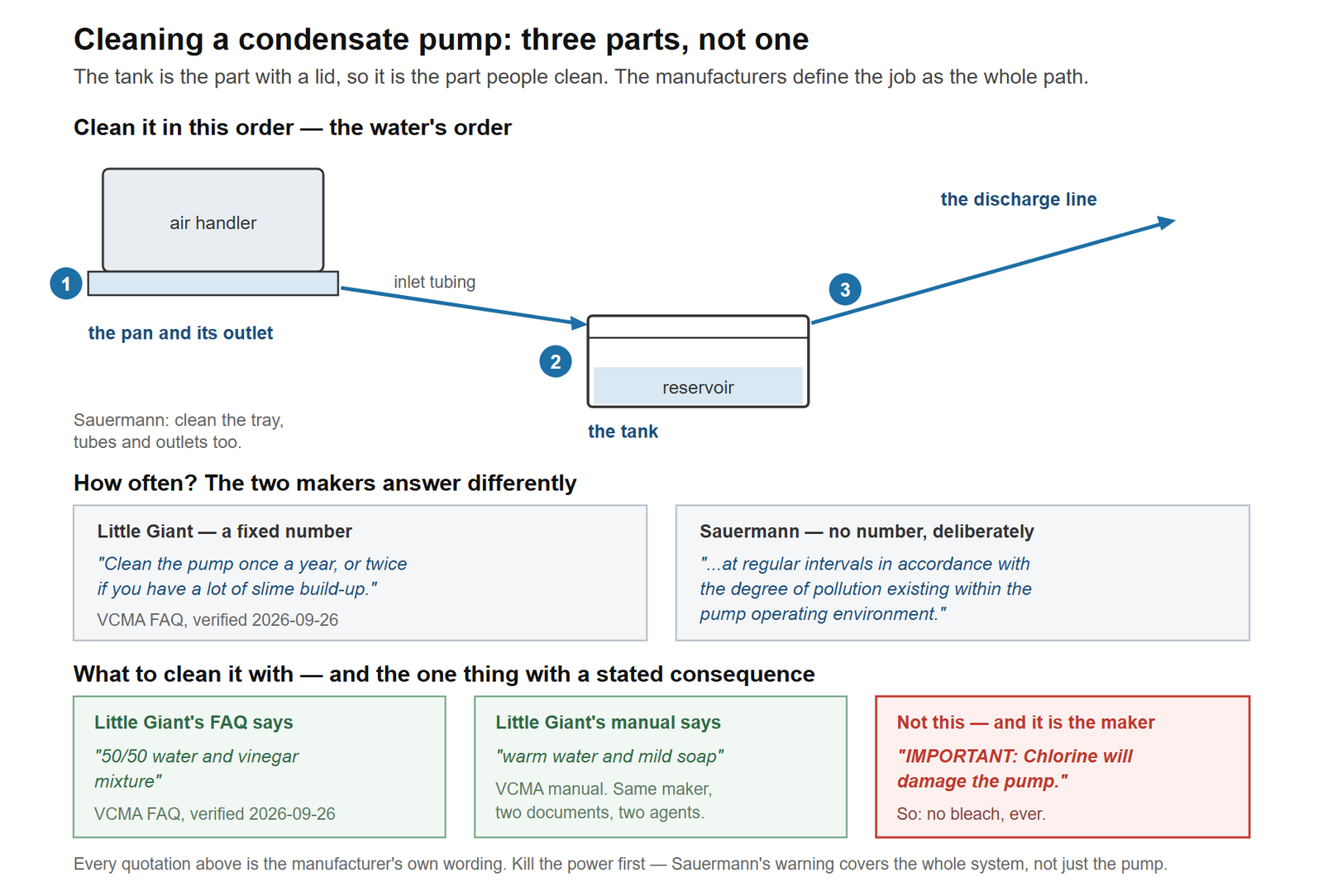
Sauermann makes the same point from the other direction, in its installation instructions — before the pump is even fitted:
“All condensate collection elements (collection tray, connecting tubes, outlets etc…) must be cleaned thoroughly prior to installing the pump.”
Tray, tubes, outlets. The manufacturer defines the job as the whole path, and it is the same path whether the pump is new or four years old.
The steps
- Cut the power — pump and air handler, per the warning above.
- Put the bucket under the pump before you disconnect anything. The tank is full and the inlet tubing still has water sitting in it.
- Pull the inlet tubing off the lid. It is usually a push-fit. Note which port it came from if there are two.
- Disconnect the discharge tubing at the pump outlet.
- Lift the pump out and take it to a sink. It is easier than working on your knees, and you will do a better job.
- Open the cover. On most units the lid unclips with a flathead — the motor and float assembly lift out with it. Support that assembly; do not let it hang on its wiring.
- Tip the standing water into the bucket.
- Scrub the tank. Bristles, not a rinse — the film that causes the trouble is biofilm, and it survives water. Get the corners and the intake screen.
- Do the float and its arm while the assembly is out, gently. This is where most damage gets done, so read which float you are holding first — most of these pumps have two, and they do different jobs.
- Flush the tank with fresh water and tip it out.
- Clean the pan and its outlet upstream, and flush the discharge line. A line that is already clogged is its own job and will not clear with a rinse.
- Reassemble, reconnect both tubes to the ports they came off, and restore power.
Step 11 is the one that gets skipped, and it is the one that decides whether you are doing this again next month.
What to clean it with — and the one thing that will damage it
Every article on this subject recommends vinegar. None of them says who told them.
Little Giant does, on its own VCMA FAQ: a 50/50 water and vinegar mixture. So the common advice turns out to be right, and now it has a source.
But there is a wrinkle worth knowing, because it is the manufacturer disagreeing with itself. Little Giant’s own manual calls for warm water and mild soap — not vinegar. Two documents, one maker, two different agents. Neither will hurt the pump, so use whichever you have; the point is that nobody publishing “use vinegar” has noticed that the maker’s manual says something else.
What is not a matter of preference:
“IMPORTANT: Chlorine will damage the pump.”
That is Little Giant’s wording. Not discouraged, not “avoid harsh chemicals” — a stated consequence. Bleach is the single most common suggestion on forums for a smelly condensate pump, and the manufacturer of the most common pump in American basements says it damages the thing. Sauermann is consistent with that, warning separately against solvents on parts that need to stay flexible.
If the smell is what brought you here, work out which smell it is first — musty is biofilm and this job fixes it, sulfur is not coming from the pump at all and cleaning will not touch it.
How often — and the two makers do not agree
This is the question every guide skips, and there is no single answer because the manufacturers answer it in two different shapes.
Little Giant gives a number:
“Clean the pump once a year, or twice if you have a lot of slime build-up.”
Sauermann deliberately does not:
“The sump/detection unit must be cleaned and serviced at regular intervals in accordance with the degree of pollution existing within the pump operating environment.”
One is a schedule; the other is a condition. Both are defensible, and together they are the honest answer: book it annually, and let what you find set the real interval. A pump in a dusty basement under a hard-working air handler will tell you it wants twice a year by how it looks when you open it. One in a clean utility room may not.
Sauermann adds a detail worth keeping: clean at the start of the season, and keep at it if the system runs all year.
Before you walk away
Nobody writes this step, and it is the one that catches a mistake while you can still fix it.
Pour a jug of water slowly into the tank until the pump kicks in. Watch three things:
- It starts, and starts before the water reaches the lid
- Water actually leaves by the discharge line
- Nothing drips at either tubing connection
If it runs but nothing moves, you have either left the discharge blocked or disturbed the check valve on reassembly. If it does not start at all, the float assembly is probably not seated back in its guides.
A tank that is cracked, or stained so deeply it will not come clean, is a different conversation — that is when the pump is genuinely finished rather than dirty.
When this needs a pro
If the pump is wired into the equipment rather than plugged in, the safety-switch circuit is live work and it is inspected work in many jurisdictions. Disconnecting and reconnecting that is not a screwdriver job.
If you cannot find a way to isolate the air handler, stop. Sauermann’s warning is about the whole system for a reason, and a condensate pump that restarts while your hand is in it is a genuine hazard.
If the pan above is rusted or the line is packed solid, you are past cleaning and into repair.
And if the water in the tank is not water — oily, rust-coloured, or smelling of sewer gas — the cleaning is not the problem to solve. The pillar guide covers what the whole arrangement is supposed to look like.
FAQ
How often should I clean my condensate pump?
Little Giant says once a year, or twice if it builds slime. Sauermann gives no fixed number and instead ties it to how dirty the pump’s environment is. Annually is the sensible default, adjusted by what you find when you open it.
Can I use bleach to clean a condensate pump?
No. Little Giant’s own FAQ says “Chlorine will damage the pump.” That is a stated consequence from the manufacturer, not general caution. Use a 50/50 water and vinegar mix, or warm water and mild soap.
Is vinegar safe for a condensate pump?
Yes — Little Giant’s VCMA FAQ specifies a 50/50 water and vinegar mixture. Worth knowing that Little Giant’s manual instead calls for warm water and mild soap; either is fine, and the makers’ two documents simply differ.
Do I need to clean the drain line too, or just the tank?
The whole path. Sauermann requires the collection tray, connecting tubes and outlets to be cleaned, and cleaning only the tank is why the problem usually comes back. The pan above and the discharge line below are part of the job.
How do I know the pump is working after I clean it?
Pour water slowly into the tank until it starts. It should cut in before the water reaches the lid, push water out of the discharge line, and drip at neither connection. If it hums without moving water, check the discharge and the check valve you disturbed on reassembly.


