On this page
Last Updated on September 26, 2026 by Muhammad Toqeer
Somewhere between three and twenty-five years, and the gap is not about brand. No manufacturer publishes a service life for these pumps. What they publish is a warranty — one to three years across the whole category — and that is a guarantee against defects, not an estimate of how long the thing will work.
The number that actually decides it is not years at all. It is cycles.
What the makers actually publish
Every figure you will find quoted online — three to seven years, five to ten, a year or twenty — is somebody’s recollection. Here is what the manufacturers put in writing:
| Maker | Published term |
|---|---|
| Little Giant VCMA (standard) | 12 months from original purchase |
| Little Giant VCMA-20-PRO | 3 years from original purchase |
| Hartell (standard) | 1 year |
| Hartell KT3 and PAB3 | 3 years from installation |
| DiversiTech / Asurity | 36 months |
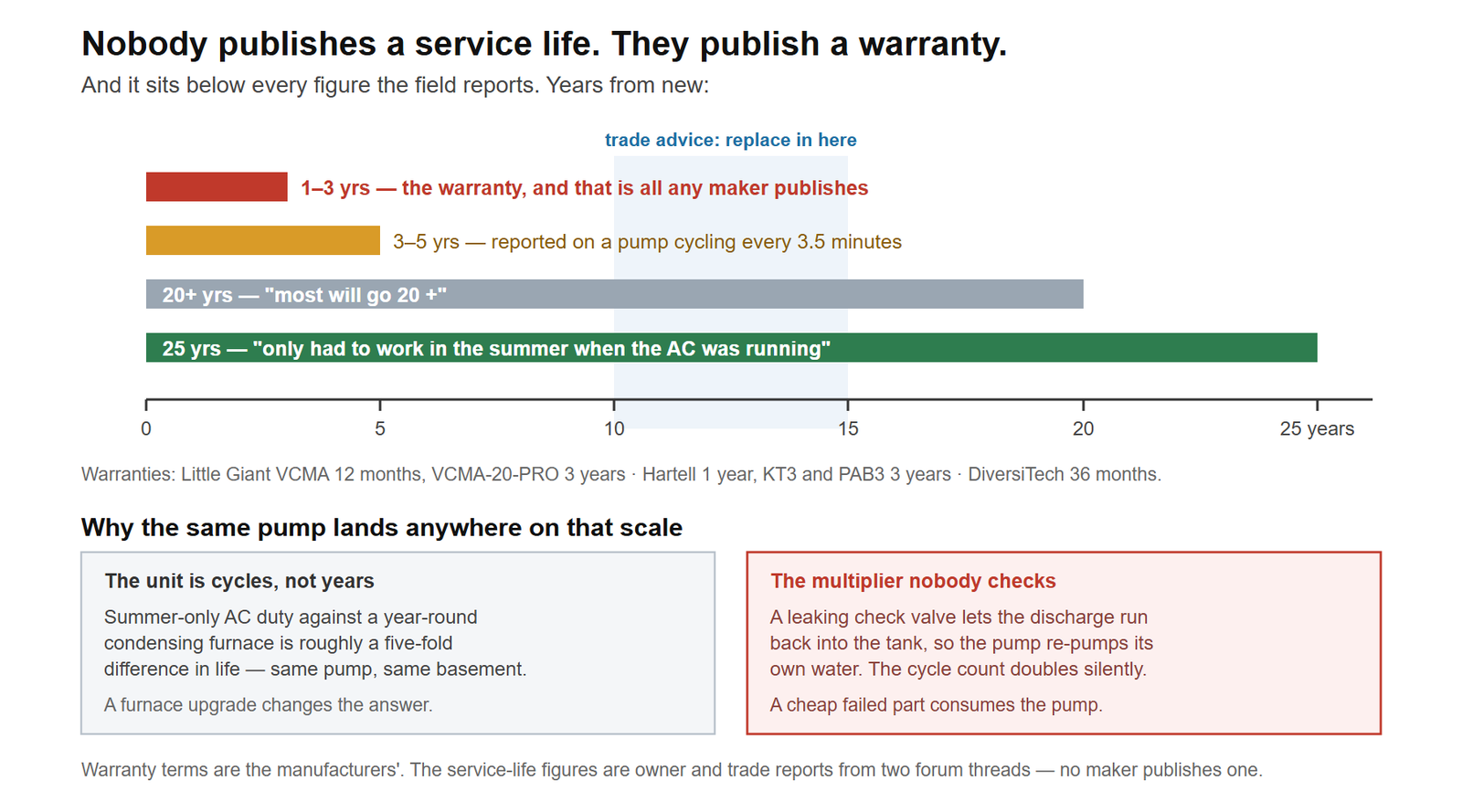
Look at where that band sits. One to three years is below even the most pessimistic thing anyone in the field says. That is not manufacturers being cynical — it is what a warranty is for. Nobody warrants a wear item for its whole expected life.
Which means the useful answer has to come from somewhere else.
The spread is duty, not quality
One thread on Fine Homebuilding happens to contain both ends of the range, which makes the point better than any average could.
One owner, eleven years in and on their third pump:
“3-5 years. I’m on my third such pump in an identical situation”
Their pump was cycling roughly every three and a half minutes.
Another owner in the same thread had the original pump still working when the furnace was finally replaced after twenty-five years — and explained why it had lasted, almost in passing: it “only had to work in the summer when the AC was running.”
Same class of pump. Roughly a five-fold difference in life, and the only variable that changed was how often it ran.
The consequence most people miss: a high-efficiency condensing furnace produces condensate in winter. Replacing an older furnace with a condensing one converts the pump from a summer appliance into a year-round one, and quietly changes its life expectancy — in the same basement, with the same pump. The second owner’s thread documents exactly that transition.
If yours seems to be running far more often than it should, that is its own question, and the duty-cycle article covers what these pumps are actually rated for.
The multiplier nobody checks
There is a cheap part that silently doubles the cycle count.
If the check valve leaks, the water the pump just pushed up the line runs straight back into the tank. The float rises again. The pump runs again. It is re-pumping its own discharge, and it will do that for years without anyone noticing, because from across the basement it looks like a pump that is simply busy.
The same Fine Homebuilding thread names it: watch the ball check valve, because excessive cycling suggests it is leaking.
That is the lifespan version of a symptom this site covers in detail — a pump that pushes water up and gets it back again. Read as a fault it is annoying. Read as a cycle counter it is expensive: a part worth very little is consuming the pump at twice the rate.
Worth checking precisely because it is invisible. Nothing leaks onto the floor, nothing smells, nothing trips.
When it goes, it goes wet
The failure is not a gradual decline. From the same thread, describing the first of three pumps:
“the first one just quit and wet itself all over the basement floor”
That is the normal way these end. There is rarely a warning period, which is why two things matter more than any lifespan number:
- The safety interlock. A pump that fails with a working switch shuts the equipment down and gives you a dry floor and a fault. A pump that fails without one gives you what happens when a condensate pump fails.
- Where it sits. A pump above a finished ceiling has a different consequence from the same pump in an unfinished basement.
So when should you replace it?
The trade’s answer is preventive rather than diagnostic. From a long-running thread on HomeOwnersHub:
“It is never too soon after about 10 or 15 years to replace them but most will go 20 +.”
Read that carefully, because it is not a contradiction. Most pumps outlive fifteen years. The advice is still to replace at ten to fifteen — because the cost of being wrong is water, and the pump is the cheapest component in the arrangement it protects.
A practical way to place your own pump on that scale:
- Summer-only AC duty, cycling a few times an hour in July and not at all in January — expect the long end.
- Year-round condensing furnace duty, cycling every few minutes — expect the short end, and plan on it.
- Cycling far more than the condensate load explains — check the check valve before you accept the number.
- Never cleaned — the interval is a lifespan input, not housekeeping. Little Giant’s own figure is once a year, twice if it builds slime.
And if yours is at the point where the tank is stained through or it has already failed once, the buying guide covers what replaces it.
When this needs a pro
If the pump is wired into a safety interlock, swapping it is control wiring as well as plumbing, and getting that circuit wrong removes the protection that makes the eventual failure survivable.
If it has failed and water has reached anything structural or electrical, the pump is the small problem.
If it is cycling constantly and the check valve is not the cause, something upstream is producing more condensate than it should — the condensate pumps guide sets out what the whole arrangement is meant to look like.
FAQ
How long should a condensate pump last?
Reported service lives run from about three years to twenty-five. Heavy year-round duty sits at the short end, summer-only air-conditioning duty at the long end. No manufacturer publishes a service life — the one to three years you will see quoted is the warranty term.
Is a condensate pump warranty the same as its life expectancy?
No, and the gap is large. Little Giant warrants the standard VCMA for 12 months and the PRO for 3 years, Hartell 1 year with the KT3 and PAB3 at 3, DiversiTech 36 months. Field reports routinely run five to twenty times longer.
Why did my condensate pump only last a few years?
Most often because of how often it runs. A pump cycling every few minutes year-round wears out far faster than one that only works in summer, and a leaking check valve can double the cycle count without any other symptom.
Should I replace a condensate pump before it fails?
The trade view is yes, at around ten to fifteen years, even though most go longer. These fail suddenly and wet rather than gradually, so the argument is about the consequence rather than the odds.
Does a high-efficiency furnace shorten the pump’s life?
Effectively, yes. A condensing furnace produces condensate in winter too, so the pump moves from seasonal to year-round duty. The same pump in the same house has a shorter expected life after that upgrade.


