On this page
Last Updated on September 3, 2026 by Muhammad Toqeer
Read the model number off the label before anything else. If it ends in ULS there is a safety switch inside that pump whose entire job was to shut your system down before the tank reached the floor — and it didn’t. If it ends in UL, there is no such switch and nothing was ever going to stop this. Those are different problems.
Everyone writing about this explains what filled the tank. Almost nobody asks why the thing that should have caught it didn’t.
Stop the water first
Short version, and none of it is controversial: turn the heating or cooling off at the thermostat so the equipment stops making condensate, unplug the pump, and get the standing water up. Photograph anything that’s been soaked before you dry it, because that’s the bit you can’t recreate later for an insurer.
Then read on, because the tank will fill again the moment the system runs.
Why nothing shut the system down
Three possibilities, and the label sorts them in seconds.
Your pump doesn’t have a safety switch. Little Giant’s own listing is blunt about what the suffix means — “UL: Underwriters Laboratories listed” and “ULS: UL listed with high water level safety switch”. Every other spec on those two models is identical. On a plain UL there is no high-water switch, so there was never anything to trip.
It has one and nobody connected it. This is the common one, and the manufacturer explains why in a single sentence: “The safety switch is optional and does not need to be hooked up for the pump to operate correctly.” The two leads that carry it — Little Giant calls them “the 2 black wires” — get tucked behind the pump at install and the pump runs perfectly for years. Nothing ever reveals the omission, right up until the tank fills.
It’s connected, and the switch or its float failed. Least common of the three, and the easiest to confirm with the test below. If the safety float is gummed up rather than broken, that’s the same job as freeing the motor float — the two sit on the same cover assembly.
One-minute test: look at the pump and find the two black leads. Are they joined to anything — a pair of wires disappearing toward the furnace or air handler — or are they capped, taped, or hanging loose? Loose leads answer the question on the spot.
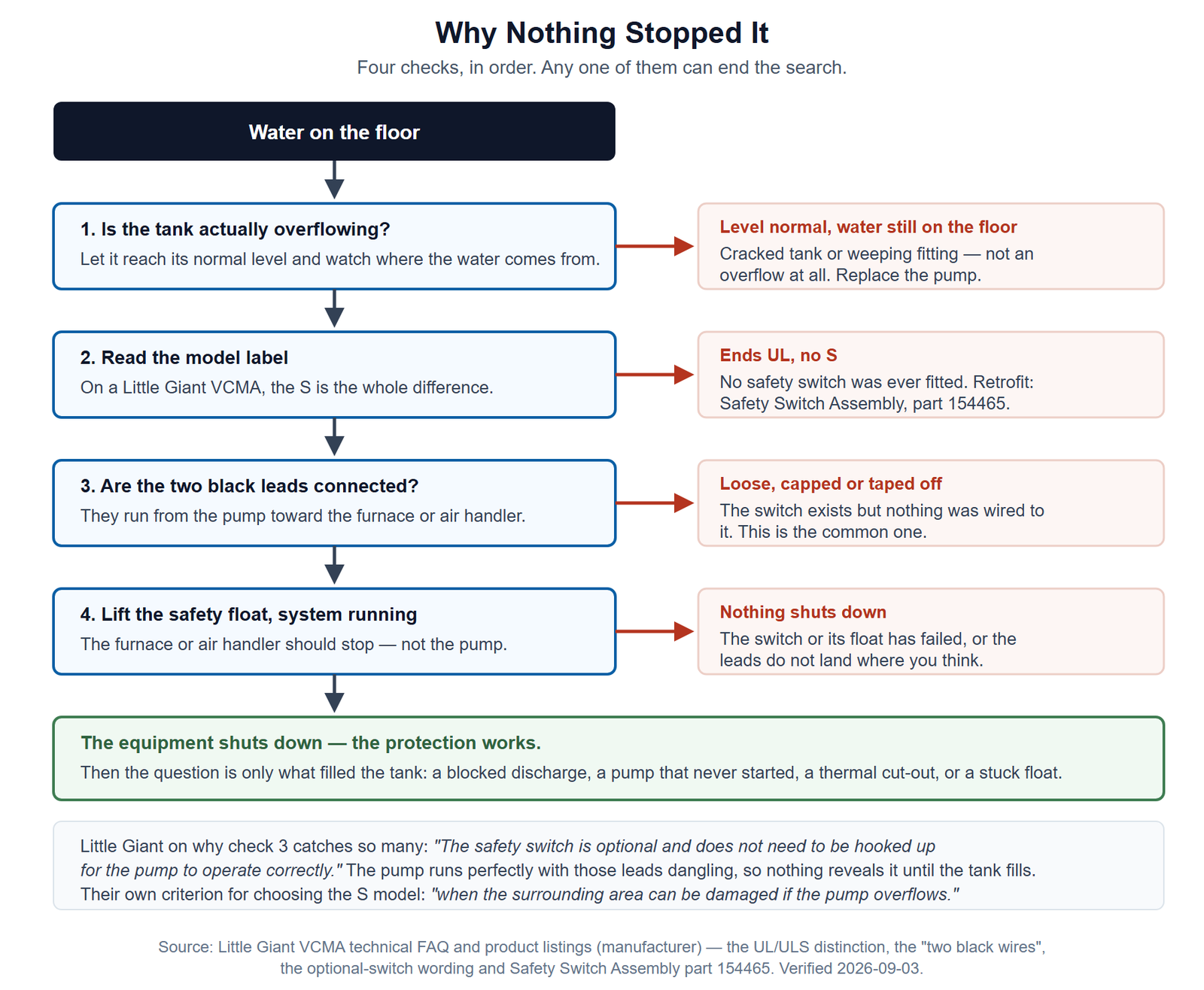
The flow below runs the same four checks in order, with what each answer means.
The test that settles it
If the leads do go somewhere, prove they work rather than assuming.
One-minute test: with the heating or cooling running, lift the safety float — the higher of the two floats on the cover assembly — all the way up with a finger. The equipment should shut down. Not the pump: the furnace or the air handler. If it keeps running, the switch is either not landing where someone thought it was, or it has failed, and you have found your answer.
That is the whole of the protection, and it takes a minute to confirm. It is also the test to run on any pump that has never flooded, because a switch that isn’t wired looks exactly like one that is.
Before you go further: is it actually overflowing?
Worth thirty seconds, because the fix is completely different and nobody separates these.
Let the tank fill to its normal working level — the pump switches on at around 2-1/4 inches of water and off at around 1-1/4 — and watch where the water is coming from.
- Water over the rim of the tank. That’s an overflow. Something stopped the pump emptying it.
- Water on the floor with the level sitting normally. That’s a leak, and the tank is cracked or a fitting is weeping. A hairline crack can sit dormant for years and only start weeping when the working level shifts — one documented case ran from installation until a float adjustment changed where the water sat. Nothing about the pump’s operation is wrong; the tank has failed and needs replacing.
Dry the outside of the tank completely, run one cycle, and look again. A crack shows itself as a wet line that reappears in the same place.
What filled the tank is a separate question
Once you know why the flood wasn’t caught, you still need to know why the pump stopped keeping up. That’s covered properly elsewhere rather than half-covered here:
- The pump runs but moves no water — a blocked line, a check valve, or water falling back down the discharge.
- The pump never starts at all — most often an outlet that isn’t live all the time.
- The pump starts and cuts out partway through — its thermal protector, tripping because something is making it work too hard.
Work through whichever matches what you saw before the water appeared.
Putting the protection in
If the answer was “there is no switch”, this is a part, not a new pump. Little Giant lists a Safety Switch Assembly, part 154465, which fits the VCMA-15UL, VCMA-20UL, VCMA-20ULS, VCMA-20ULT, VCMA-20S and VCMA-20ST. A plain UL pump can be brought up to the same protection as the S model.
Where a switch in the equipment’s drain pan makes more sense than one in the pump, Little Giant’s standalone overflow switches carry published ratings: the ACS-4 and ACS-5 are rated 24 VAC input at 5 amps FLA maximum, the ACS-2 at 48 V AC/DC and 5 amps, and the ACS-3 at 125–250 V AC/DC and 11 amps. Match the rating to the circuit it’s going into.
There’s also a line in Little Giant’s guidance that reads differently once you’ve mopped a floor. Use the S model, they say, “when the surrounding area can be damaged if the pump overflows.” If you’re reading this, that condition was already met before the pump was chosen.
And it may not have been optional in the first place. Under the residential code provision covering condensate disposal, equipment installed where a clogged drain could damage the structure needs one of three things: a secondary drain pan with its own drain, a secondary drain line run to a conspicuous place, or a float switch that shuts the whole system down. An attic, a closet, or anywhere above a finished ceiling puts you in that category — and if none of the three is present, the install was short of what the code asks for.
When this needs a pro
Connecting those two leads is low-voltage control work inside your furnace or air handler. It is not a big job for a tech, and it is not a job to improvise: the leads land in the same 24-volt circuit as the thermostat, and getting it wrong can leave the equipment unable to start or, worse, leave you with a switch that looks connected and does nothing.
Call sooner if water has reached a ceiling, insulation, or anything electrical. And if the overflow happened in an attic or above finished space, ask the tech to look at whether the install actually meets the secondary-drain requirement, rather than only replacing the pump. A new pump in the same unprotected install floods the same ceiling next year.
Never tape the safety float down or bypass the switch to get the heat back on. That switch is the only thing standing between the next blockage and the same repair bill.
FAQ
How do I know if my condensate pump has a safety switch?
Read the model number. On Little Giant’s VCMA range the S at the end — as in VCMA-20ULS — means a high-water safety switch is fitted. Without the S there isn’t one. You can also look for two black leads coming off the pump; if they’re there, so is the switch.
My pump has the two black wires but they aren’t connected to anything. Is that normal?
It’s extremely common, because the pump works without them. The manufacturer describes the switch as optional and not required for the pump to operate. Common isn’t the same as right, though — unconnected leads mean nothing will shut your system down when the tank fills.
Can I add a safety switch to a pump that doesn’t have one?
Yes. Little Giant sells a safety switch assembly, part 154465, that fits the UL models as well as the ULS. Fitting it and wiring it into the control circuit is a job for an HVAC tech.
The tank isn’t overflowing but there’s still water on the floor. What is it?
Most likely a crack in the tank or a weeping fitting. Dry the outside of the tank, run one cycle, and look for a wet line that comes back in the same spot. A cracked tank means replacing the pump.
Will a bigger pump stop it overflowing?
Only if the pump was genuinely too small, which is rare in a house. An overflow almost always means the pump stopped moving water rather than that it couldn’t keep up, so a larger one usually just fails the same way.


