On this page
Last Updated on September 23, 2026 by Muhammad Toqeer
Pick the position before the product. RectorSeal says it plainly in its own data sheet: “This device will not detect clogs occurring upstream from the installation point.” A switch protects what is downstream of it and is blind to everything behind it, so where you put it decides what it can save.
Then check one number almost nobody publishes. These switches are not interchangeable electrically — their current ratings span nine times over, and only one in this group is rated for line voltage at all.
The three positions, and what each one can see
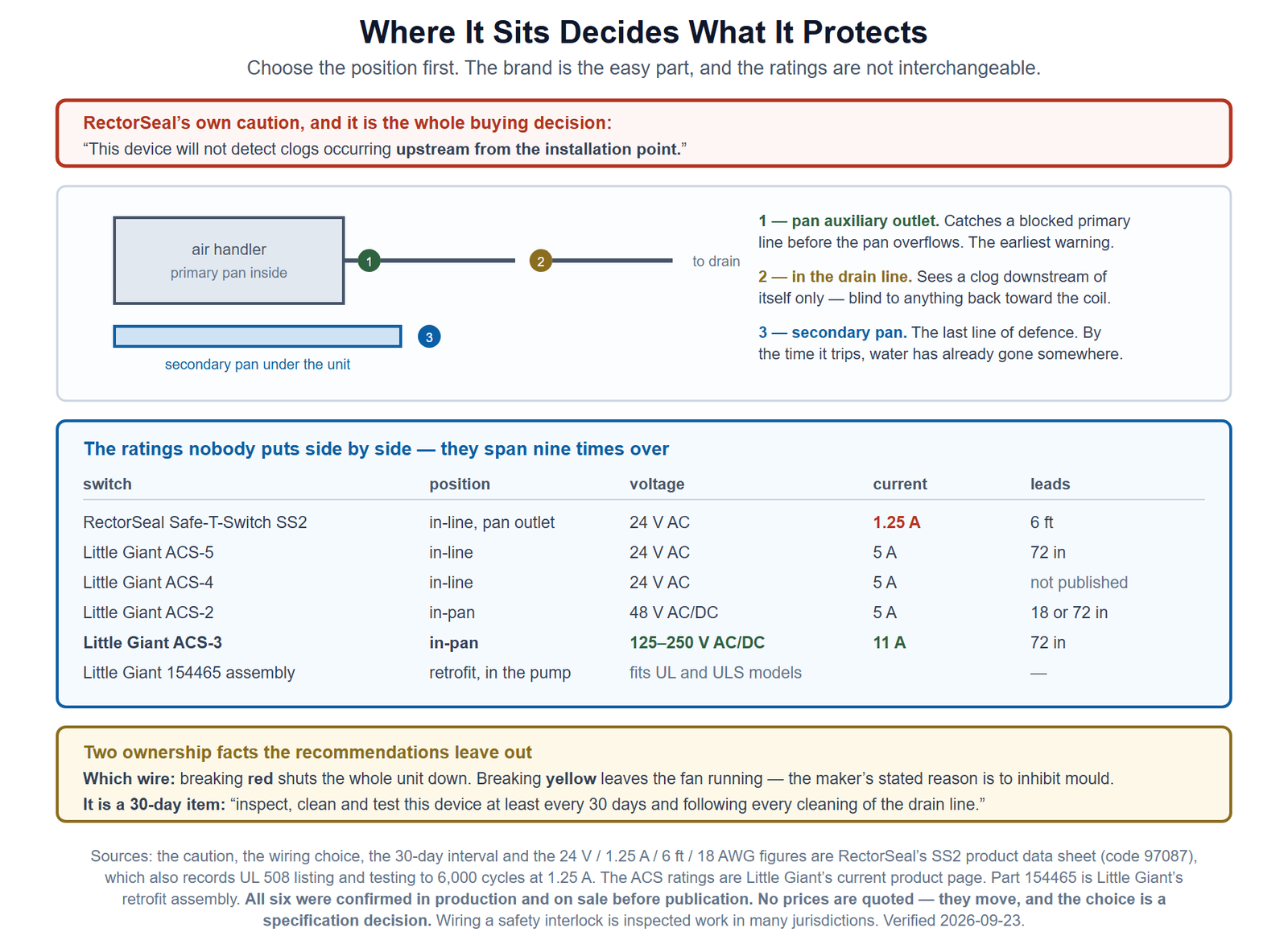
The primary pan’s auxiliary outlet. The earliest warning available. It catches a blocked primary line before the pan overflows, which is the failure you actually want to prevent.
In the drain line itself. Sees a clog downstream of where it sits and nothing behind it. Useful, but it will not notice a pan filling because the outlet above it has blocked.
The secondary pan. The last line of defence. By the time this trips, water has already left the primary pan and gone somewhere — which is better than a ceiling, but it is not early warning.
If you are fitting one switch, the auxiliary outlet of the primary pan is usually the position that buys the most.
RectorSeal Safe-T-Switch SS2
Who it is for: the single-switch install, on the auxiliary outlet of the primary drain pan.
Installs with an included 3/4 inch adaptor. The mechanism is a patented magnetic reed switch, and the manufacturer says it will work “on a slope of up to 45°” — a real advantage in the awkward geometry around an air handler. The cap comes off for cleaning, which matters more than it sounds given the maintenance interval below.
Electrically: 24 V AC, maximum 1.25 A carrying capacity, 6 ft of 18 AWG lead. UL 508 listed and tested to 6,000 cycles at that 1.25 A.
The honest drawback: that 1.25 A is the lowest rating in this group by some distance — a quarter of the Little Giant in-line switches. It is a control-circuit device and nothing more, which is fine for the job it is sold for but leaves no headroom if you were hoping to switch anything else with it.
Little Giant ACS-5
Who it is for: the same in-line job, with more electrical margin.
24 V AC, 5 A (FLA) max, 72 inch leads. Installs directly to the drain pan outlet using an included 3/4 inch PVC drain pan fitting, so it goes into the same position as the SS2. ABS housing and ABS float.
The honest drawback: still a low-voltage device despite the higher current rating, so it does not solve the line-voltage problem below. The longer leads are useful; they are also more wire to route tidily.
Little Giant ACS-4
Who it is for: an in-line switch where the ACS-5’s fitting is not what you need.
24 V AC, 5 A (FLA) max.
The honest drawback: Little Giant publishes less about it than the others — the lead length is not given on the product page, which is exactly the sort of detail that decides whether a part reaches your air handler. Check before buying rather than after.
Little Giant ACS-2
Who it is for: pan mounting, in the secondary pan or in a primary pan with room for a float.
48 V AC/DC, 5 A max, and it is the one that comes in two lead lengths — 18 inch or 72 inch. That choice is the point: 18 inches is tidy where the control board is close, 72 inches reaches when it is not.
The honest drawback: in-pan means it is the last line of defence rather than early warning. It tells you water has already overflowed the thing it sits in.
Little Giant ACS-3
Who it is for: the case none of the others cover — where the switch has to interrupt line voltage rather than a control circuit.
125–250 V AC/DC, 11 A max, 72 inch leads. That is the outlier in this group and the reason to know it exists. Every other switch here is a 24 or 48 volt device; this one is rated to break mains-level power.
The honest drawback: it is the wrong answer for most homes. If your equipment shuts down through its 24 V thermostat circuit — which most does — you do not need a line-voltage switch, and specifying one does not make the installation safer. Buy it when the job genuinely requires it, not as an upgrade.
Little Giant Safety Switch Assembly, part 154465
Who it is for: a condensate pump that shipped without a switch.
This is not a pan or line switch at all — it is the retrofit that adds overflow protection to the pump itself, and it fits UL models as well as ULS. If your pump has no suffix S, this is the part rather than a new pump.
The honest drawback: it protects the pump’s own tank and nothing else. A blocked primary drain upstream of the pump is invisible to it, which is precisely the caution this article opens with.
The comparison
| Switch | Position | Voltage | Current | Leads |
|---|---|---|---|---|
| RectorSeal Safe-T-Switch SS2 | in-line, pan outlet | 24 V AC | 1.25 A | 6 ft |
| Little Giant ACS-5 | in-line | 24 V AC | 5 A | 72 in |
| Little Giant ACS-4 | in-line | 24 V AC | 5 A | not published |
| Little Giant ACS-2 | in-pan | 48 V AC/DC | 5 A | 18 or 72 in |
| Little Giant ACS-3 | in-pan | 125–250 V AC/DC | 11 A | 72 in |
| Little Giant 154465 | retrofit, in the pump | fits UL and ULS | — | — |
Read the current column before the brand column. A 1.25 A switch and an 11 A switch are not competing products; they are different classes of device that happen to do the same job in different circuits.
Two things about owning one
Which wire you break changes the behaviour, and it is a choice. From the SS2 wiring instructions: “Incorporating switch in red circuit shuts down entire unit. If placed in the yellow circuit, fan continues to run (to inhibit mold growth during long absences.)”
That is a genuine design decision rather than a detail. Red is the safe default. Yellow is worth considering on a property that sits empty, where a dead fan and a damp coil is its own problem. Which wire the switch ends up in is also what makes a shutdown produce no fault code at all.
These are 30-day maintenance items. The manufacturer asks you to “open the Cap/Float Subassembly to inspect, clean and test this device at least every 30 days and following every cleaning of the drain line.”
Monthly. Nobody recommending these mentions it, and it is a real ownership cost — though the second half of that sentence is the more practical trigger: do it whenever you have cleared the drain line, because that is when debris has been disturbed.
Which one to buy
One switch, best coverage: the RectorSeal SS2 or the Little Giant ACS-5, both on the primary pan’s auxiliary outlet. The SS2 if the run is awkward and you need the 45° tolerance; the ACS-5 if you want the larger current rating and longer leads.
Your pump has no safety switch: part 154465, and read what a missing switch actually costs you first — it is the article that explains why this is a part rather than a new pump.
Equipment that switches on line voltage: the ACS-3, and only then.
Buying a new pump anyway: get the one with the S. Whether a switch is in the box is a suffix, not an option, and that is covered in the furnace pump buying guide.
When this needs a pro
Wiring a safety interlock is inspected work in many jurisdictions, and getting it wrong in the quiet direction — into a circuit that keeps the equipment running — leaves you with a device that looks fitted and protects nothing. The terminal-pair trap that causes exactly that is set out in why a furnace will not start after a pump swap.
If you are not sure which circuit your equipment shuts down on, that decides the voltage rating you need, and guessing it is not a good plan.
And the standing caveat: all six of these were confirmed in production and on sale before publishing, and no prices appear here — they move, and this is a specification decision rather than a price one.
FAQ
Where should a condensate safety switch go?
On the auxiliary outlet of the primary drain pan, if you are fitting one. The manufacturer states the device cannot detect clogs upstream of where it sits, so that position gives the earliest warning — it catches a blocked primary line before the pan overflows.
Are condensate safety switches interchangeable?
Electrically, no. The ratings in this group run from 1.25 A on the RectorSeal SS2 through 5 A on most of the Little Giant range to 11 A on the ACS-3, and the ACS-3 at 125–250 V is the only one rated for line voltage. Match the switch to the circuit it has to break.
Can I add a safety switch to a pump that does not have one?
Yes. Little Giant’s Safety Switch Assembly, part 154465, fits UL models as well as ULS. It protects the pump’s tank only, not the drain line upstream of it.
Should the switch break the red wire or the yellow?
Red shuts the whole unit down and is the usual choice. The manufacturer notes that putting it in the yellow circuit leaves the fan running, which is suggested to inhibit mould growth during long absences — worth considering on a property that stands empty.
Do condensate safety switches need maintenance?
More than most people expect. RectorSeal asks for the float assembly to be opened, inspected, cleaned and function-tested at least every 30 days, and after every cleaning of the drain line.


