On this page
Last Updated on September 26, 2026 by Muhammad Toqeer
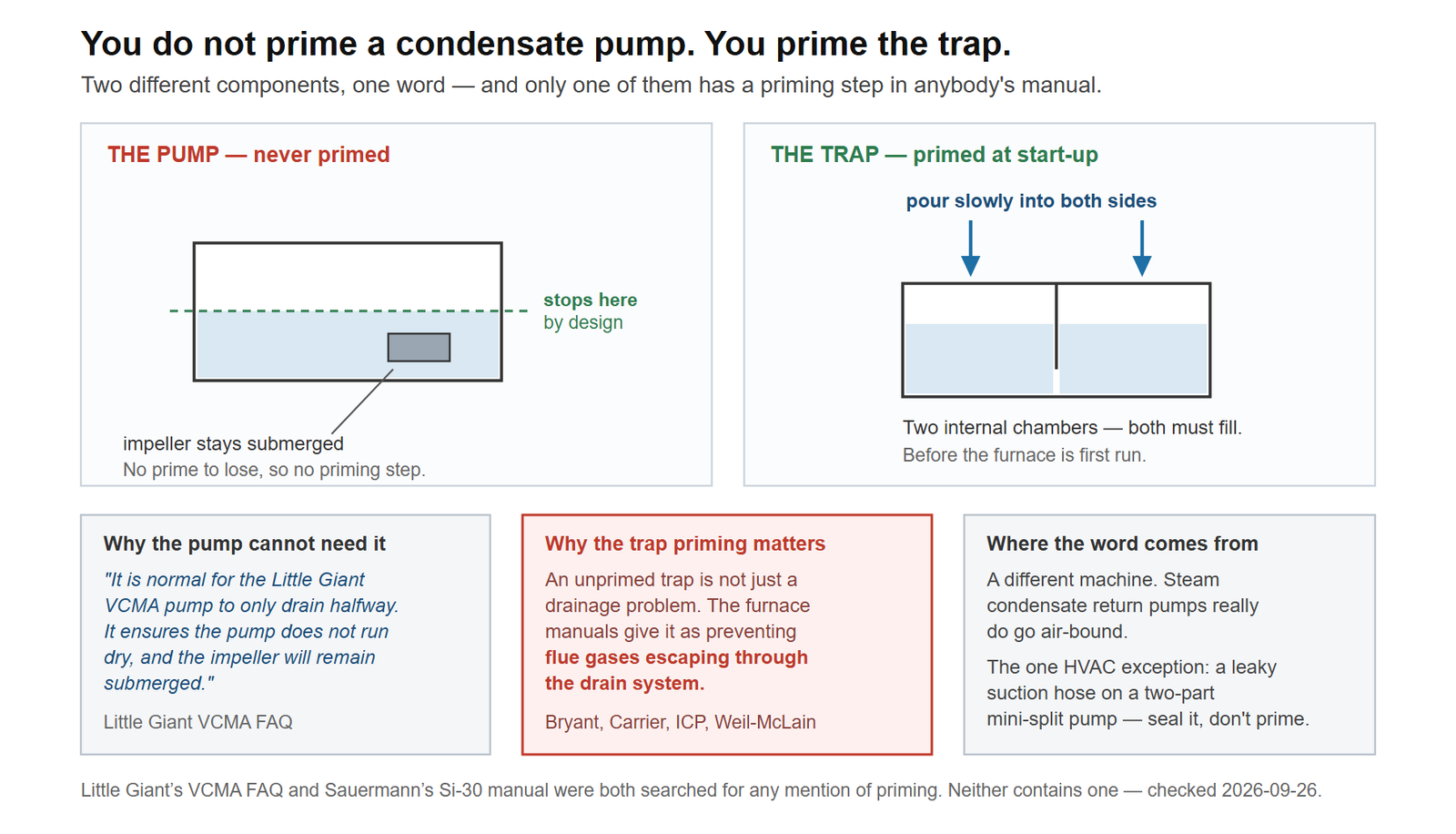
A condensate pump is not primed, and it cannot need to be. Little Giant’s VCMA FAQ never mentions priming. Neither does Sauermann’s Si-30 manual. The impeller sits permanently under water by design, so there is no prime to lose.
The component in a condensate system that genuinely does get primed is the furnace’s condensate trap — and every condensing-furnace manufacturer requires it before start-up. That procedure is below.
Why the pump cannot need priming
A well pump or a jet pump sits above the water and has to pull it up. Air in the casing breaks the pull, so you fill the casing first. That is priming, and it is a real job on those machines.
A condensate pump does the opposite. It sits under the water it moves, in a tank the condensate drains into by gravity. The impeller is submerged before it ever runs.
Little Giant states the mechanism outright, in an answer to a completely different question:
“It is normal for the Little Giant VCMA pump to only drain halfway. It ensures the pump does not run dry, and the impeller will remain submerged.”
Read that twice, because it resolves two things at once. The tank is designed not to empty. The leftover water people report as a fault — “it never pumps the tank dry” — is the feature that guarantees the impeller is always wet. A pump that emptied itself completely would be a pump that could lose prime.
The one exception, and it is not priming either
Most condensate pumps are a single tank unit. Some mini-split pumps are not: they are two-part, with a small detection unit near the indoor head and a separate pump connected to it by a suction hose. That hose can let air in.
Sauermann’s Si-30 manual names it:
“If the pump is running continuously and does not suck water, check that the suction hose (hose that connects the pump and detection unit) is connected and air tight”
That is an air-leak fault, and the fix is sealing the hose — pushing it fully home on both spigots and checking the barbs. It is the closest thing in this product class to losing prime, and the remedy is still not to pour water into anything.
What you actually prime: the furnace trap
This is the real procedure, and it is the one that belongs in a search for “priming” on a condensing furnace.
A 90%+ furnace condenses flue gas into acidic water, and that water leaves through a trap before it reaches the drain or the pump. That trap must be full of water before the furnace runs. Bryant, Carrier, ICP and Weil-McLain all carry a start-up step for it — on several of those manuals the section is headed, word for word, Prime Condensate Trap With Water.
How to do it:
- With the furnace off, locate the trap — a moulded plastic body on the condensate line, usually below the inducer.
- Fill both sides. The trap has two internal chambers, and filling one does not fill the other. Pour slowly into the inlet and the outlet in turn until each is full. On some models the chambers can only be reached by pouring into the inducer drain.
- Check it holds. Water should stay in it rather than draining straight through.
- Then start the furnace.
Why it matters more than drainage. The manuals do not give this as a convenience step. An unprimed trap is an open path, and the reason they insist on it is to prevent flue gases escaping through the drain system. That makes a dry trap a combustion-safety issue, not a nuisance — which is also why this step comes before first firing, not after.
The trap’s height and position matter as much as its priming, and they are their own subject — where the trap sits relative to the pump decides whether the system drains at all.
Where the word comes from
Worth explaining, because the reader is not being stupid — they have picked up a real term from a real machine.
Steam condensate return pumps genuinely lose prime. Those are boiler-system pumps: a receiver tank feeding a centrifugal pump that sits beside it rather than in it. When a check valve leaks, water drains back and air follows, pushing the water out of the pump’s volute until it is air-bound — running, moving nothing. Heating forums are full of that conversation, and every word of it is correct for that pump.
It is simply a different machine from the box under your furnace. Searching the symptom brings back the steam answer, plus a shelf of well-pump and pool-pump priming guides that do not apply either.
So what is actually wrong with yours?
If you arrived here because the pump runs and the water is not going where it should, priming was never the fix — but something is. The usual suspects, in the order they actually occur:
- A check valve installed backwards or stuck. Water climbs, then falls back.
- A kink, a sag or a blockage in the discharge tubing.
- Lift beyond the pump’s real rating. The number on the box is at zero flow.
- A clogged intake or a tank full of biofilm — which is a cleaning job with a manufacturer-specified method.
Telling those apart takes about thirty seconds once you know what to look at, and that is a whole article of its own: running but not pumping. If the pump itself turns out to be finished rather than blocked, the buying guide covers what replaces it.
When this needs a pro
Priming the trap means working at the furnace with the power and gas off. If you are not certain which component is the trap, do not pour water into something else — a few cups into the wrong opening can reach the inducer or the burner compartment.
If the trap will not hold water, it is cracked or the drain below it is blocked, and that is a repair rather than a priming problem.
If the furnace has been running with a dry trap, have the flue and the drain checked. The reason the manuals insist on priming is combustion gas, and that is not a DIY diagnosis.
And if there is no trap at all on a high-efficiency furnace, stop and get it looked at — the condensate pumps guide sets out what the arrangement should include.
FAQ
Do you need to prime a condensate pump?
No. The impeller sits permanently submerged in the tank, so there is no prime to lose. Little Giant’s VCMA FAQ and Sauermann’s Si-30 manual were both searched for any mention of priming, and neither contains one.
Why does my condensate pump never empty the tank?
Because it is designed not to. Little Giant’s own answer is that it is normal for the VCMA to drain only halfway, which “ensures the pump does not run dry, and the impeller will remain submerged.” The leftover water is the feature that makes priming unnecessary.
How do you prime a furnace condensate trap?
With the furnace off, pour water slowly into both sides of the trap until each chamber is full — there are two internal chambers and filling one does not fill the other. On some furnaces the chambers are reached through the inducer drain. Then start the furnace.
What happens if the condensate trap is not primed?
Beyond poor drainage, the furnace manuals give the reason as preventing flue gases escaping through the drain system. That makes an unprimed trap a combustion-safety issue rather than an inconvenience.
My condensate pump runs but the water comes back down — is that an air lock?
Almost always a check valve that is stuck, backwards or leaking, rather than air. Air-binding is a real fault on steam condensate return pumps, which are a different machine; on a tank-style condensate pump the check valve and the discharge line are where to look first.


